Dental SEO services that help new patients find your practice
Dental SEO is the work of helping a dental practice show up when nearby patients search for a dentist, a treatment or an urgent appointment, in Google Search, on Google Maps and in AI answers from tools like ChatGPT. Good dental SEO makes your website, your Google Business Profile and your reviews tell the same clear story, so the patients who are already looking can find you and book. Generative Digital offers dental SEO services to practices across the US, from a single office to a group with several locations.
Dental SEO is one part of our wider work on healthcare SEO. This page covers what is specific to dental practices: how patients search for a dentist, what each treatment page needs, how Google treats dentists on Business Profiles, and how AI tools decide which practice to name.
How do patients search for a dentist?
Think of search like a new neighbor asking around for a dentist. People name the practice they can describe with confidence: where it is, what it does, when it is open and whether patients like it. Search engines and AI tools work much the same way. They point people to the practice whose details are clear and agree everywhere.
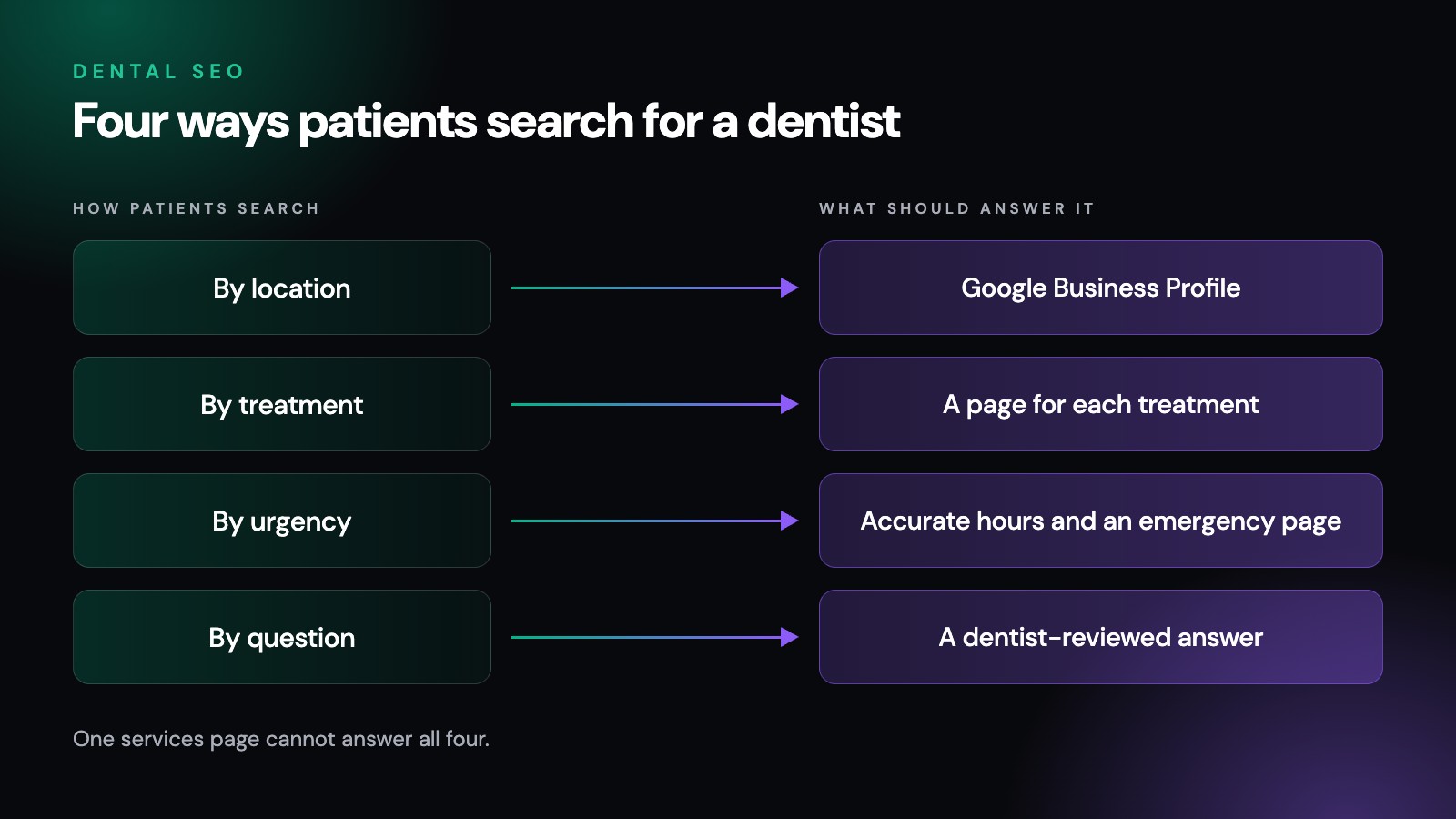
Patients tend to search in four ways, and each one needs its own answer on your site:
- By location.
Searches for a dentist near them, mostly on a phone and often inside Google Maps. Your Google Business Profile does most of the work here.
- By treatment.
Searches for implants, crowns, clear aligners, teeth whitening or a root canal. Each treatment you offer needs its own page.
- By urgency.
A cracked tooth or a sudden toothache sends people looking for whoever can see them today. Accurate hours and a clear way to reach you decide these.
- By question.
Patients ask AI tools whether a treatment is worth it, how long it lasts or what to expect. Plain answers, checked by a dentist, are what these tools look for.
What does a dental practice website need to rank?
A common gap on dental websites: the practice offers a dozen treatments, and the site lists them all on one services page with a sentence each. That page cannot rank for any of them.
Here is what works better:
- One page per treatment you actually offer.
Who it suits, what the visit involves, how recovery usually goes and what affects the cost, written for patients and reviewed by the dentist who performs it.
- A new patient page.
What happens at the first visit, the forms to fill in ahead of time and the insurance plans you accept. Patients search for those plans by name, so list them in plain text, not only as logos.
- An emergency page, only if you offer same-day care.
Real hours, what counts as an emergency and what to do after hours. A page that promises urgent care the office cannot deliver costs you trust.
- A page for each dentist and each office.
Our guide to GEO for healthcare covers how to set up provider and location pages so AI tools can match each person and place.
- A clean technical base.
Pages Google can index, a title on each page that names the treatment and your town, a phone number and booking button that are easy to tap on a phone, and no stray copies of pages left behind by old site versions or booking plug-ins.
What is local SEO for dentists, and why does it come first?
Local SEO for dentists is the work of showing up in Google Maps and in the map results at the top of a local search. For a practice that serves its own area, the map results are often the first thing a patient sees, so we start here.
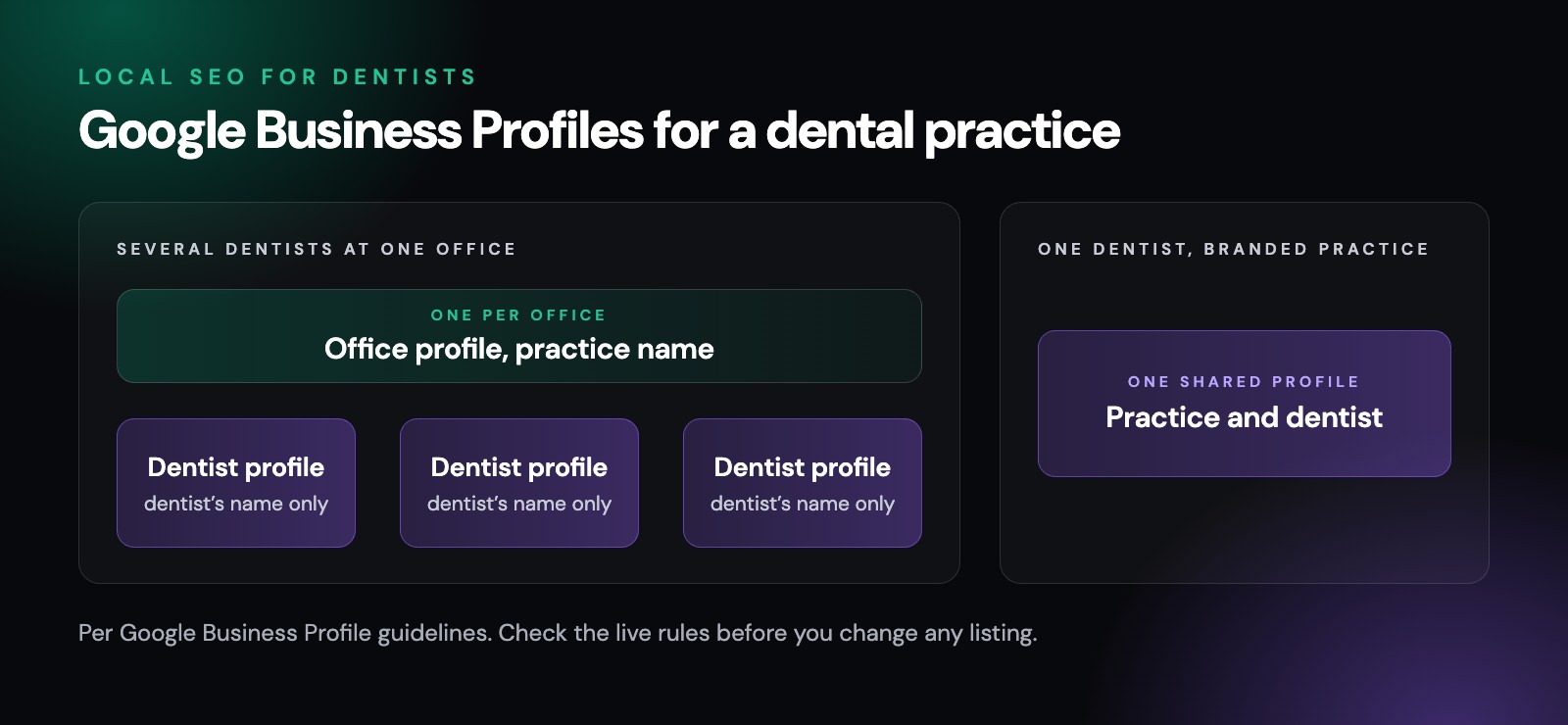
Google’s Business Profile guidelines name dentists directly. They say “Doctors, dentists, lawyers, financial planners, and insurance or real estate agents are all individual practitioners.” That shapes how a practice should set up its listings:
- One profile per office.
Google says “Do not create more than one page for each location of your business.” Duplicate profiles for one address go against Google’s guidelines and do not help you rank.
- A separate profile for each dentist, when there are several.
Google says that when a practitioner is one of several at a location, “The organization should create a Business Profile for this location, separate from that of the practitioner.” The dentist’s profile carries only the dentist’s name.
- A solo dentist shares one profile.
If one dentist is the only public-facing practitioner at a branded practice, Google says it is best to share a single profile with the practice.
- Details that match everywhere.
The same practice name, address, phone number and hours on your site, your profile, dental directories and insurance directories. Mismatches make it harder for Google and AI tools to trust any of them.
- A profile that shows the real practice.
The services you offer, holiday hours kept current and photos of your actual office and team.
How should a dental practice handle reviews?
Reviews shape both where you show up and whether a patient calls, so give them a steady process rather than an occasional push.
- Ask every patient the same way.
A short text or email after the visit, with a direct link to your profile. Asking everyone, not only happy patients, keeps the process honest.
- Never buy, write or filter reviews.
The FTC rule covering fake and deceptive reviews and testimonials has been in force since October 21, 2024. Its guidance says that if you ask family members to post a review, you should “ask them to clearly and conspicuously disclose their relationship to your business.”
- Keep replies short and general.
Thank the reviewer, never confirm that they are a patient or mention their care, and invite them to call the office. We write reply drafts for your team to approve, and we never edit or take down a patient’s review. In 2019, a dental practice paid HHS’s Office for Civil Rights $10,000 to settle potential HIPAA Privacy Rule violations after its replies to online patient reviews disclosed patients’ health information.
- Bring the questions back to your pages.
The questions patients raise in reviews are often the questions your treatment pages should answer.
How does SEO for dentists work in AI answers?
SEO for dentists now has to work in two places: the regular list of results and the short answers AI tools write. The good news is that most of the work is the same. Google says “There are no additional requirements to appear in AI Overviews or AI Mode, nor other special optimizations necessary.”
What changes is how the answer gets built. Google says its AI features may use a “query fan-out” technique, “issuing multiple related searches across subtopics and data sources” before writing a response. A patient asking about implants may set off searches on cost factors, recovery and who is a good candidate, all at once. If your site has a clear page on each of those questions, those searches have something to land on.
Three habits help most:
- Answer first.
Put a plain, one-paragraph answer under each heading, written so it still makes sense when quoted on its own.
- Name the reviewer.
Add the reviewing dentist’s name and a date to every page with clinical content. State each credential exactly as it appears on the dentist’s own bio.
- Check your own answers.
Ask a few AI tools the questions your patients ask, note who gets named, and repeat each month with the same list.
Our guide on how to rank in AI Overviews goes deeper on how Google picks its sources.
What structured data should a dental website use?
Structured data is code that tags the facts about your practice, such as its name, address and hours, so search engines can read them. Schema.org has a type called Dentist, which sits under both LocalBusiness and MedicalBusiness. Google tells site owners to “Use the most specific LocalBusiness sub-type possible,” so Dentist is the right choice for each office.
Keep it simple and accurate:
- One Dentist block per office,
with the same name, address, phone number and hours as that office’s Business Profile.
- Only the services you offer.
Never list a treatment in structured data that the practice does not provide.
- Credentials word for word.
Any credential in your structured data must match the dentist’s own bio exactly.
What do our dental SEO services include?
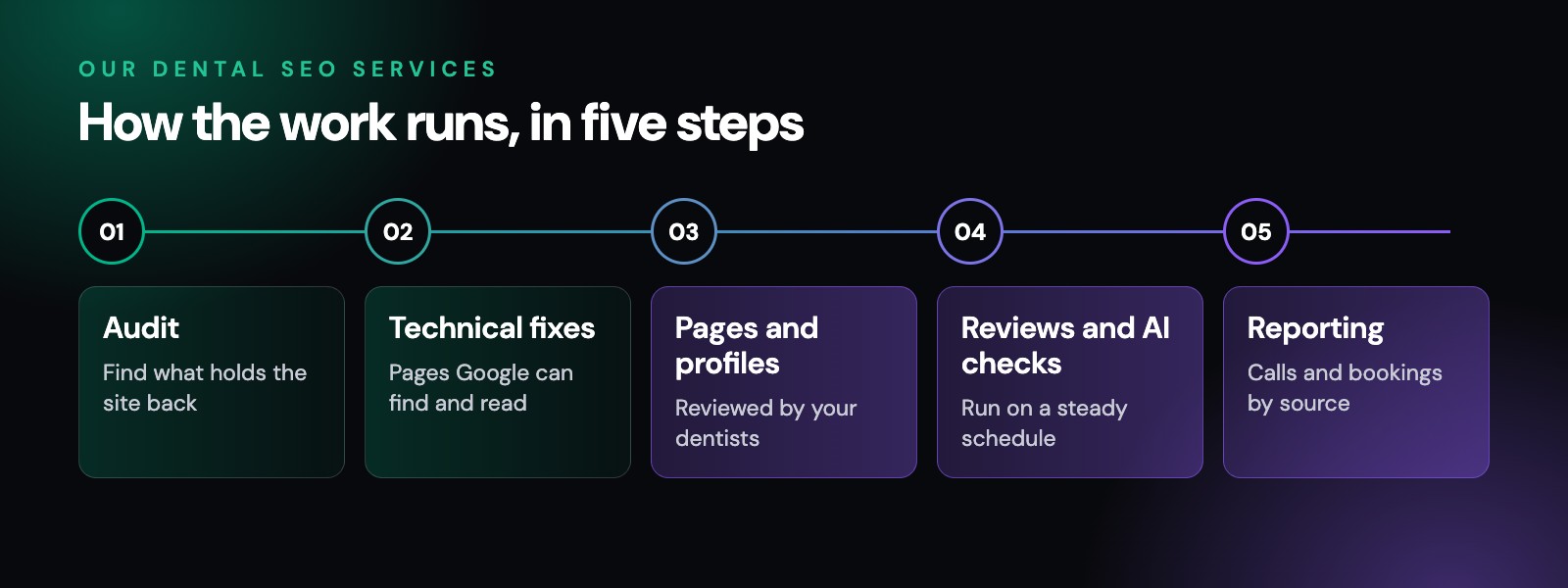
The work usually covers:
- Technical fixes
so every important page can be found, read and indexed.
- Treatment, location and dentist pages
written for patients and sent to your dentists for review before anything goes live.
- Business Profile cleanup
for each office and each dentist, following Google’s own guidelines.
- A review process
your front desk can run, plus reply drafts for your approval.
- Structured data
for each office.
- AI answer checks,
a fixed set of patient questions run through ChatGPT, Perplexity, Google AI Overviews and Copilot on a schedule.
- Reporting tied to patients,
with calls, booking requests and form fills traced back to where they came from, as far as each platform allows.
Generative Digital is a one-person practice, so the same person runs your audit and does every part of the work. We also run Google Ads, which can bring in patients for key treatments while organic search builds. For the rest of the plan, from recall to referrals, see our guide to dental marketing. See all of our digital marketing services.
What else do dentists ask about SEO?
Can you guarantee my practice will rank first on Google?
No. No one can guarantee a top spot on Google or a mention in an AI answer, and you should be wary of anyone who promises one. What we do promise: clear work, honest reports and a straight read on what is moving.
Does each dentist need their own Google Business Profile?
If several dentists see patients at one office, Google’s guidelines allow each dentist a profile of their own, separate from the office’s profile. If one dentist is the only practitioner at a branded practice, Google says it is best to share one profile with the practice.
Is SEO or Google Ads better for a dental practice?
They do different jobs. Google Ads can bring in calls as soon as a campaign goes live, and stops when the budget stops. SEO takes longer to build, and it keeps bringing patients in after the work is done. Many practices use ads for high-value treatments while SEO builds.
Should a dental practice write blog posts?
Treatment pages come first. Once each treatment you offer has a strong page, short articles that answer real patient questions can help, as long as a dentist reviews anything clinical.
How long does dental SEO take to work?
Three to four months as a general guide for measurable movement to show. Practices in crowded markets and newer websites often take longer.
Where does your practice stand today?
Our free digital audit shows how search engines and AI tools see your practice right now, and what to fix first.
Get startedWorking with businesses across the US
© 2026 Generative Digital LLC