SEO and GEO for Healthcare
Healthcare SEO is not regular local SEO with medical words added in. Google treats health content as YMYL, short for Your Money or Your Life. That is Google’s term for topics that can affect someone’s health or money, and it holds those pages to a higher standard for accuracy, authorship, and sources than almost any other category. AI answer tools are just as careful. A page that would rank easily in another industry can go unseen here.
Generative Digital is a one-person SEO and GEO practice working with businesses across the US. GEO means showing up in AI answers from tools like ChatGPT, Perplexity and Google’s AI Overviews. We do technical SEO and GEO together, so your practice shows up in regular search and in the AI answers that more and more people see first.
What makes healthcare search different
Higher scrutiny
Accuracy, named authors, and reviewer credentials matter far more here than for a landscaping site.
Accurate credentials
Every board, degree, fellowship, and affiliation is a factual claim, and each one has to be exactly right.
Many locations and providers
Two offices and six providers are a group of related people and places that search engines have to tell apart.
Procedure and device names
Patients search one treatment by its clinical name, brand name, and everyday name.
Limits on images and ads
State board rules and HIPAA control your galleries, results language, and testimonials, not whatever brings in the most leads.
Platform rules
Google requires certification for some kinds of healthcare advertisers and limits personalized ads around health, so targeting you could use elsewhere is limited here.
Credentials have to match the board’s own wording
The most common factual problem we find on practice sites is a credential that a marketer reworded. “Board certified cosmetic surgeon” is not the same claim as certification by a specific, named surgical board. Several states also control which certifications a practice may advertise.
For Utah Facial Plastics, we checked every provider credential across the whole site. We brought each claim in line with the exact wording the certifying board itself uses. It is unglamorous work, but it holds up when a search engine, an AI tool, or a state board takes a close look.
“Working with Generative Digital has been a game changer for us. We’re seeing real improvements across the board, and their attention to detail and expertise has given us a solid foundation we can trust and continue to build on.”
Multi-location practices need a real structure, not copied city pages
A location page that is just the last one with a new city name is a risk here. Build each page around what is actually different.
- One page for each location, with what is specific to it: the providers there, the procedures that office offers, hours, and insurance.
- One page for each provider, which acts as the main reference for that person: how their name is written, degrees, board certifications, fellowship training, and the procedures they perform themselves.
- One main page for each procedure, linked from every location that offers it, instead of the same 900 words copied for each city.
- The same details on your site, your Google Business Profile, and online directories. Mismatched details make search engines unsure who you are.
How you name procedures and devices is a real decision
A common mistake is building a page around a device or drug brand as if the brand were the treatment itself. That page gets missed when a patient searches for the treatment type. It also goes out of date as soon as the practice adds a newer device.
Build the page around the type of treatment, and list brands as options within it. For Utah Facial Plastics, we also published device comparison tables checked by the providers who use them. That kept them clinically accurate, not marketing copy in a table.
Image, claim, and advertising rules come first
- Before-and-after photos need documented consent, no retouching, and the same conditions in each shot. Typical, not best case.
- Results language stays within what the practice can back up. Words like guaranteed, permanent, and painless invite complaints.
- Testimonials in healthcare come with rules other industries do not have. Even replying to a review can create a HIPAA problem.
- State medical board advertising rules vary from state to state, and they cover your website, not just your ads.
Your attorney, your malpractice carrier, and your state board decide what you may publish. Our job is to build pages that perform well within those limits. We also flag any copy that would not pass review before it goes live.
Patients now ask AI before they call your front desk
A patient looking into a procedure often gets an AI-written answer about who is a good fit, recovery, risks, and cost before visiting a single practice website. That answer cites only a few sources. Health is the topic these AI tools handle most carefully. That makes it harder to get cited, but a citation tends to last once you earn it. Our approach to AI SEO for healthcare practices covers both regular search and AI answers. The details are on our page about GEO for healthcare and how practices get cited in AI answers.
How we work
Free audit to start
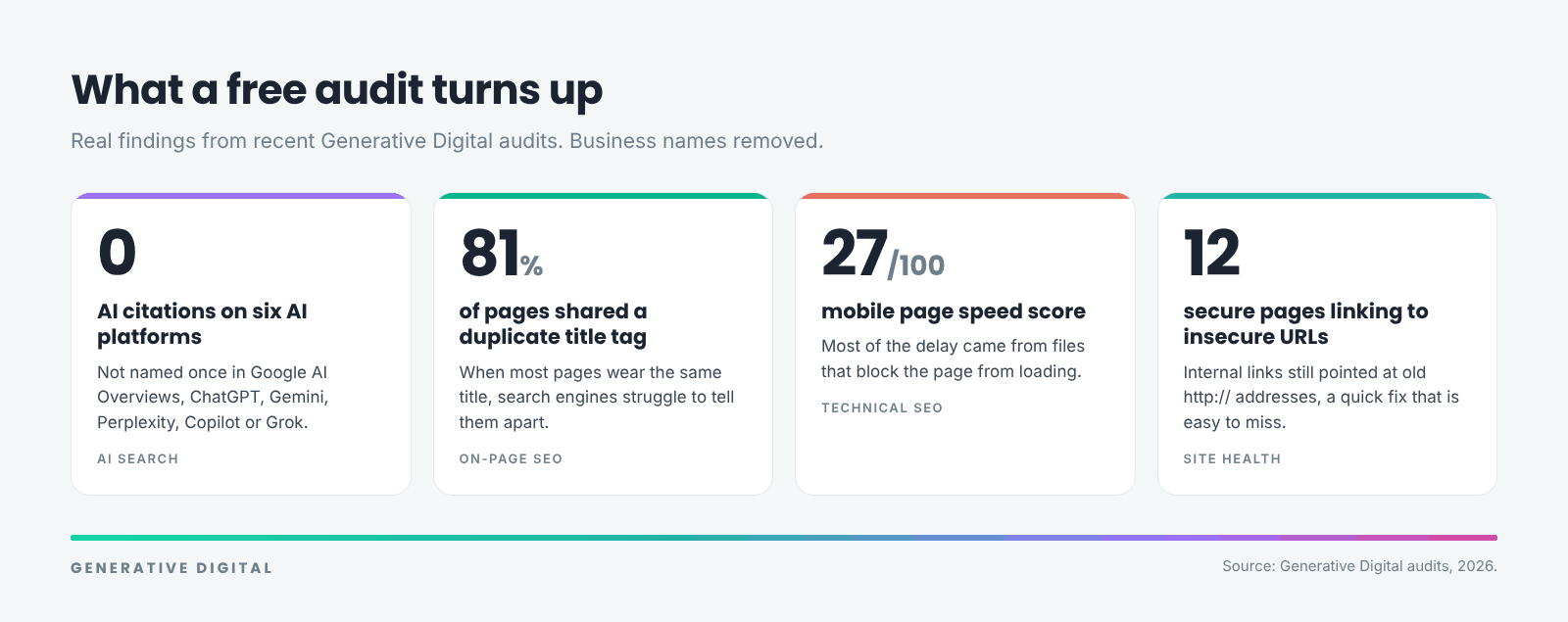
The free digital audit is a full site scan and a check of which pages Google has indexed, meaning included in its results.
One person, on purpose
You work directly with the person doing the work, from strategy and communication through execution.
SEO and GEO together
The technical groundwork that earns rankings is most of what earns AI citations too.
Nothing clinical goes live unchecked
Provider claims, procedure details, and device comparisons go back to the practice for review first.
See our full scope on our services page. Dermatology practices have their own page on dermatology SEO and marketing. These limits are a lot like the ones we work within for law firm SEO, another field where advertising rules shape the copy.
Questions we get
Does a medspa need the same care as a surgical practice?
Mostly, yes. Injectables, lasers, and body contouring are medical procedures with real risks, and Google holds them to the same higher standard. The provider pages are often harder, because supervising physicians, nurse injectors, and estheticians each need what they are allowed to do stated accurately.
We have two locations. Do we need two websites?
Almost never. Two sites split your strength in search and make your procedure pages compete with each other. One site with separate location pages and a clear provider setup does better in both regular search and AI answers.
How long does healthcare SEO take to work?
It depends on your site’s technical health, its history, and your market. As a general guide, most sites see measurable movement in three to four months, and competitive markets take longer. We can give you a firm timeline for your practice after the audit.
See where you stand today
Start with the audit. We scan your site, review which pages Google has indexed, check provider credentials against the boards that issued them, and tell you what is holding your practice back.
Get a free digital auditWorking with businesses across the US
© 2026 Generative Digital LLC