Automotive SEO for car, boat and powersports dealerships
Automotive SEO is the work of getting your dealership found when shoppers look on Google, scroll Google Maps or ask an AI tool where to buy or service a vehicle. For a dealer, that means inventory pages search engines can actually read, a Google Business Profile for every real rooftop, service and parts pages that answer local searches, and accurate facts that AI tools can repeat. Generative Digital does this work for car, boat and powersports dealerships across the US, and plans it alongside your paid search when you run both.
Think of your inventory as a lot that rearranges itself every night. A search engine is a shopper who walks that lot every so often. If every unit has its own parking space and a clear window sticker, the shopper sees all of it. If half the lot sits behind a locked gate and the same truck is parked in dozens of rows, the shopper runs out of time before reaching your best units. Much of dealer SEO is clearing the aisles.
This page is one of our industry guides, and it covers what makes dealership search different and how we approach it. For everything else we offer, from Google Ads to website builds, see our digital marketing services.
What does it cost a dealership to be left out of AI answers?
“car dealership” is searched about 38,000 times a month across the US, and Google now shows an AI Overview on that search. Here is what an AI Overview does to every 10,000 of those searches in your market, using published numbers and rounding down at every step:
- 700 fewer clicks.
People clicked a regular search result on 15% of searches without an AI summary and 8% with one. On 10,000 searches, that gap is 700 clicks that never reach any website.
- 39 fewer leads.
Organic search visitors in the automotive industry turn into a call or form at 5.7%. Applied to 700 clicks, that is 39 leads, rounded down.
- What they were worth.
Each of those 39 is a shopper, and the average new vehicle sold at a franchised dealership went for $48,205 in 2025. Your close rate decides how many become deals.
Assumptions, stated plainly: the click drop is a national average across all kinds of searches, not just yours. Clicks lost to the Google Maps pack are left out, so the real loss is likely higher. Being the business the AI answer names is how you win some of those people back. Sources: Pew Research Center (2025), Ruler Analytics conversion benchmarks for 2027 (published November 2026), NADA Data 2025, Ahrefs Keywords Explorer, US (November 2026).
What is automotive SEO, and what does it cover?
Automotive SEO is search engine optimization for businesses that sell and service vehicles. Most of the work falls into five areas:
- Inventory pages. Search results pages and vehicle detail pages, often called VDPs, that crawlers can reach, read and index while each unit is in stock.
- Model, service and parts pages. The pages that answer the searches inventory cannot, such as how two trims compare, where to get brakes done this week, or when the parts counter opens.
- Local search. A Google Business Profile for each real location and department, with the right categories and hours, plus a steady flow of honest reviews.
- Structured data. Code in the page that labels facts about your dealership and your vehicles for machines, using only documented types.
- AI answers. Making sure ChatGPT, Google AI Overviews and similar tools describe your dealership with the right brands, departments and hours.
The same principles apply whether you sell pickups, pontoons or side-by-sides. The details change by vehicle type, which we cover further down.
Why is dealership search different from other local search?
Most local business websites have a handful of pages that rarely change. A dealer website works more like a store catalog that restocks every day. Three things set it apart:
Inventory turns over constantly.
Units arrive and sell every week, so pages appear and leave faster than on almost any other local business site.
One rooftop often acts like several businesses.
Sales, service and parts each have their own customers, hours and searches.
Much of the site is not yours to edit.
Many dealer websites run on a platform that controls templates, inventory feeds and URL patterns. Good SEO starts by learning what your platform lets you change and what needs a request to your provider.
How should a dealership choose its keywords?
Keyword research for a dealership starts with search intent, meaning what the person is trying to get done. Dealer searches fall into a few clear groups:
- Shopping searches. A model, a body style or “new” versus “used”, often with a town name attached. These belong on model pages and on the few filter pages you choose to index.
- Service searches. A repair or maintenance job, often with “near me”. These belong on service pages and your service department’s Business Profile.
- Parts searches. A part name or an accessory. These belong on parts pages and the parts profile.
- Brand searches. Your dealership’s own name. These belong on your homepage and main Business Profile, and they tell you how well people already know you.
The best source is your own data. Google Search Console shows the queries that already bring people to your site, which is a more reliable starting point than a generic keyword list. We map each group of searches to one page, so two of your own pages never compete for the same search.
How do you get vehicle inventory pages indexed?
Indexing comes first. A vehicle page that Google has not stored cannot rank, cannot show in local search results and cannot be quoted by an AI tool.
Can search engines read your vehicle detail pages?
Start with how each page is built. Google says it renders JavaScript pages in a headless Chromium browser, but pages wait in a queue before rendering, and that wait can run longer than a few seconds. Inventory that only appears after scripts run has to wait for that step, while inventory sent as plain HTML can be read on the first pass.
Links matter just as much. Google says it can generally crawl a link only if it is an HTML anchor element with an href attribute. The links from your search results pages to each VDP should be ordinary links, not buttons that load a vehicle through a script.
A quick check anyone can run: open a VDP, view the page source and search for the stock number. If it is missing from the source, the vehicle details depend on JavaScript. Then confirm what Google sees with the URL Inspection tool in Google Search Console.
What should you do with inventory filters?
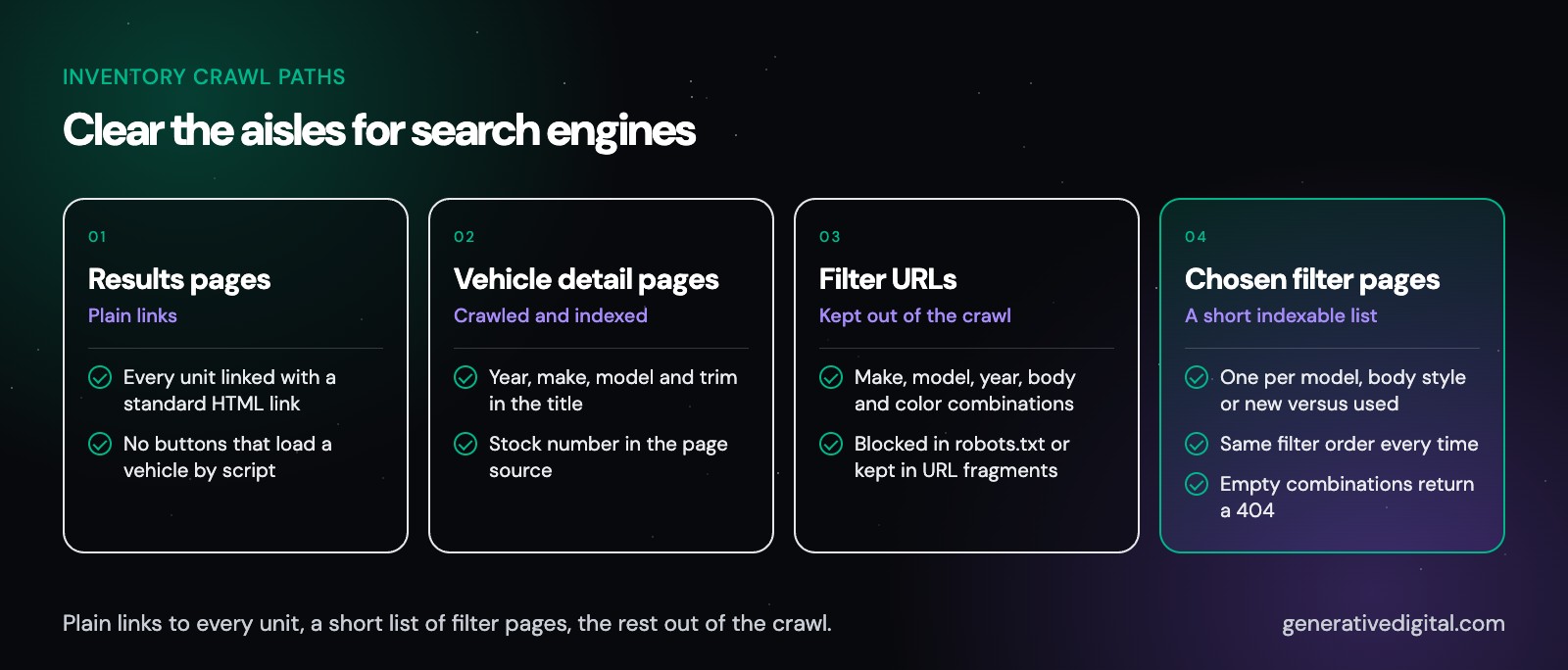
Filters for make, model, year, body style and color help shoppers, but every combination can create a new URL. Google calls this faceted navigation. It warns that these URLs can cause overcrawling and slower discovery of new pages, because crawlers spend their time on filter combinations instead of fresh inventory. Google’s guidance:
- Keep most filter URLs out of the crawl. If you do not need them in search, block them in robots.txt or put the filters in URL fragments, the part after a # sign, which Google generally does not crawl.
- Index only the filter pages worth ranking. For those, use the standard ampersand separator between parameters, keep filters in the same order every time, and return a 404 status when a filter combination has no results.
- Treat canonical tags and nofollow as weaker tools. Google says they are generally less effective in the long term than the two methods above.
Most dealers want a short list of filter pages indexed, such as one page per model, body style or new versus used, and the rest kept out. We build that list from your own search data, not from a template.
What belongs on a vehicle detail page?
- A unique title with the year, make, model and trim, so two similar units never share a title.
- Photos of the actual unit, with alt text that describes the vehicle.
- The same content on phones. Google says it uses the mobile version of a site’s content for indexing and ranking, so a VDP should show the same text, photos and links on a phone as it does on a desktop.
- A short description in your own words, not only the manufacturer’s spec sheet.
- Key facts as plain text: stock number, VIN or hull identification number, mileage or engine hours, and which location the unit sits at.
- One clear next step: a short button such as “Check availability” that opens a contact form, with a phone number close by. Form submissions reach your CRM, and Google Analytics can count each one as a key event.
- Links out to the matching model page and to your service department.
Keep your XML sitemap current too. Google says it uses the lastmod date when it is consistently and verifiably accurate, so that date should change only when the page itself really changes.
What does car dealership SEO need beyond inventory?
Car dealership SEO is more than the lot. Inventory pages come and go, so the pages that build lasting search rankings are the ones that stay put:
- Model pages. One page per model you sell new, answering the questions car buyers ask before they choose a trim. Write them in your own words and refresh them each model year.
- Service pages. One page per main service, such as oil changes, brakes, tires, alignments or state inspections. Service searches are local and happen all year, not only when someone is shopping for a vehicle.
- Parts and accessories pages. Hours, how to order, and what the parts counter can source.
- Finance and trade-in pages. A plain explanation of how the process works at your store. Have your finance office approve the wording before it goes live.
- Location pages. One per real rooftop, with directions and department hours. Never a page that presents a town you only deliver to as if you had a store there.
- Answers to real buyer questions. The questions your sales and service teams hear every week make better content marketing than any generic topic list.
Link these pages to each other and to live inventory. Internal links tell crawlers which pages matter most, and they move shoppers from research to a unit they can see in person.
What changes for boat and powersports dealers?
The foundation is the same. A few details are not:
- Seasonal demand. Shopper interest in boats and many powersports units follows the season. Build and refresh model pages before your busy season starts, not in the middle of it.
- Different identifiers. Federal rules require a manufacturer to mark each boat with a hull identification number, so boat VDPs use that number instead of a VIN. Many boats and off-road units are measured in engine hours rather than miles.
- Packages. A boat often sells with a motor and a trailer. List each part clearly on the VDP so the page matches what shoppers actually search for.
- Service and storage pages. If you offer rigging, winterization or storage, each one deserves its own page.
- Business Profile rules. Google’s dealership-specific profile guidance is written for car dealerships. Boat and powersports dealers follow the general guidelines, which allow separate profiles only for public-facing departments that operate as distinct entities.
How should each rooftop show up on Google Maps?
Local SEO for a dealership starts with the Google Business Profile, often the first thing a shopper sees in Google Maps and in local search results. Google publishes rules written specifically for car dealerships:
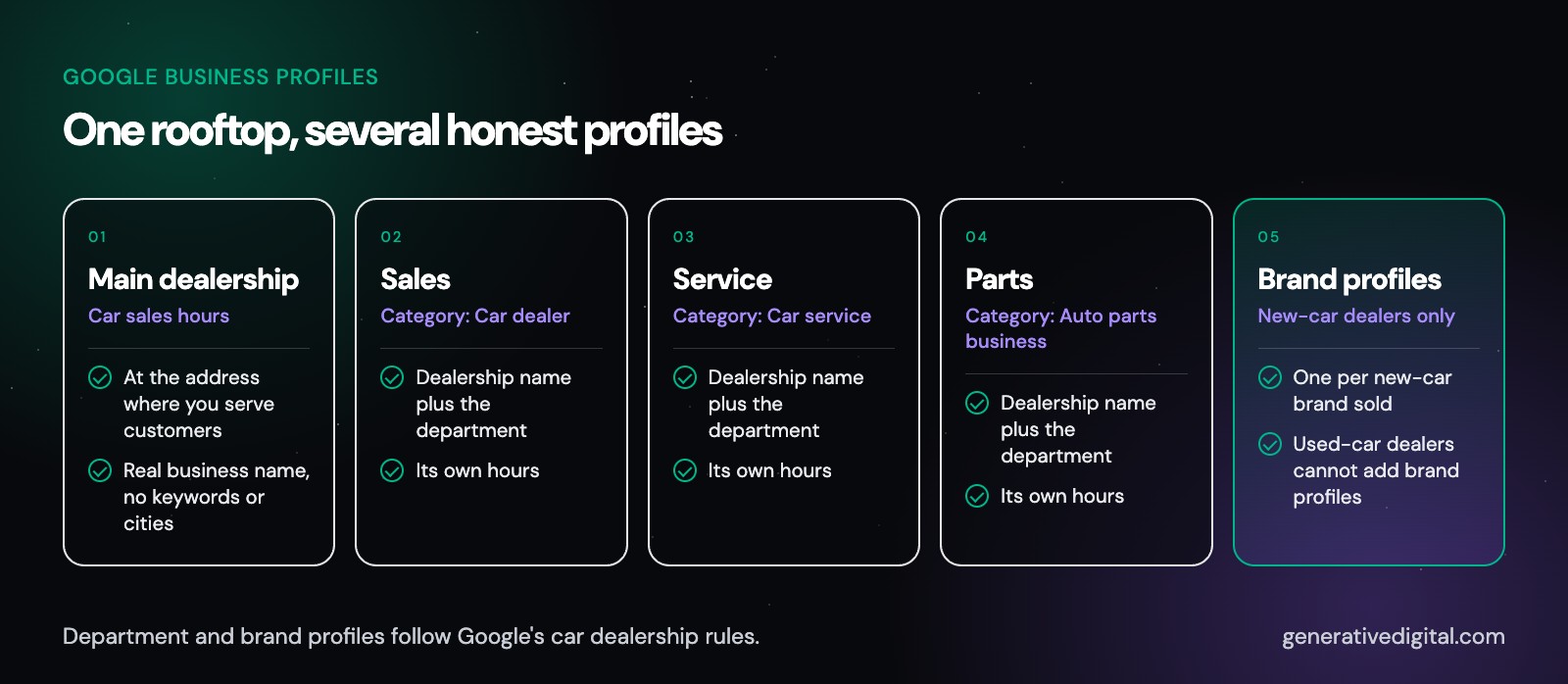
- One profile per real rooftop. It belongs at the address where you serve customers during your stated hours. A mailing address or a rented office where you do not operate is not eligible.
- Department profiles are allowed. Google says car dealerships can add profiles for departments like sales, parts or service. Name each one with the dealership name plus the department.
- Use the categories Google recommends. “Car dealer” for sales, “Car service” for maintenance and “Auto parts business” for parts.
- Brand profiles are for new-car dealers only. New-car dealerships can have a profile for each brand of new cars they sell. Used-car dealerships cannot have profiles per brand, because Google notes that used-car brands change often.
- Set the right hours. For the main dealership profile, Google says to use car sales hours. Service and parts hours go on their own profiles.
- Use your real name. Google says unnecessary information in a business name is not permitted and can lead to suspension, so leave keywords and city names out of it.
- Ask for reviews the honest way. Google’s content policy bars offering payment, discounts or free services in exchange for a review. It also removes reviews based on a conflict of interest, including current or former employment, so staff should never review their own store. We draft review replies for your team to approve.
Do backlinks still matter for dealership SEO?
Yes, but only the honest kind. Search engines use links to find pages and to weigh them, and a link from a respected local site carries real meaning. Google’s spam policies treat buying or selling links for ranking purposes as link spam, and that includes trading goods or services for a link. So skip the link packages.
High quality backlinks for a dealership usually come from things you already do:
- Community involvement. Teams, events and charities you actually support, where the organization chooses to link back.
- Local news. A new location, an expanded service department or a community event can earn coverage on its own merits.
- Accurate listings. Industry and local online directories that list your dealership with the right name, address and phone number.
Which structured data should a dealership use?
Structured data helps search engines read facts about your business without guessing. Use only types that schema.org defines, and only for facts a visitor can see on the page:
- AutoDealer for each rooftop. It is a schema.org subtype of LocalBusiness. Google’s local business documentation asks you to define each location as a LocalBusiness and use the most specific subtype possible. MotorcycleDealer exists for motorcycle and powersports stores, and AutoRepair for a service department. Boat dealers have no dedicated type, so plain LocalBusiness is the honest choice.
- Vehicle, Car or Motorcycle on VDPs. Schema.org defines Vehicle as transport over land, water or air, with Car and Motorcycle as more specific types. There is no Boat type, so boats use Vehicle.
- Only what you actually offer. List the brands, departments and services each location really has, and nothing it does not.
One caution. In June 2025 Google announced it was phasing out several structured data features, and in September 2025 it removed its vehicle listing documentation because those results are no longer shown in Google Search. Vehicle markup still describes a unit to machines, but be wary of anyone who sells it as a way to win special search results.
How do AI tools describe a dealership?
Google states that AI Overviews and AI Mode have no extra requirements beyond normal SEO best practices. It also explains that both features may fire off multiple related searches on subtopics, a method it calls query fan-out, and then build one answer. A shopper asking which dealer nearby services outboard motors sets off searches about brands, service types and locations at once. Your site should answer each of those plainly.
What helps most:
- The same facts everywhere. Name, address, hours, departments, brands sold new and services offered should match across your website, every Business Profile and the online directories you appear in.
- Plain answers on the page. Which brands you sell new, whether you take trade-ins, and whether your service department works on vehicles you did not sell. AI tools quote short, clear passages.
- Let the right crawlers in. OpenAI says a site that opts out of its OAI-SearchBot crawler is left out of ChatGPT search answers, apart from navigational links. Check your robots.txt and any bot-blocking settings your platform or host applies.
- A monthly check. Run the same set of shopper questions through the AI tools your customers use, and record whether your dealership is named and whether the facts are right.
The full method is in our answer engine optimization guide, and our GEO audit checklist lets you test your own site first.
How do you measure dealer SEO?
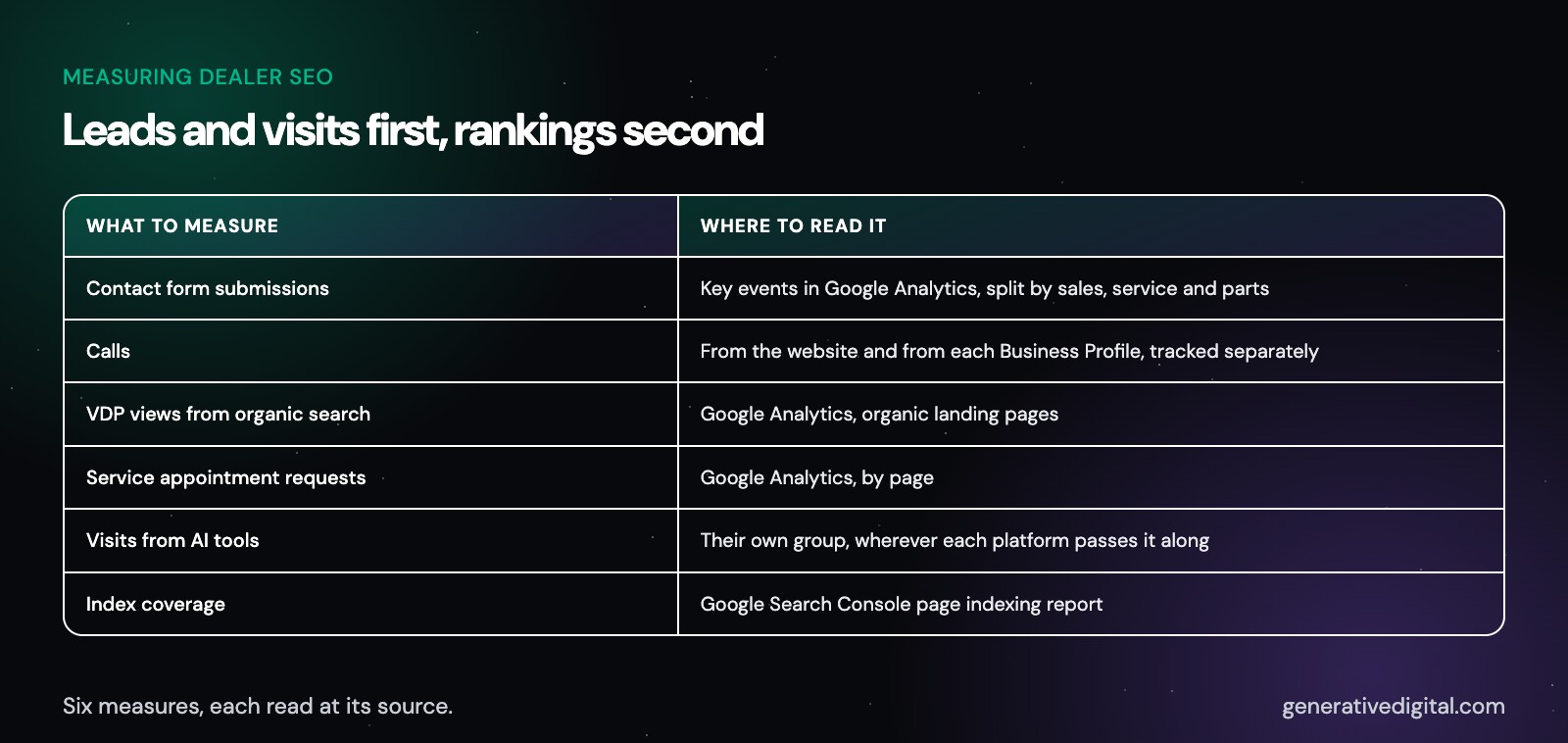
Rankings are an early sign, not the goal. Dealer SEO is measured in leads, appointments and visits to the store:
- Contact form submissions counted as key events in Google Analytics, split by sales, service and parts.
- Calls from the website and from each Business Profile, tracked separately.
- VDP views from organic search, an early sign that inventory is being found.
- Service appointment requests by page.
- Visits from AI tools, grouped separately wherever each platform makes that possible.
- Index coverage in Google Search Console, so you know which inventory and model pages Google has stored.
Where your CRM and dealer management system can report it, we match leads back to sold units and repair orders. If a figure was not measured, our reports say so instead of estimating it.
How does Generative Digital work with dealerships?
- A free audit to start. Our free digital audit looks at your site, which inventory pages Google has indexed and how AI tools describe you, then shows you what to fix first.
- We work inside your platform. You do not need to switch website providers to start. We document what we can change directly and write clear requests for anything your provider controls.
- One person does the work. Generative Digital is run by one person on purpose. Whoever reviews your dealership site also makes the fixes and replies to your email.
- Search and ads from one plan. We run Google Ads as well as SEO, so car dealership marketing on both sides works from the same data and the same tracking. The same approach drives our AI SEO agency work.
- No passwords. We never ask for your login details. You add us as a user on the tools we need.
months
When should you expect to see movement?
For organic search, three to four months as a general guide is a realistic window for rankings and leads to shift enough to measure. Busy markets, large inventories and young websites can take longer. No agency controls whether Google or an AI tool names your dealership for a given search, and a promise otherwise is a red flag. Our commitment is steady work, clear monthly reports and plain talk about what is and is not moving.
What else do dealers ask about automotive SEO?
Does a dealership need a separate Google Business Profile for service and parts?
It can have them. Google says car dealerships can have separate profiles for departments like sales, parts or service, named with the dealership name plus the department. Each one needs its own hours and the category that fits, such as Car service or Auto parts business.
Can a used-car dealership have a profile for each brand it sells?
No. Google allows a profile for each brand of new cars a dealership sells, but used-car dealerships cannot have profiles per brand, because the brands on a used lot change often.
Does vehicle structured data still create rich results in Google?
No. Google removed its vehicle listing structured data documentation in September 2025 because those results are no longer shown in Google Search. Markup that describes your dealership as a local business is still documented and worth keeping accurate.
Can you work with our existing dealer website platform?
In most cases, yes. We start by mapping what your platform lets you change, such as titles, page copy and robots.txt, and what needs a request to your provider. You do not need to switch providers to get started.
How long does automotive SEO take to show results?
As a general guide, give it three to four months to show measurable change in search. Bigger inventories, busy markets and young websites often need longer.
See where your dealership stands today
The fastest way to know what to fix is to look. Our free digital audit reviews your website, which inventory pages Google has indexed and how AI tools describe your dealership, then shows you what to fix first. It costs nothing, and most audits come back within 48 hours.
Get startedWorking with businesses across the US
© 2026 Generative Digital LLC