Answer engine optimization: how to become the answer
Answer engine optimization (AEO) is the work of making your website the source that search engines and AI tools quote when someone asks a question. That includes Google featured snippets, Google AI Overviews and AI Mode, ChatGPT, Perplexity, Microsoft Copilot and voice assistants. Instead of competing only for a spot in a list of links, AEO aims to make your page the clear, trusted answer a machine can lift and repeat. Most of it rests on solid SEO. The difference is that every key passage on your page has to work as an answer on its own.
Where answers show up today
AEO is the wide umbrella. Generative engine optimization, or GEO, is the part of it focused on AI tools that write their own answers. Our generative engine optimization page covers that part in depth. This page covers the whole picture, including how to measure it.
An answer engine is any search feature or AI tool that replies with an answer instead of only a list of links. These are the ones that matter for most businesses right now:
Google featured snippets and People Also Ask
The answer boxes and expandable questions near the top of a results page. Google says its own systems decide which page makes a good featured snippet. There is no way to mark your page as one.
Google AI Overviews and AI Mode
AI-written summaries on the results page, and a full conversational search mode. Google says both may use a “query fan-out” technique, which means running several related searches across subtopics before writing a response. For the full Google checklist, see how to rank in AI Overviews.
ChatGPT search
ChatGPT can search the web and link to the pages it used. OpenAI uses a crawler called OAI-SearchBot for this and says sites that block it will not be shown in ChatGPT search answers. A crawler is the automated program that visits and reads web pages. For the full ChatGPT checklist, see how to rank in ChatGPT.
Perplexity
An AI search tool built around answers with sources. Its crawler, PerplexityBot, follows your robots.txt file, the short set of instructions on your site that tells crawlers where they may go. Our guide to Perplexity SEO covers it step by step.
Microsoft Copilot and Bing
Copilot and Bing write AI answers that cite web pages, and Bing now reports how often your pages are cited in them.
Voice assistants
The original answer engines. They read one answer out loud, so there is no second place.
The answer engine map
Every answer engine has two doors. One lets it read your site. The other is the report that tells you whether you were quoted. Most guides cover the first door and skip the second. Here are both, side by side.
| Where the answer shows up | What lets it read your site | Where you can see results | Clicks reported? |
|---|---|---|---|
| Google featured snippets and People Also Ask | Googlebot, plus your snippet settings | Search Console Performance report | Yes |
| Google AI Overviews and AI Mode | Googlebot. The page must be indexed and allowed to show a snippet | Search Console Performance report (mixed in with regular search) and the generative AI report | Mixed in only. The AI report shows impressions, not clicks |
| ChatGPT search | OAI-SearchBot | Your analytics, as referral visits | Partly. Some visits arrive without a source |
| Perplexity | PerplexityBot, which follows robots.txt | Your analytics, as referral visits | Partly |
| Microsoft Copilot and Bing AI answers | Bing’s crawler, Bingbot | Bing Webmaster Tools AI Performance report | No. It reports citations, not clicks |
| Voice assistants | Varies by assistant | No dedicated report | No |
Read across a row and the gaps jump out. Google will tell you how often you appeared in AI answers but not how many people clicked. Bing will tell you how often you were cited but not who visited. That is why measurement, further down this page, uses four signals instead of one.
How answer engines pick a source
Think of a reporter writing a news story. They talk to several people, but only one or two lines make it into print.
The quotes that survive are short, clear and come from someone the reporter trusts. Answer engines work in a similar way. They read several pages, then quote a sentence or a passage from a few of them.
No platform publishes its full selection rules. Here is what they confirm in their own documentation:
The page has to be reachable.
Google says a page only needs to be indexed and eligible to show a snippet to appear in AI Overviews and AI Mode, with no extra requirements. OpenAI says sites that block OAI-SearchBot will not be shown in ChatGPT search answers.
Your snippet settings carry over.
Google applies settings like nosnippet and max-snippet to its AI features too, so a setting that hides text from a snippet can hide it from an AI answer.
No special file or code is required.
Google says you do not need new machine-readable files, AI text files or special schema to appear in its AI features. See what llms.txt is and where it does help.
And here is what follows from how they work, since they quote passages rather than whole pages:
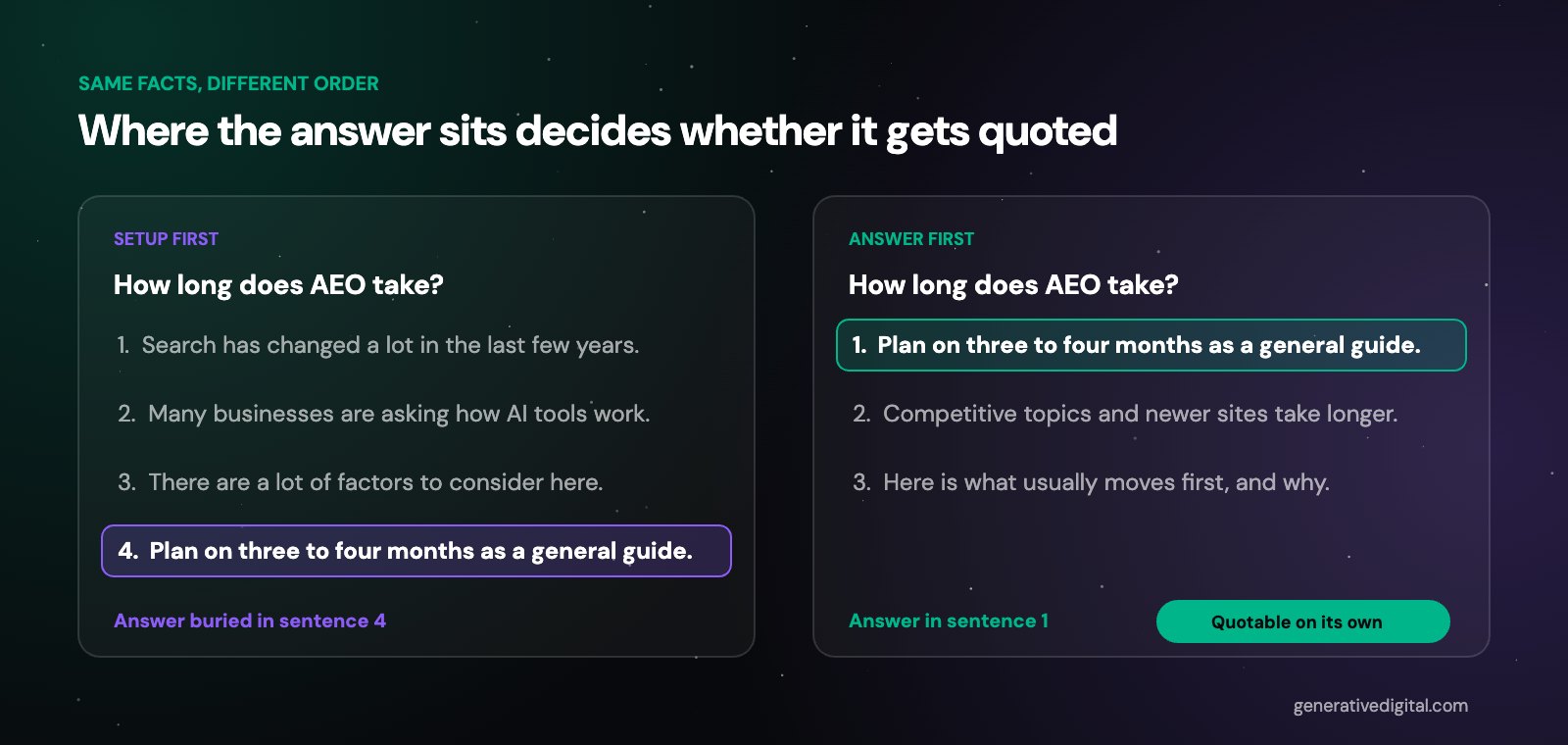
Lead with the answer.
The first sentence after a heading should answer that heading. Detail follows.
Make each passage stand on its own.
It should still make sense when pulled out of the page. Phrases like “as mentioned above” break it.
Keep your facts the same everywhere.
Your name, services and contact details should match on your site and on outside listings, so a tool comparing sources finds one consistent story.
AEO, GEO and SEO: how they fit together
All three aim to get your business found. They differ in what counts as a win:
SEO
Earns a place in the list of search results.
AEO
Earns the answer itself, on every surface above, including the ones that are not AI-written, like featured snippets and voice.
GEO
The part of AEO aimed at AI tools that write their own answers, like ChatGPT, Perplexity, AI Overviews, AI Mode and Copilot.
At Generative Digital we use the term GEO for our AI search work. If another agency calls the same work AEO, that is a difference in words, not in method. Our guide to what generative engine optimization is compares the terms side by side. For a one-table comparison and help choosing where to start, see AEO vs SEO vs GEO.
An AEO strategy in seven steps
A good AEO strategy starts with access and ends with proof. Here is a practical order to work in:
Open the door to the right crawlers.
Check your robots.txt for Googlebot, Bingbot, OAI-SearchBot and PerplexityBot. Treat training crawlers like GPTBot and Google-Extended as a separate decision, because blocking them limits model training, not whether you can appear in answers. Also check that preview settings like nosnippet or a low max-snippet are not hiding your text by accident, since Google applies those settings to its AI features too.
Make your text readable without scripts.
Your headings and answers should be in the page code the server sends, not only after JavaScript runs. Many AI crawlers do less of that loading work than Google does.
Build pages around real questions.
Pull them from sales calls, your inbox and the search terms in Google Search Console, not only from keyword tools.
Write answer-first passages.
Put a short, direct answer in the first sentence or two under each heading, then add the detail.
Cover the follow-up questions.
Because AI Overviews and AI Mode can run several related searches before answering, a page that covers the natural next questions gives those searches more to find.
Make your business identity clear.
Keep your name and details the same everywhere, and add structured data, a small block of code that labels facts for machines. Google says no special schema is needed for its AI features, so treat it as a clarity aid, not a ticket in. See which schema types matter for AI search.
Earn mentions on trusted sites.
Claim and correct your listings, reviews and association profiles, so outside sources describe you the way your site does.
Our GEO audit checklist turns these steps into checks you can run on your own site, in order.
How to measure answer engine optimization
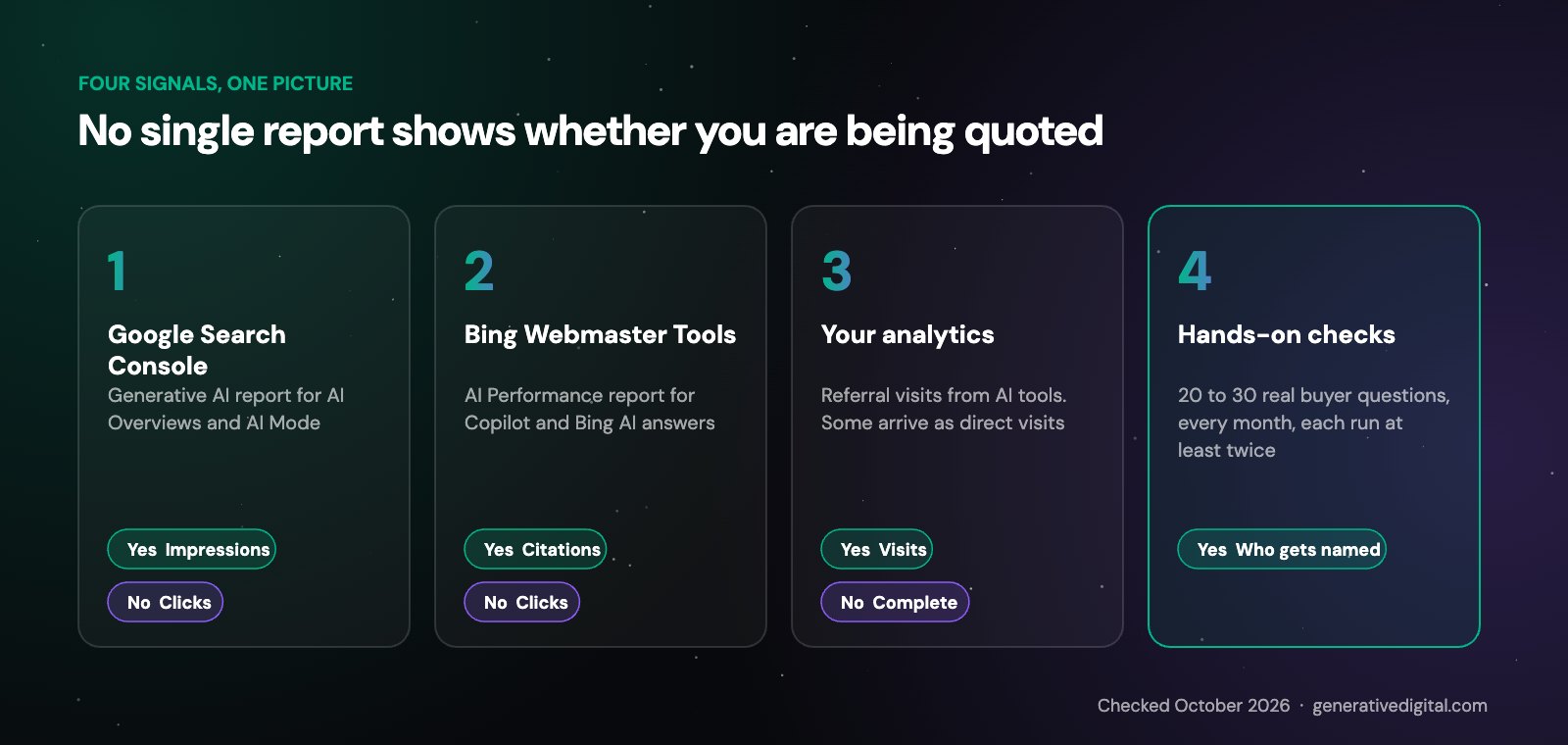
No single report shows the whole picture yet, so use four signals together:
Google Search Console
Traffic from AI Overviews and AI Mode is counted in the Performance report under Web, mixed in with regular search. Google also added generative AI performance reports, announced in June 2026 and rolled out to all websites worldwide as of August 31, 2026. They show impressions from AI Overviews and AI Mode, but not clicks, and sites with very few AI impressions may not see them yet.
Bing Webmaster Tools
Its AI Performance report, launched in public preview in February 2026, shows how often your pages are cited in Copilot and Bing AI answers and the search phrases behind those citations. A June 2026 update added your share of citations for each phrase. It reports citations, not clicks.
Your analytics
Some AI tools pass along where a visitor came from and some do not, so part of this traffic shows up as direct visits. Treat it as the minimum, not the total.
Hands-on question checks
Each month, run a fixed set of 20 to 30 real buyer questions through the tools your customers use, at least twice in separate sessions, and record who gets named. AI answers change from one try to the next, so one check proves nothing.
What AEO is not
It is not a trick.
Hidden text and invisible instructions aimed at AI tools are old spam tactics in new clothes. When they work at all, they stop working at the next update.
It is not a file or code you install.
Google says you do not need new machine-readable files, AI text files or special markup to appear in its AI features.
It is not a replacement for SEO.
Nearly every AEO gain depends on a site that search engines can already reach, read and trust.
It is not guaranteed.
No one can promise that Google, ChatGPT or Perplexity will quote your business, and you should be cautious of anyone who does.
Answer engine optimization services from Generative Digital
Generative Digital works with businesses across the US. We run SEO and answer engine work as one program, which we offer as our AI SEO agency services. Comparing agencies? Here is how to choose an AI SEO agency.
We are a single-operator practice, so the person who reviews your site is the person who does the work. AEO tends to pay off most where one new client is worth a lot, like healthcare practices and law firms, and for any business whose buyers research by asking questions.
months
What to expect
As a general guide, plan on three to four months before you see measurable movement. Competitive topics and newer websites usually take longer. No one can guarantee that Google, ChatGPT or Perplexity will quote your business.
Frequently asked questions
Is AEO the same as GEO?
Close, but not quite. AEO is the wider term and covers any answer a search feature gives, including featured snippets and voice answers. GEO focuses on AI tools that write their own answers, like ChatGPT, Perplexity and Google AI Overviews. The day-to-day work overlaps almost completely.
Does AEO replace SEO?
No. Answer engines pull from pages that can be found, read and trusted, which is what SEO already builds. Google says a page only needs to be indexed and eligible to show a snippet to appear in AI Overviews and AI Mode. Weak SEO leaves any answer engine with less to quote.
Do I need special schema or an llms.txt file for AEO?
No. Google says you do not need new machine-readable files, AI text files or special schema to appear in its AI features. Structured data is still a cheap way to state facts clearly, as long as it matches what people can see on the page.
How do I know if AEO is working?
Use several signals together. Search Console shows impressions from AI Overviews and AI Mode, Bing Webmaster Tools shows citations in Copilot, your analytics shows some visits from AI tools, and a monthly check of real buyer questions shows who gets named.
How long does answer engine optimization take?
As a general guide, plan on three to four months before you see measurable movement. Competitive topics and newer websites usually take longer.
Find out where you are being quoted today
The easiest first step is to see where you stand. Our free digital audit checks how search engines and AI tools see your site right now, whether you are being named in AI answers, and what to fix first. Most audits come back within 48 hours.
Get a free digital auditWorking with businesses across the US
© 2026 Generative Digital LLC