Hair transplant marketing for Google search, AI answers and paid ads
Hair transplant marketing is the work of helping people with hair loss find your practice, trust it and request a consult, whether they start on Google, in Google Maps or by asking an AI tool like ChatGPT. Generative Digital handles hair transplant marketing and hair restoration marketing as one plan: SEO, AI search, Google Ads and the website that ties them together. We work with hair restoration practices across the US.
Picking a hair restoration practice is a lot like buying a car you plan to keep for years. Nobody buys on the first visit. People read for weeks, compare options, check the reviews, and come back more than once before they ask for a test drive. Good marketing is there at every one of those visits, with the same clear answers each time.
This page sits under the industries we work in, next to our med spa marketing page, which covers the questions every aesthetic practice should ask before hiring an agency. Here we stay on what is different about hair restoration.
What does hair transplant marketing cover?
For a hair restoration practice, the work usually falls into five parts:
Your homepage and treatment pages.
Clear pages for each surgical and non-surgical option you offer, written for a patient who is still deciding.
Local search.
A Google Business Profile for each real office, set up the way Google’s rules describe.
AI answers.
Pages that ChatGPT, Perplexity and Google AI Overviews can read and quote correctly.
Paid search.
Google Ads built around the audience limits that apply to surgery and injections.
Tracking.
A record of which channel brought in each consult request, so the budget follows real patients.
Generative Digital handles all five. The full list is on our services page.
What hair transplant marketing should never promise is a result. Hair restoration depends on each patient, and no agency controls what Google or an AI tool shows. You will see some agencies promise a set number of new patients. We do not.
How do people with hair loss research a practice?
Hair loss is personal, and the decision is rarely quick. Before they reach out, patients tend to:
- Compare surgical and non-surgical options. They want to know the difference between an FUE hair transplant, an FUT hair transplant and treatments that do not involve surgery.
- Ask AI tools to explain the choices. A question like “what is the difference between FUE and FUT” can be answered by an AI tool before any website gets a click.
- Look for proof. Reviews, photos and the surgeon’s own background carry a lot of weight.
- Shop on price. Some patients compare offices across the country, or abroad. We advise practices to keep prices off their service pages. A number on a page answers one question and raises several more, and those answers depend on the patient in front of the surgeon.
A practice that answers each of those steps clearly, on its own website, gives the patient a reason to stay instead of going back to the search results.
What should a hair restoration homepage say?
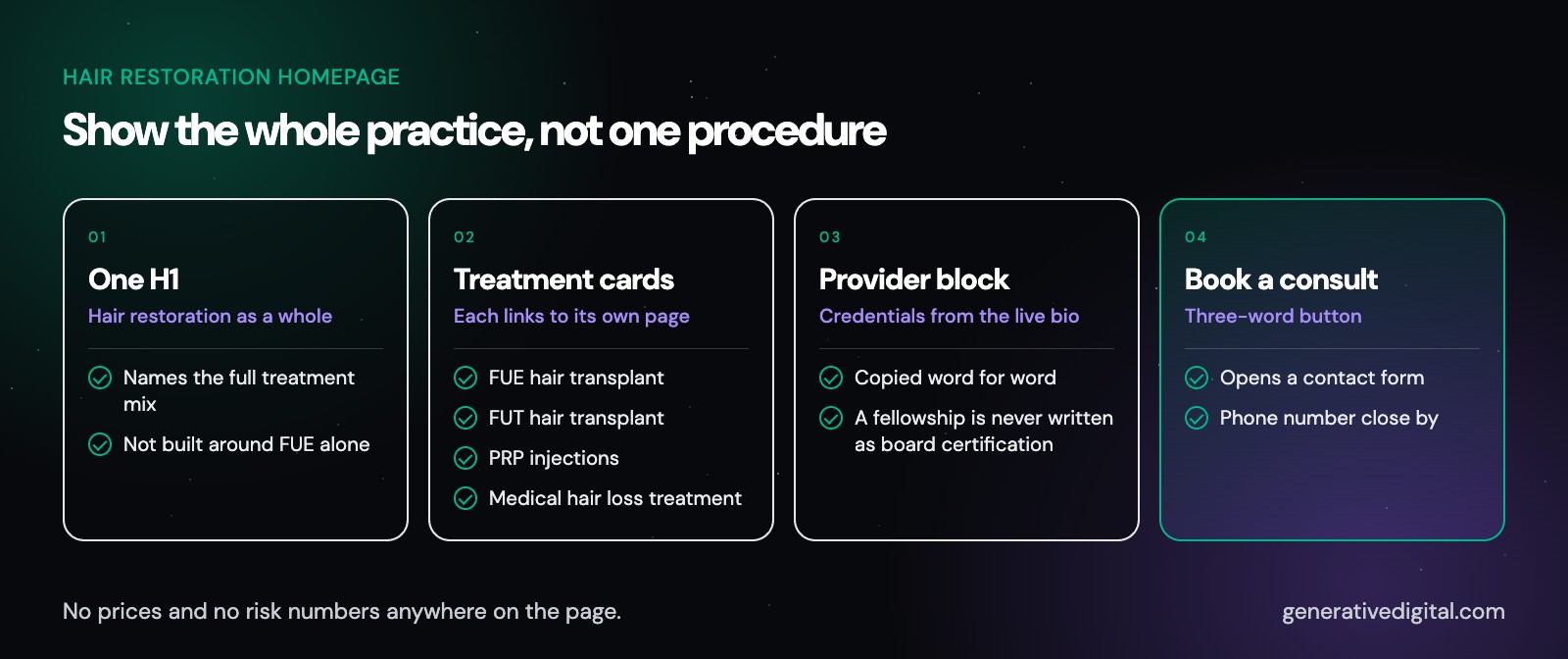
Your homepage should describe the full mix of what you offer, not one procedure. A homepage built around a single surgery tells every other patient they are in the wrong place.
A stronger homepage names each part of the practice in plain words, for example:
- FUE hair transplant
- FUT hair transplant
- PRP injections
- Medical hair loss treatment your providers prescribe or recommend
- A consult where the provider recommends a plan
Each item links to its own page. That helps a patient who is not ready for surgery find a starting point, and it helps search engines and AI tools understand the whole practice. Name the technique, not the machine. “FUE hair transplant” tells a patient more than a device brand does, and it stays accurate if you change equipment.
How should hair transplant procedure pages be built?
Which pages does a hair restoration practice need?
Give each main option its own page, and give each surgeon or provider a page too. When FUE, FUT and PRP injections share one page, none of them has a clear subject for search engines to rank. A good procedure page walks a patient through, in order: what the option is, who tends to consider it, how the consult works and what the first days afterward usually involve.
Which claims need provider sign-off?
All of them. The mechanics of a procedure, recovery time, what happens to the donor area and how results develop are clinical statements, so the treating surgeon or provider reviews and approves each one before the page is published. Describe your approach as what your practice does in most cases, never as a promise. A plainly generic example: “In most cases, our surgeon reviews your hair loss pattern and family history at the consult before recommending a plan.” Even that line should go live only if your surgeon confirms it is how they work.
Words to keep off the page entirely: “guaranteed”, “permanent”, “scar-free” and “painless”. Leave out risk or complication numbers too. Those belong in the consult, with the surgeon.
What should the consult button do?
We recommend that the main button on every surgical page opens a contact form rather than a phone link or a booking widget. A submitted form lands in your CRM and can be marked as a key event in Google Analytics, which ties each consult request to the page and channel behind it. Three words is plenty for the label, for example “Book a consult”. A visible phone number still belongs on the page for patients who prefer to talk first.
How does hair restoration marketing work in local search?
When a patient searches close to home, the map results come from Google Business Profiles, so yours matters. Google’s guidelines set the rules:
- One profile per real office. Google says not to create more than one page for each location, and a mailing address the business rents but does not operate from is not eligible.
- Your real name. The profile name should be the name on your door and your signage. Google says taglines, phone numbers and hours do not belong in it.
- Practitioners with care. Google lets a public-facing practitioner have a profile at the location where patients can reach them, and says a practitioner should not have several profiles to cover each specialty.
Three rules we add for hair restoration practices:
- No office claims for cities you only draw patients from. Patients who travel to you are welcome, but a page or profile that hints at a local office you do not have misleads them.
- Build a city page only for what that office offers. Each office page names only the services patients can get there.
- Describe surgery only where the operating room is. A patient should never discover on the day that the procedure happens somewhere else.
Can you advertise hair transplants on Google Ads?
Yes. Paid search puts your practice in front of people searching for a procedure right now, while organic search builds. Two Google policies shape how the campaigns are built.
Which audiences can a hair transplant campaign use?
Google’s personalized advertising policy treats Health as a sensitive interest category. Its Health list names invasive medical procedures, including cosmetic surgery, surgical procedures or injections. Google does not name hair transplants, but a hair transplant is a surgical procedure and a PRP treatment is an injection, so we plan both kinds of campaign as inside that category.
For ads in a sensitive interest category, Google says you can’t use advertiser-curated audiences. Customer match, your data segments (which Google used to call remarketing), audience expansion and lookalike segments are not supported. In plain terms, you cannot target lists of your own past visitors or patients. Predefined Google audiences can still be used, such as in-market segments, affinity segments, life events, location targeting and, with exceptions, demographics. Custom segments come with a catch. When the ad or its landing page is sensitive, Google says a custom segment serves only in Display campaigns, to non-sensitive audiences or by context, and other campaign types using it are not eligible to serve. Nobody under 18 can be reached with personalized ads of any kind.
So a hair transplant campaign leans on search intent instead. We build ad groups around the treatments and questions people type, send each ad to its matching procedure page, and judge the campaign on consult requests, not clicks.
What about prescription hair loss medicines?
Google’s policy on prescription drug terms covers them wherever they appear: in ad text, on landing pages and as keywords. If your practice prescribes hair loss medicines, their names may count as prescription drug terms. For US campaigns, Google allows promotional use of those terms as long as local laws and regulations allow it. Certification is not needed to use them in ads and on landing pages, but it is needed to target them as keywords. Google posted that change on October 14, 2025 and began enforcing it on October 29, 2025. Before you bid on a drug name, confirm with Google Ads support what your account needs.
What rules apply to hair transplant photos, reviews and claims?
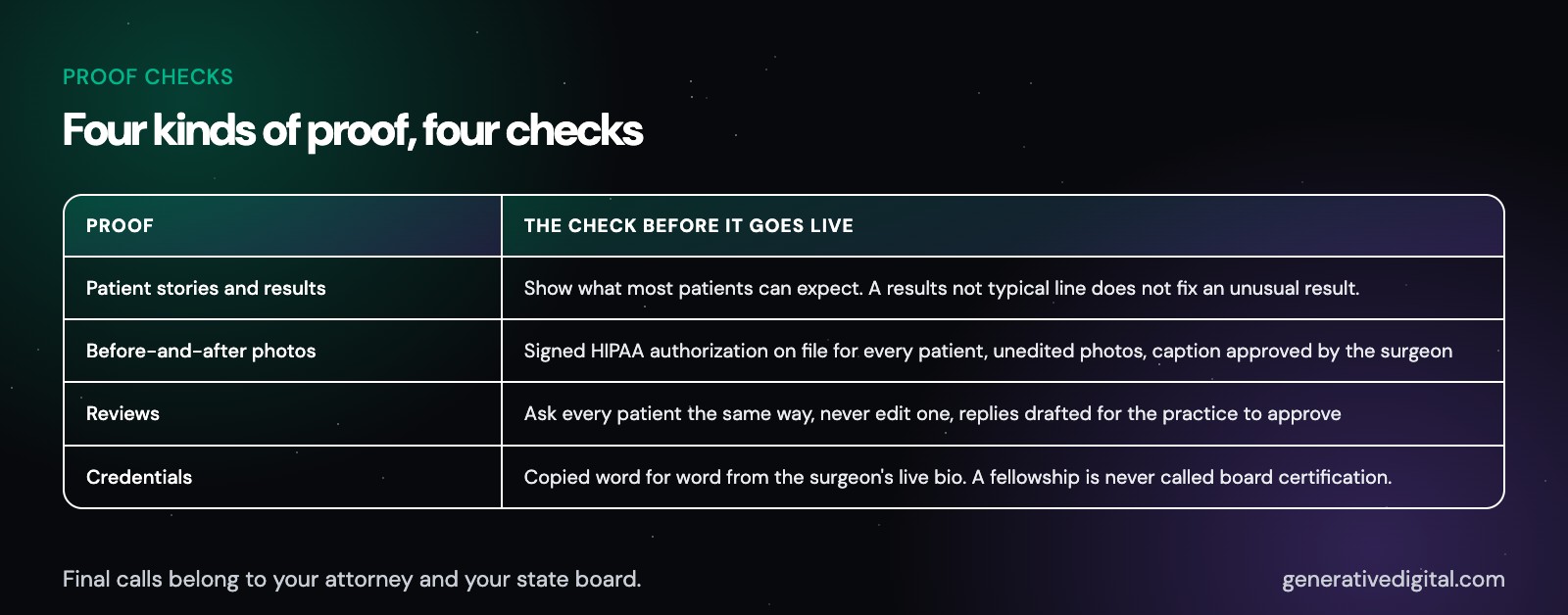
Hair restoration marketing leans heavily on proof, which is exactly where the rules are strictest. Final calls on what you publish belong to your attorney and your state board. Here is how we work inside those limits.
- Results must be typical. Under the FTC’s health products guidance, a patient story showing a better result than most people get is likely deceptive, even with a “results not typical” line under it. The FTC also reads an ad by the overall impression it leaves, images included, so a before-and-after pair makes a claim of its own.
- Photos need a signed authorization. We hold one line on this: a patient photo appears on your website, ads or social media only when that patient’s signed HIPAA authorization is on file. HHS says a covered entity needs the patient’s authorization before using their health information for marketing, with narrow exceptions such as a face-to-face conversation.
- Reviews stay untouched. Request reviews from all patients in one consistent way. Patient reviews are never edited or changed in any way. Any reply we write is a draft that the practice approves before it is posted.
- Credentials match the bio, word for word. Copy each credential, in the page text and in the schema markup, exactly as it reads on the surgeon’s own live bio. A fellowship is described as a fellowship, never as board certification, and a membership missing from the bio stays off every other page too.
Why is hair restoration SEO not a blogging project?
A common hair transplant SEO plan is to publish a new blog post every week and wait. For most hair restoration practices, that is the wrong place to start. Patients who are close to booking land on procedure pages, provider pages and your Google Business Profile, not on a blog archive.
So our hair restoration SEO work starts with the pages that turn research into a consult:
- Technical health. Pages that load quickly on a phone, can be crawled and indexed, and carry clear title tags.
- Procedure and provider pages. The pages described above, each answering the questions patients ask most.
- Structured data. Schema markup that lists only the services your practice actually offers, with credentials that match each provider’s bio.
- A few deep answers. A short set of plain-language pages on the biggest questions, such as the difference between FUE and FUT, linked back to the procedure pages.
A blog can help later. It should support the procedure pages, not replace them.
How do AI tools describe a hair restoration practice?
Google’s guidance for its AI features is short: no special code or extra optimization is needed for AI Overviews or AI Mode, and a page qualifies as a supporting link only if it is indexed and eligible to show in Search with a snippet. Google adds that these features can use query fan-out, issuing multiple related searches across subtopics before they answer. A patient asking about hair transplants may set off searches on the techniques, on recovery and on how to choose a surgeon. A clear, provider-approved page for each gives those searches something accurate to find.
Three habits help AI tools describe your practice the way you would:
- Keep your treatment list identical everywhere. Your homepage, your procedure pages, your Google Business Profile and your schema markup should name the same treatments, using the same words.
- Spell every provider the same way. One version of each name and each credential, used on your site, your profiles and your directory listings.
- Check the answers every month. We run the same set of patient questions through the AI tools your patients use and note whether your practice is named, and how it is described.
We explain the wider method in our answer engine optimization guide. Hair restoration can be one service line among several, and if your practice also offers surgery or skin care, see our pages for plastic surgery practices and dermatology practices.
How do you measure hair transplant marketing?
Rankings and visits are early signals. What counts is how many people ask for a consult, and later how many of them go ahead with treatment. The reporting we build includes:
- Consult form submissions, marked as key events in Google Analytics and broken out by page and channel.
- Phone calls, with website calls and Google Ads calls counted apart.
- Traffic from ChatGPT, Perplexity and other AI tools, split out on its own wherever the platform passes that information along.
- Each consult traced to its first source, to the extent your CRM and front desk records allow.
Hair restoration decisions take time, so a consult request this month may come from a first visit months ago. If a figure has not been measured, our reports say so instead of estimating it.
months
How long before hair transplant marketing shows results?
Three to four months, as a general guide, is a fair window before search brings changes in rankings and consult requests that you can actually measure. A new website or a crowded market stretches that. Google Ads can start producing consult requests earlier, once the campaigns are approved.
Whether Google or an AI tool names your practice is not something any agency controls, so treat any promise otherwise with suspicion. Our promise is narrower: thorough work, straight reporting and a clear account each month of what changed.
What else do hair restoration practices ask?
Is hair transplant marketing different from plastic surgery marketing?
Partly. The search, website and tracking work is similar, but hair restoration patients weigh surgical and non-surgical options side by side, and some travel for the procedure. The homepage, the procedure pages and the ad plan should reflect that.
Can we use remarketing ads for hair transplants?
We plan as if you cannot use your own lists. Google’s Health sensitive interest category includes invasive medical procedures such as cosmetic surgery, surgical procedures and injections, and for those ads it does not support customer match, your data segments, audience expansion or lookalike segments. Predefined Google audiences, such as in-market and affinity segments, can still be used.
Should we put hair transplant prices on our website?
We recommend keeping them off your service pages. The cost depends on each patient’s plan and changes over time, so the surgeon’s consult is where that number belongs.
Can we post before-and-after photos of hair transplant patients?
Yes, when that patient has signed a HIPAA authorization and it is on file. We apply that to every patient photo without exception. Choose unedited photos that reflect what most patients see, and have the surgeon approve the caption for each.
How long does hair transplant marketing take to work?
For search, three to four months is a general guide before movement you can measure. Google Ads can bring consult requests in earlier, as soon as campaigns are approved.
See where your practice stands today
A short look at your site now beats guessing at what to fix. Our free digital audit reviews your website, your index status and how AI tools see your practice, then shows you what to fix first. It costs nothing, and most audits come back within 48 hours.
Get startedWorking with businesses across the US
© 2026 Generative Digital LLC