Dental marketing: how a practice attracts new patients and keeps them coming back
Dental marketing is everything a dental practice does to bring in new patients and keep current patients coming back: its website, Google Maps listing, reviews, ads, social media, recall reminders, referrals and the way the front desk answers the phone. A good plan treats those as one system, so each part sends patients to a practice that is ready to book them. This guide explains what to work on first, how to market each treatment, the ethics rules that shape dental advertising, and how to tell whether any of it is working.
Search is one piece of the plan, and our page on dental SEO covers it in depth. For the wider picture across medical fields, see our work on healthcare SEO. This guide stays on the parts of dental marketing that sit around search: the phones, each treatment, ads, social media, recall, referrals and the rules.
What does dental marketing include?
Picture your patient list as a bucket. New patients pour in from the top. Patients who move away, switch dentists or simply stop booking leak out of the bottom. Most talk about dental marketing is about pouring faster. Practices that grow steadily also patch the leaks.
So dental marketing has two jobs:
- Bringing in new patients.
Your website, Google Maps, reviews, Google Ads, social media, and referrals from patients and from other dentists.
- Keeping current patients.
Recall reminders, easy rebooking, follow-up on treatment patients have put off, and a front desk that makes every visit simple to schedule.
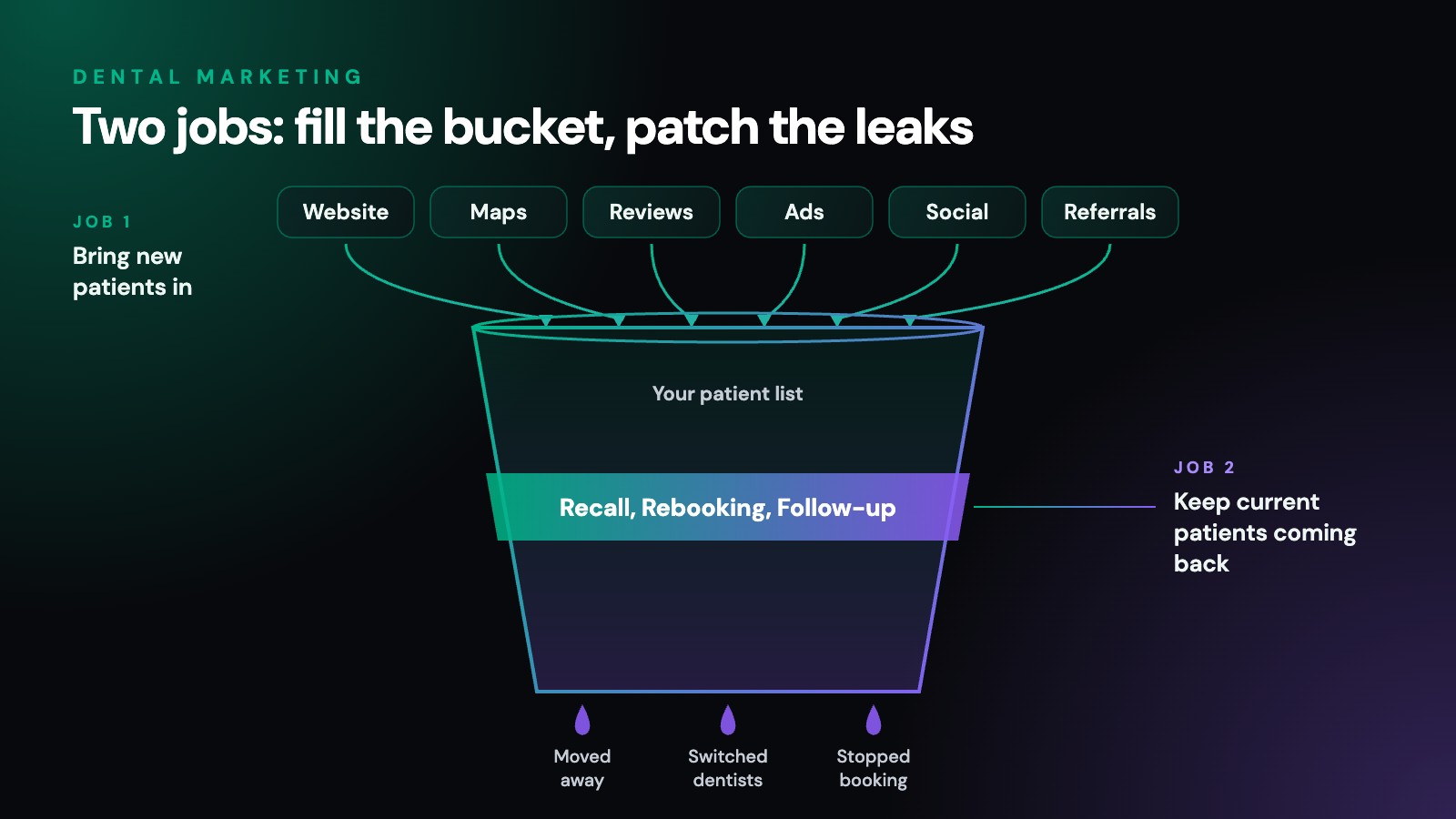
Both jobs rest on the same base: correct practice details everywhere, a website that works on a phone, and a team that picks up when patients call. Our guide to healthcare digital marketing covers the same channels for medical practices.
What should dental practice marketing focus on first?
Dental practice marketing works best in a set order, because each step makes the next one pay off. As a general guide:
- Answer the phone and track the calls.
Before spending on anything new, make sure calls get answered, missed calls are returned the same day and each call is tracked by source.
- Fix the website.
A page for each treatment, a clear new patient page, the insurance plans you accept in plain text and a booking button near the top of every page.
- Get your Maps listing and reviews right.
A correct Google Business Profile for each office and one steady way to ask every patient for a review.
- Run your recall system.
Reminders for patients who are due, and a simple way to reach patients who have not been in for a while.
- Add paid ads for chosen treatments.
Once the pages and phones are ready, spend on the treatments where a new patient matters most to the practice.
- Check how AI tools describe you.
Patients now ask ChatGPT and similar tools to suggest a dentist. Our guide on how to rank in ChatGPT explains how those tools pick the businesses they name.
Social media, newsletters and community events can all help. They work best on top of these basics, not in place of them.
Why does the front desk matter as much as the ads?
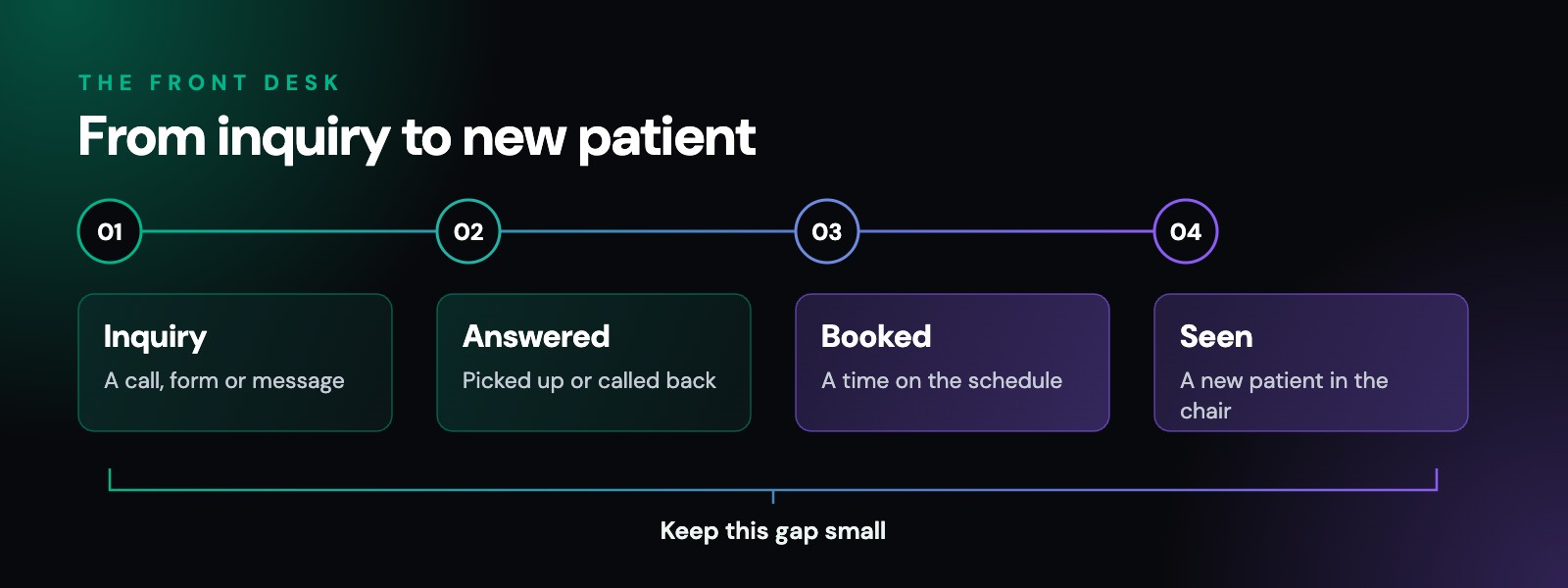
Marketing brings in the call. The front desk turns it into a patient. The American Dental Association’s guide to building a marketing plan says it directly: “even the best marketing campaign can fail if your practice’s internal systems can’t support it.”
A few habits make the biggest difference:
- Answer live during office hours
whenever you can, and call back anyone you missed the same day.
- Use a short script for new patient calls.
The treatment they asked about, their insurance, how they heard about you, and a booked time before the call ends.
- Make online booking easy
for patients who would rather not call, and confirm each request quickly.
- Brief the team before every campaign,
so nobody is caught off guard when a patient asks about a new treatment page or ad.
The same ADA guide suggests counting patient inquiries next to the number of actual new patients, and notes that “When marketing is working well, there is very little gap between these two totals.” A wide gap is a sign to look at how calls are handled before adding more marketing.
How should a practice market each treatment?
Treatments are not all marketed the same way. A family looking for a new general dentist is choosing a practice they may stay with for years. A patient looking into implants, clear aligners or veneers is weighing one larger decision and may be paying more of it out of pocket.
- General and family dentistry.
Location, hours, insurance and reviews decide most of these choices. Your Maps listing and new patient page carry the load.
- Larger and elective treatments.
Patients read more before they call. Give each treatment its own page covering who the treatment is for, the steps from first visit to finish, and the things that change the cost, reviewed by the dentist who provides it.
- Urgent care.
If you see emergency patients, say so clearly and keep your hours accurate. If you do not, leave it out of your ads.
Two rules hold for every treatment. Send each ad or post to the page for that treatment, not your homepage. And describe what the treatment involves rather than promising how it will turn out.
When does dental advertising make sense?
Dental advertising, mostly Google Ads and paid social, buys attention for as long as it runs. It makes the most sense when you have open time in the schedule, a new office or dentist to introduce, or a treatment you want to grow.
- Search ads follow intent.
People who search for a treatment are already looking. Send them to the page for that treatment, with the phone number and booking button easy to find.
- Social ads build familiarity.
They reach people nearby who are not searching yet, so they suit introducing a practice better than urgent needs.
- Ads follow the same rules as your website.
The ethics rules covered below apply to every ad and every post.
- Judge ads by new patients, not clicks.
A cheap click that never books costs more than a pricier one that does.
We run Google Ads for practices alongside SEO and AI search. See all of our digital marketing services.
How does dental social media marketing work?
Dental social media marketing is less about going viral and more about letting nearby patients see who you are before they walk in. Posts that tend to fit a dental practice:
- Introductions to your dentists, hygienists and front desk team
- A look around the office, so a nervous patient knows what to expect
- Short, plain answers to common patient questions, reviewed by a dentist
- Office news, such as new hours, a new dentist or a community event
Two rules matter more here than anywhere else.
- Patient photos and stories need written permission.
HIPAA’s Privacy Rule says a covered entity “must obtain an authorization for any use or disclosure of protected health information for marketing,” with narrow exceptions. Before any before-and-after photo, smile photo or patient story goes on social media, your website or an ad, get the patient’s signed authorization and have your compliance lead approve the form.
- Claims need evidence.
The ADA’s Code of Professional Conduct treats social media advertising that “promises superior results,” or that calls a product or service safe and effective without scientific support, as false or misleading. It also says anyone endorsing a product or service “must disclose any paid partnerships” with vendors.
How do recall and referrals keep a practice growing?
Patching the bucket often costs less than filling it. Current patients already know you, and the patients they refer tend to arrive with some trust already in place.
- Recall reminders.
Remind patients when they are due for their next visit, using the patient messaging tools your compliance lead has approved.
- Patients who have drifted.
Pull a list of patients who have not been in for a while and reach out with a friendly call or message. Some meant to book and simply forgot.
- Treatment patients put off.
Follow up on treatment a dentist recommended that the patient has not scheduled, led by the clinical team.
- Patient referrals.
Thank patients who send someone your way. Before offering a reward or anything of value for a referral, check the ADA Code and your state dental board’s rules.
- Referrals between dentists.
General dentists and specialists send each other patients. A clear referral page that shows how to send a patient and what happens next makes you easy to refer to.
What rules shape marketing for dentists?
Marketing for dentists follows professional ethics rules on top of general advertising law. The ADA Code of Professional Conduct says “no dentist shall advertise or solicit patients in any form of communication, including via social media, in a manner that is false or misleading in any material respect.” The Code is binding on ADA members, and it notes that state laws may also apply, so check your state dental board’s rules too. This is general information, not legal advice.
The Code’s examples of false or misleading statements make a handy checklist for any page, ad or post. Leave out anything that would:
- Misstate a fact, or leave out a fact the reader needs to avoid being misled
- Create an unjustified expectation about results the dentist can achieve
- Claim your care is better than other dentists’ without reasonable proof
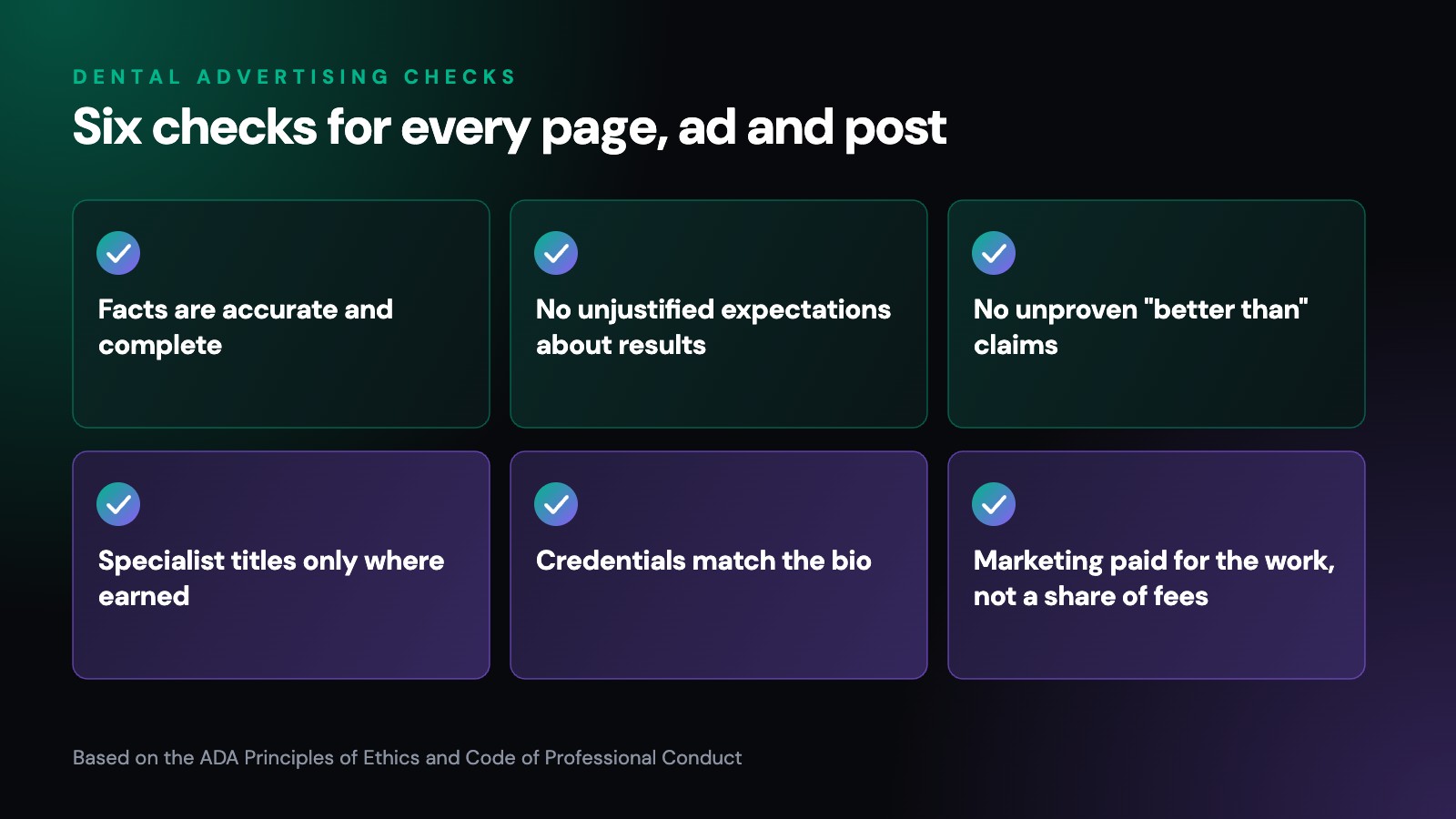
Three more points come up often:
- Specialist titles.
The ADA Code lets a dentist announce as a specialist only in a recognized specialty, and only after meeting the required education, and it asks those dentists to use the words “specialist in.” A general dentist should not imply specialist status.
- Fellowships and memberships.
The Code warns that fellowships granted as a token of membership “may be misleading” in advertising to the public. Match every credential word for word to the dentist’s own bio.
- How you pay for marketing.
The Code treats paying a marketing vendor “a specific amount or percentage of professional fees collected” from patients as fee splitting, and it names social media coupons and social media influencers. Pay for the marketing work itself, not a share of what patients pay.
How do you know if dental marketing is working?
Judge dental marketing by the schedule, not by likes or clicks. The numbers worth checking each month:
- New patients by source,
from search, Maps, ads, social media, patient referrals and referrals from other dentists, counted at the front desk and checked against call tracking.
- Calls answered and calls booked.
A missed call can undo a good campaign.
- Recall bookings,
meaning how many patients who were due for a visit actually booked one.
- The treatment pages patients read
before they booked.
- How AI tools describe your practice,
using the same list of patient questions each month.
Ask every new patient how they heard about you when they book. It catches the word of mouth and referral visits that tracking tools miss.
What else do dentists ask about marketing?
Should a dental practice run its marketing in-house or hire help?
Either can work. The ADA’s guide to marketing plans says a team member who runs marketing in-house should expect to spend about 10 hours a week on it, with other staff helping. One workable split: keep reviews, recall and referrals in-house, and hire outside help for the website, search and ads. If you hire help, the questions in how to choose an SEO company are a good place to start.
Can a practice pay a marketing company a share of each new patient’s fees?
The ADA Code treats that as fee splitting, which it prohibits for its members. State laws may also apply.
Is it OK to share patient before-and-after photos?
Only with the patient’s signed authorization. HIPAA’s Privacy Rule requires an authorization, with narrow exceptions, before protected health information is used for marketing. Have your compliance lead approve the form and keep the signed copy on file.
How long does dental marketing take to work?
It depends on the channel. Paid ads can bring calls soon after launch, and recall reminders reach patients who already know you. Search and AI answers build more slowly, so count on three to four months as a general guide until measurable movement shows. Crowded markets and new websites usually take longer.
Where does your practice’s marketing stand today?
Generative Digital helps dental practices across the US with SEO, AI search, Google Ads and websites, and one person handles your account from start to finish. Our free digital audit shows how search engines and AI tools see your practice right now, and what to fix first.
Get startedWorking with businesses across the US
© 2026 Generative Digital LLC