Healthcare digital marketing: how a medical practice brings in new patients online
Healthcare digital marketing is the work of helping patients find, trust and book with a medical practice online, through its website, Google Search and Maps, AI answers, Google Ads, reviews and email. Done well, every one of those channels tells a patient the same clear story about who you are, what you treat and how to get an appointment. This guide explains what each channel does, the rules that make healthcare different, and what to fix first.
Search is the channel most practices lean on, and we cover it in depth on our page about healthcare SEO. This guide steps back to the whole plan, so you can see how search, ads, reviews and tracking fit together. Dental practices can read our guide to dental marketing.
What does healthcare digital marketing include?
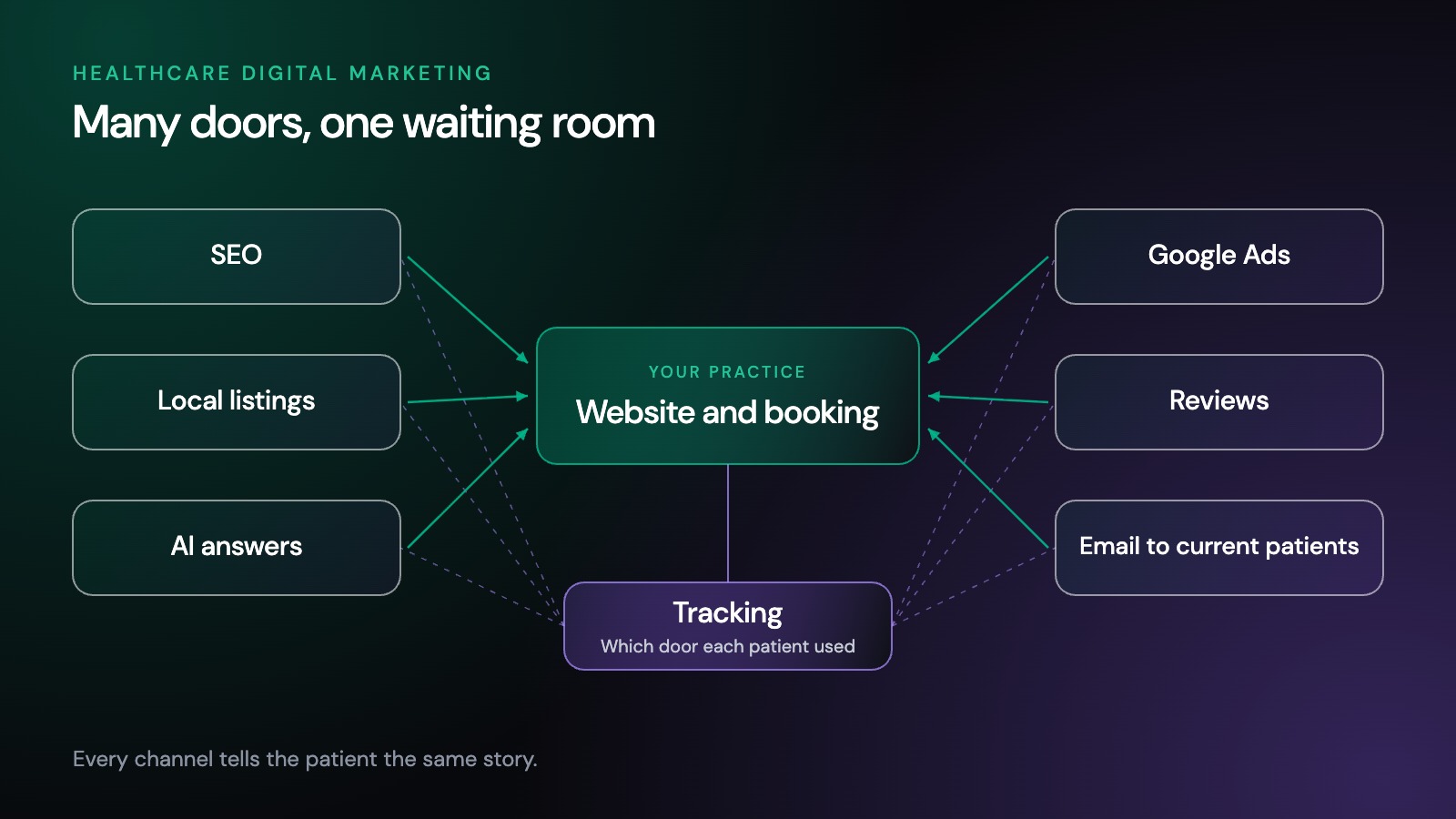
Picture your practice as one waiting room with several doors. One patient walks in from a Google search, another from a map listing, another from an ad, another because an AI tool named you. Each door is a channel. Patients do not judge you by your best door. They judge you by the one they happened to use.
For most practices, the doors are:
- Your website.
The one place you fully control. Every other channel sends people here.
- Search engine optimization (SEO).
Earning a spot in regular Google results for the conditions and services you treat.
- Local listings.
Your Google Business Profile and the health directories that show your address, hours and phone number.
- AI answers.
The short answers ChatGPT, Perplexity and Google AI Overviews write when a patient asks a health question.
- Google Ads.
Paid search ads that show when someone searches for a service you offer.
- Reviews.
What patients say about you on Google and other sites, and how you reply.
- Email to current patients.
Reminders and updates sent to people who asked to hear from you.
- Tracking.
Knowing which channel brought in each call, booking request and form.
Why does healthcare marketing follow stricter rules?
Google holds health content to a higher bar than most topics. Its guide to helpful content says its systems “give even more weight to content that aligns with strong E-E-A-T for topics that could significantly impact the health, financial stability, or safety of people.” E-E-A-T stands for experience, expertise, authoritativeness and trust. For health topics, the same guide asks for accuracy that matches established expert consensus.
Advertising has its own limits. Google’s healthcare and medicines policy says “Some types of healthcare-related content can’t be advertised at all, while others can only be advertised in certain locations by advertisers who have applied and been approved.” Google’s personalized advertising policy also lists Health among its categories with targeting restrictions, which limits how ads can be aimed at people based on health interests.
HHS guidance on online tracking says tracking tools on a page where patients book appointments can capture protected health information, and that cookie banners asking visitors to accept or reject tracking “do not constitute a valid HIPAA authorization.”
In practice, that means three habits:
- A clinician reviews every clinical claim.
Before it goes live, on the website, in an ad or in an email.
- Your compliance lead approves any tracking tag.
Before it is added to pages where patients type in their own details, such as forms and booking pages.
- Nothing promises a result.
Describe what a visit involves and who a service suits. Leave outcomes to the conversation between a patient and their provider.
What should a practice fix first?
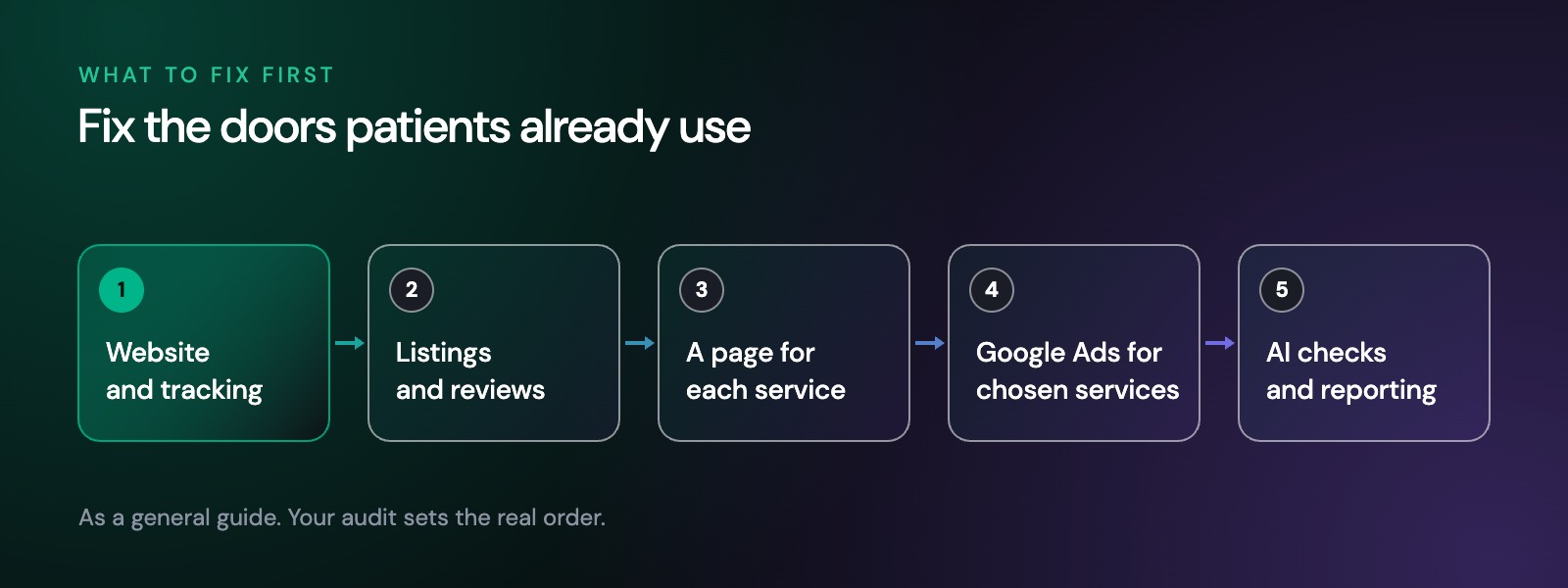
The order matters more than the budget. A practice that runs ads to a slow, confusing website pays to send patients to the wrong door. As a general guide, we work in this order:
- Website basics and tracking.
Pages load fast on a phone, the phone number is easy to tap, booking takes a few steps, and calls and forms are tracked by source.
- Local listings and reviews.
A correct Business Profile for each office and a steady way to ask for reviews.
- A page for each service.
One clear page for each condition or service you want more of, reviewed by the provider who performs it.
- Google Ads for chosen services.
Paid ads for the few services where a new patient is worth the most, sent to the matching page.
- AI answer checks and monthly reporting.
A fixed list of patient questions run through AI tools each month, plus one report that ties each channel to appointments.
How does a practice website turn searches into appointments?
Most patients who find you online will land on your website before they call. That visit decides whether they book. A website that works for patients usually has:
- One page per service or condition,
written in plain words, covering who it suits, what to expect at the visit and how to get started.
- Clear authorship.
Google’s guide asks site owners, “Do pages carry a byline, where one might be expected?” Name the provider who reviewed each clinical page and link to their bio. Google also warns that “Fabricating creator profiles” is a form of deception, so every name must be a real person at your practice.
- Easy next steps.
A booking button and phone number near the top of each page, and a short form for patients who would rather not call.
- Insurance and new patient details in plain text,
so patients and search engines can both read them.
- Speed on a phone.
Patients often search on a phone, sometimes while they feel unwell. Slow pages lose them.
For practices with several offices or many providers, our page on GEO for healthcare explains how to set up provider and location pages so search engines and AI tools can tell each one apart.
Where do search, maps and AI answers fit?
These three work from the same foundation, so one set of fixes helps all of them.
- Regular search
rewards pages that answer a patient’s question clearly and that Google can crawl and index. Our guide to medical SEO covers that work step by step.
- Maps and local results
depend on your Google Business Profile. Google’s guidelines ask businesses to “Represent your business as it’s consistently represented and recognized in the real world across signage, stationery, and other branding.” Your name, address, phone number and hours should match on your site, your profile and every directory.
- AI answers
draw on pages that already do well in search. Google’s documentation on its AI features says a page has to be in Google’s index and eligible for a snippet in regular results before it can be linked from AI Overviews or AI Mode, and adds that “There are no additional technical requirements.”
The difference is in how AI tools read. They pull a short passage, not a whole page, so put a plain answer at the top of each section. Our guide to answer engine optimization goes further on writing for AI answers.
When do Google Ads make sense for a medical practice?
Google Ads can put a practice in front of patients the day a campaign goes live, which makes them useful for a new office, a new provider or a service with open appointment slots. They stop working the day the budget stops, so most practices pair them with SEO rather than choosing one.
A few things to check before you spend:
- Whether your service needs approval.
Google’s healthcare policy says online pharmacies and telemedicine providers fall under its prescription drug services rules, and that recovery-oriented addiction services can only be promoted, in certain locations, by advertisers Google has certified. Check the live policy for your service before building a campaign.
- How you will reach people.
Because health is a restricted targeting category, plan healthcare campaigns around what people search for, not around audiences built on health interests.
- Where each ad lands.
Send every ad to the page for that exact service, not to your homepage.
How should a practice handle reviews and patient email?
Reviews and email both reach people who already know your name, so they are where trust is won or lost.
- Use one review request for all patients,
a short message after the visit with a direct link. Asking everyone, not only patients who seemed happy, keeps the process fair.
- Reply in general terms.
Thank the reviewer and invite them to call the office. Never confirm that someone is a patient or mention their care in a public reply. We draft replies for the practice to approve and never edit or remove a review.
- Email only people who asked for it.
Appointment reminders, office updates and seasonal care reminders work well. Keep health details out of subject lines, and have your compliance lead approve the email tool you use.
What does medical practice marketing look like for a small team?
Medical practice marketing does not need a marketing department. Most of the work fits into a simple rhythm a practice manager can follow with outside help.
- Every week:
reply to new reviews and check that the phone number, hours and booking link still work.
- Every month:
review calls, booking requests and forms by source, update one service page with questions patients asked at the front desk, and run your list of patient questions through a few AI tools.
- Every quarter:
confirm each provider’s bio matches their current credentials, check each office’s Business Profile, and decide which service gets ad budget next.
The point of the rhythm is that small, steady fixes add up. A practice that keeps its details right and its pages current tends to hold its ground better than one that redoes everything once a year.
How do you measure healthcare digital marketing?
Count what fills the schedule, not what looks busy. Clicks, impressions and followers are easy to report and hard to connect to appointments. The numbers that matter are:
- Phone calls by source,
so you know whether a call came from search, maps, an ad or your website.
- Booking requests and form fills by source,
counted once each.
- Which pages patients read before they booked,
so you know which service pages earn their keep.
- AI mentions,
meaning how often AI tools bring up your practice across one fixed list of patient questions, checked on the same day each month.
Some of this is only partly measurable. Not every AI tool passes along where a visitor came from, and a patient who hears your name from a friend and then searches for you shows up as a branded search. Good reporting says plainly what it can and cannot see.
What else do practices ask about healthcare digital marketing?
Can anyone guarantee new patients from digital marketing?
No. No one can guarantee rankings, ad results or a mention in an AI answer, and a promise like that is a reason to keep looking. A good partner can commit to the work itself, reporting you can check and straight talk about what is and is not changing.
Should a medical practice start with SEO or Google Ads?
It depends on how soon you need new patients. Google Ads can bring in calls quickly while the budget runs. SEO takes longer to build but keeps working after the work is done. Many practices start ads for one or two key services while SEO builds underneath.
Do we need a different agency for each channel?
Not usually. Search, ads, reviews and tracking all depend on the same website and the same business details, so one plan run by one team avoids fixes that work against each other. Our guide on how to choose an SEO company lists the questions to ask before you hire anyone.
Who should review our marketing before it goes live?
A provider should review anything clinical, and your compliance lead should approve anything that touches patient information, such as forms, tracking tags and email tools. Your marketing partner’s job is to build within those limits and flag anything that needs a second look.
How long does healthcare digital marketing take to work?
Google Ads can bring in calls within days of launch. SEO and AI answers are slower. Plan on three to four months as a general guide for the first measurable change, and longer for a new website or a busy specialty.
Where does your practice stand today?
Generative Digital is a one-person practice that handles SEO, AI search, Google Ads and websites for healthcare practices across the US. You deal with one person from the first audit to the monthly report. See all of our digital marketing services. Our free digital audit shows how search engines and AI tools see your practice right now, and what to fix first.
Get startedWorking with businesses across the US
© 2026 Generative Digital LLC