Plastic surgery marketing for Google, AI answers and Google Ads
Plastic surgery marketing is the work of helping people find your practice when they search Google, check Google Maps or ask an AI tool like ChatGPT about a procedure, and then turning that interest into a consultation request. Generative Digital handles plastic surgery marketing as one digital marketing plan: SEO, AI search, Google Ads and your website. We work with plastic surgeons and plastic surgery practices across the US.
The goal is simple. When a potential patient researches a procedure you perform, your practice should be easy to find, easy to trust and easy to contact.
This page sits alongside our med spa marketing guide for aesthetic practices, under the industries we work in. It covers our plastic surgery marketing services, how plastic surgery SEO works, the advertising rules that shape the work, and how to judge any agency, including us. Dermatology practices have their own page on dermatology SEO and marketing, and hair restoration practices have their own page on hair transplant marketing.
What plastic surgery marketing covers, and what it should not promise
A plastic surgery practice does not need more marketing noise. It needs the right patients to find it at the moment they are deciding. Good plastic surgery marketing works on four things:
Being found.
Showing up in organic search, local search results and AI answers when someone looks up a procedure.
Being trusted.
Clear surgeon credentials, honest procedure pages and real online reviews.
Being contacted.
A website that makes it easy to request a consultation.
Being measured.
Tracking that shows which channel brought in real consultation requests, not just clicks.
How patients choose a plastic surgeon now
Choosing a plastic surgeon is a lot like hiring an architect for your home.
You look at their past work, check their credentials, read what past clients say, and only then book a meeting. Plastic surgery patients follow the same path, and they take their time, because the decision is personal and the procedure is real surgery.
They usually start in one of three places:
Google search and Google Maps.
A search for a procedure plus “near me” shows a map with a few practices first. Your Google Business Profile drives that result.
AI tools.
People ask ChatGPT, Perplexity or Google AI Overviews what a procedure involves, how to choose a surgeon, or which practices to consider. These tools read a few websites and quote them.
Social media.
Someone sees a post, then searches your name to check you out.
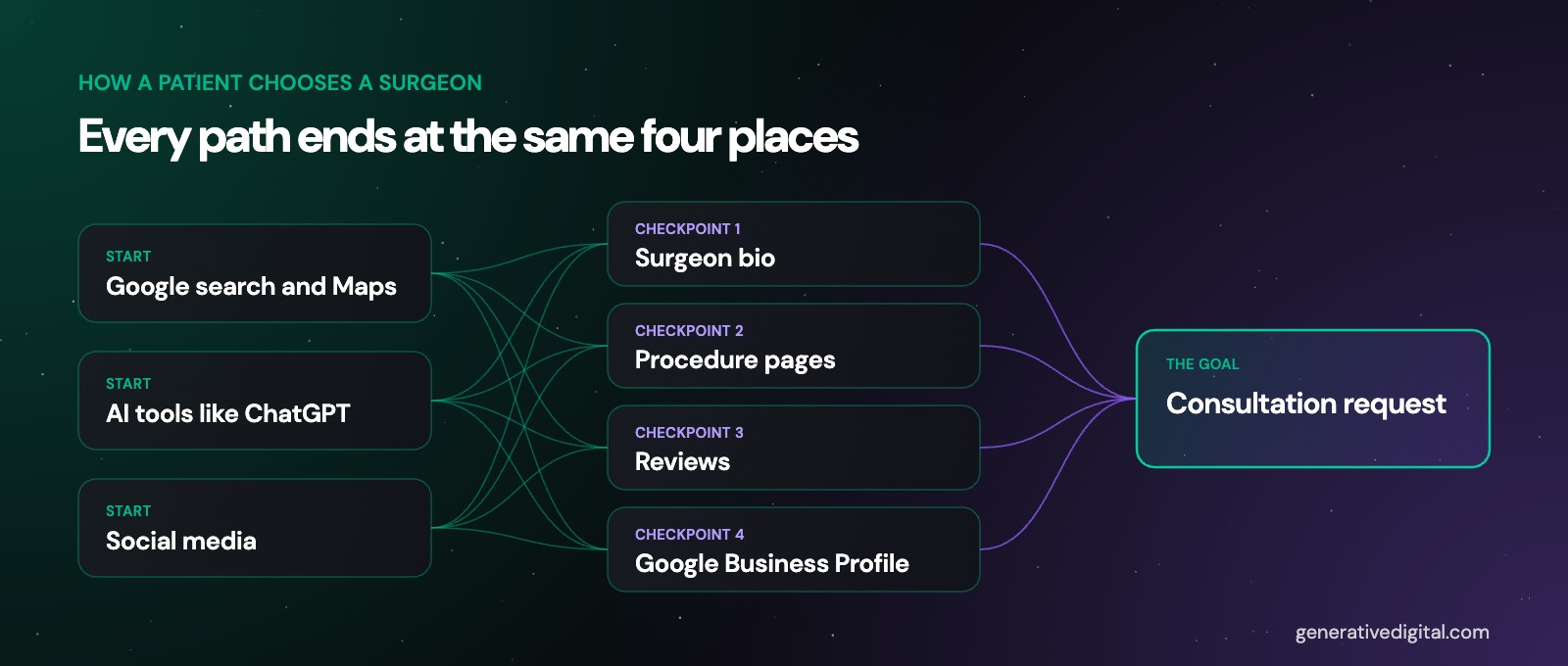
All three paths end at the same places: your surgeon bio, your procedure pages, your reviews and your Google Business Profile. That is where a practice wins or loses prospective patients.
Our plastic surgery marketing services
Generative Digital sells SEO, AI search optimization, paid search and websites. For plastic surgery practices, that work usually covers the five areas below, matched to the plastic surgery services you offer. You can see our full list of services too.
Every plan starts from your procedures, your surgeons, your market and your goals. It is built for your practice, not a package with your logo swapped in.
Local SEO and your Google Business Profile
Local SEO decides whether you show up on the map. We set up and clean up your Google Business Profile so your name, address, hours, categories and services are correct and match your website.
Google’s own rules matter here. Google says your business name should reflect your real-world name. It allows one profile per location. It also treats doctors as individual practitioners, who can have their own profile when patients can reach them directly at that location. For a group with several surgeons or two offices, getting this structure right is a big part of the local SEO work. Our guide to med spa SEO covers the same profile rules in more depth.
We also look at reputation management: how you ask for reviews, how fast you reply, and how you reply without sharing anything private.
Plastic surgery websites built around procedures
Many plastic surgery websites list every procedure on one or two pages. That makes it hard to rank for any of them. We plan one clear page for each main procedure, such as breast augmentation, eyelid surgery, rhinoplasty and facelift, plus one for each surgeon.
Each procedure page answers what a patient actually asks: what the procedure is, who it may suit, what the consultation involves, and what recovery usually looks like. Clinical details come from your surgeons, and nothing clinical goes live until your team has reviewed it.
We handle the website development side too: page speed, mobile layout, clear navigation and a consultation form that is easy to find. Good web design for a plastic surgeon is not only about looking polished. It is about making the next step obvious.
Showing up in AI search
AI tools pull short, clear passages from websites they can read and trust. Google says there are no additional requirements to appear in AI Overviews or AI Mode, so strong SEO comes first. Google also says both features may run several related searches across subtopics before writing an answer, which it calls query fan-out. Covering each question a patient asks gives those searches more to find.
We write procedure pages so key passages make sense when quoted on their own, keep your practice details consistent across the web, and check how often AI tools name your practice for real patient questions. Our guide to answer engine optimization explains the method in depth.
Google Ads for consultation requests
Google Ads puts your practice at the top of the page while organic traffic builds. We plan paid ads around procedures with clear demand, send each ad to a matching landing page, and track consultation requests, not just clicks.
Advertising for medical procedures comes with limits. Google restricts prescription drug terms in ads, landing pages and keywords. In the US, advertisers may use those terms in ads and landing pages in line with local law, but must be certified to target them as keywords. That can affect how practices that also offer non-surgical cosmetic procedures, such as injectables, advertise. Our guide to Botox and dermal filler marketing goes deeper. We plan around those limits from the start.
Tracking from first click to consultation
Without tracking, many practices only know that the phone rang. We set up analytics and conversion tracking so you can see which channel brought in each form fill and call. That lets you judge lead quality and put more budget behind what brings in real consultations.
Plastic surgery SEO: what it takes to rank
Plastic surgery SEO is search engine optimization for a practice that sells surgery. The basics are the same as any local business. The bar is higher, because health topics get extra scrutiny.
Google calls topics that could significantly affect a person’s health “Your Money or Your Life” topics. It says its systems give extra weight to content with strong experience, expertise, authoritativeness and trust on those topics, and that trust matters most. For a plastic surgery practice, that shapes the SEO strategy:
- Surgeon pages that show real credentials. Training, board certification and memberships, listed exactly as the certifying body states them and checked by your team.
- Plastic surgery content written for patients. Well written content that answers real questions in plain words, reviewed by the surgeon whose name is on it.
- Technical SEO. Fast pages, clean HTML markup, clear title tags, structured data, and photo galleries that load quickly and carry useful alt text instead of text locked inside static images.
- Local SEO for every office. A Google Business Profile for each location, with the right surgeons attached.
- A clean link profile. Mentions from real directories, professional organizations and local press, never bought links.
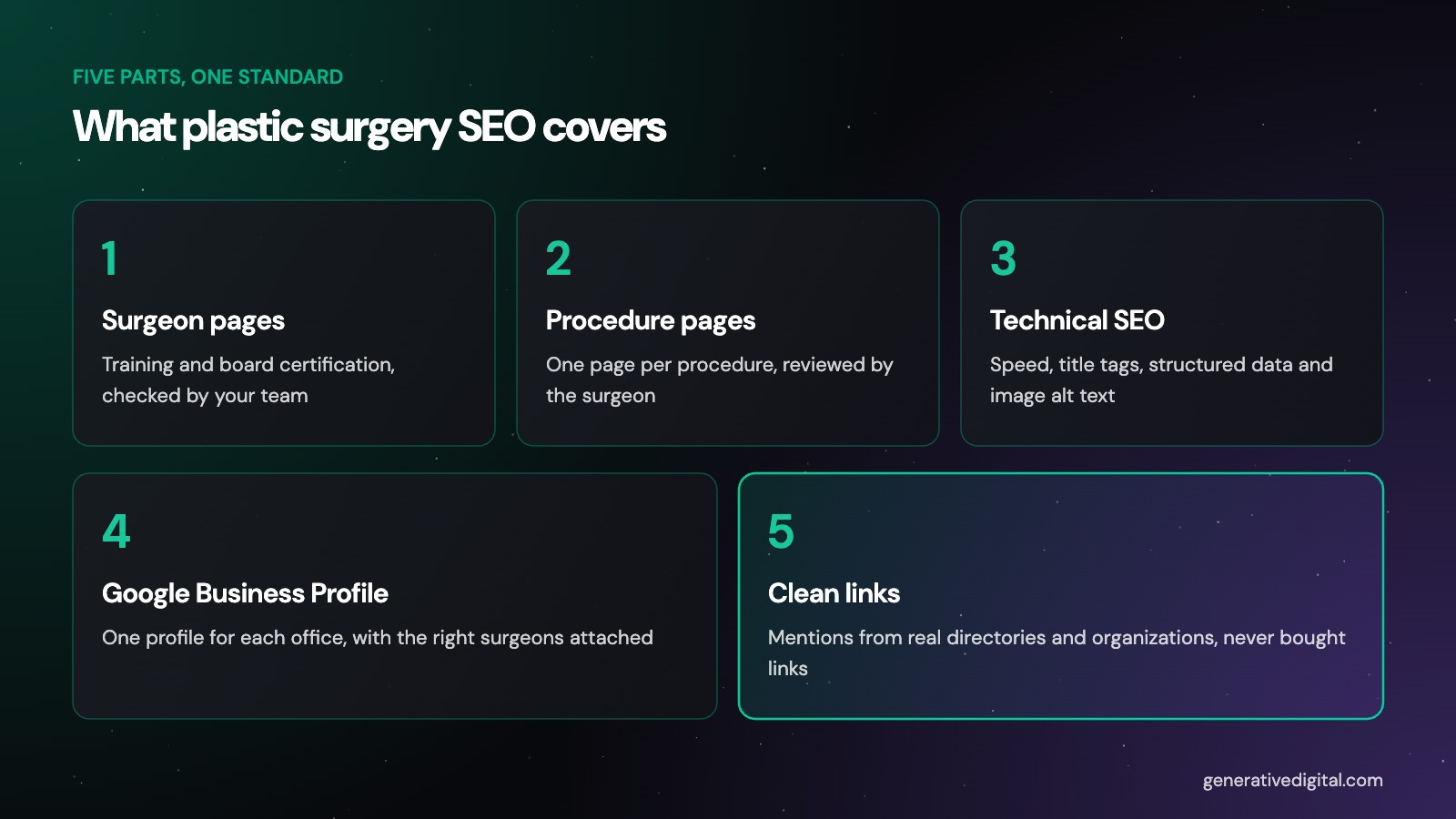
Good SEO for plastic surgeons is steady work, not a trick. It compounds as each page earns its place.
The rules that shape plastic surgery advertising
Plastic surgery marketing is medical marketing, not regular local marketing with beauty words added. Surgery carries real medical risk, so the rules on claims, photos, reviews and patient privacy are stricter. Here is what matters most.
- Patient stories and photos set expectations. The FTC’s Endorsement Guides say an ad that features a customer’s experience is likely to be read as showing what people will generally achieve. If the advertiser cannot back that up, the ad should clearly disclose the generally expected results. A small “results may vary” note does not fix a misleading overall impression.
- Patient photos can be protected health information. HHS lists full-face photographs and comparable images among the identifiers in health information. For practices covered by HIPAA, the Privacy Rule requires a patient’s written authorization before their protected health information is used for marketing, with narrow exceptions. Before and after galleries should have a signed authorization on file for every patient shown.
- Reviews must be real. The FTC’s rule on consumer reviews and testimonials went into effect on October 21, 2024. It bans fake reviews, including AI-generated ones, paying for reviews that must say something positive or negative, and using groundless threats to remove bad ones. Asking all of your patients for reviews is allowed.
- Review replies can expose patient information. A dental practice paid $23,000 to settle with the US Department of Health and Human Services after its replies to online reviews disclosed patient information. We help your team reply in a way that shares nothing about anyone’s care.
- State medical boards set their own rules. The Federation of State Medical Boards’ model practice act lists a false or misleading statement about a physician’s skill, or about how well a treatment works, as grounds for discipline. Each state board writes and enforces its own rules, and they can reach your website, not just your ads.
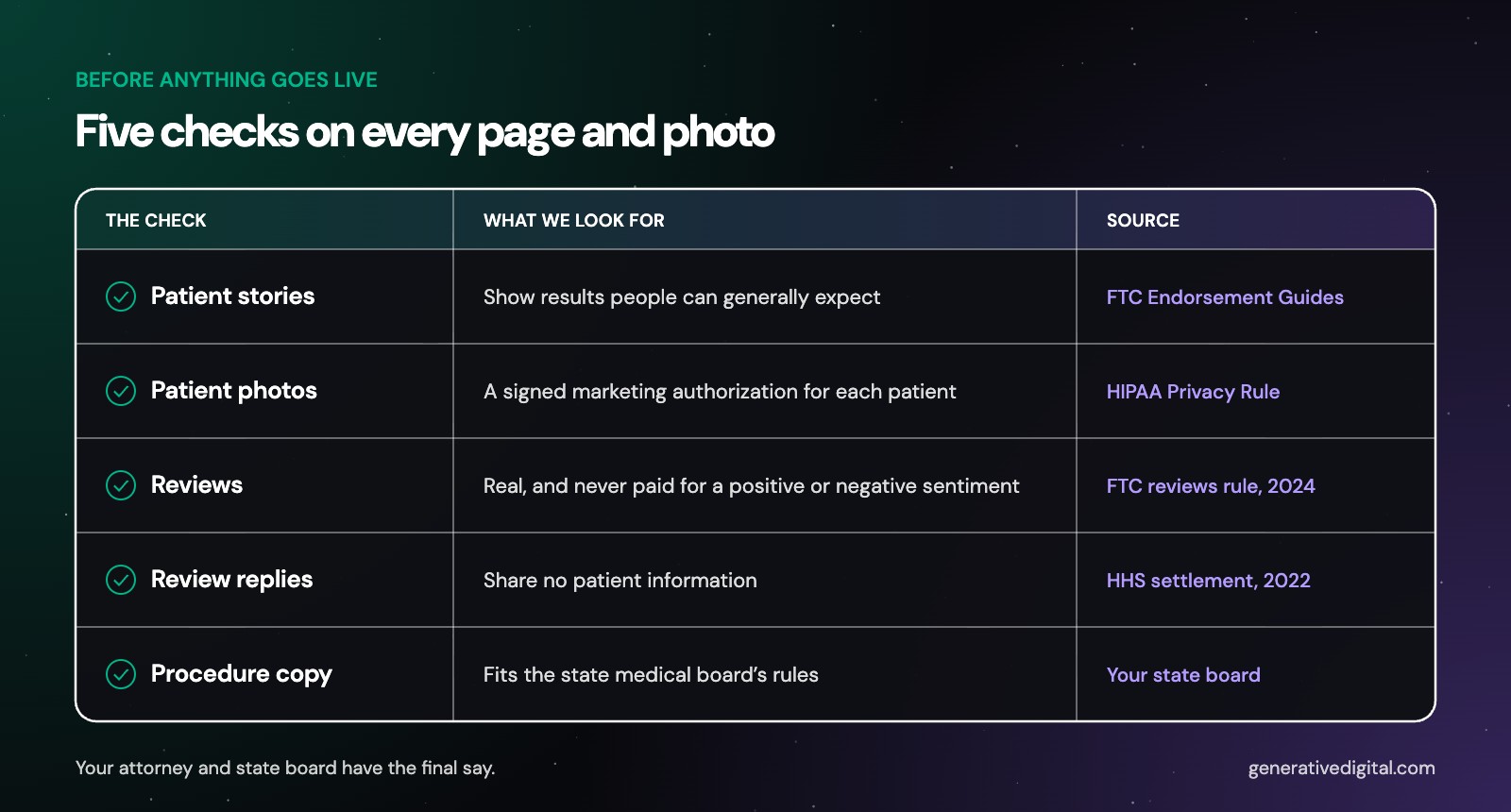
Your attorney, your malpractice carrier and your state board decide what you may publish. Our job is to build marketing that performs well inside those limits, and to flag anything that looks risky before it goes live.
Social media and email: where they fit
A full marketing plan for a plastic surgery practice often includes channels we do not run. We would rather say so up front.
Social media marketing.
Posts and video content keep your practice in front of past and future patients. That is a different job from search. We focus on the searches that happen after someone sees you on social media, so they land on a strong website.
Email marketing.
Email keeps past patients informed and builds loyal patients over time. Many practices run it through their patient management software. We do not run it, but we make sure your tracking can show when a website lead becomes a consultation, as far as your systems allow.
How to choose a plastic surgery marketing agency
Whichever marketing agency you pick, ask these questions first:
- Who does the work? Find out whether the person you meet is the person who builds your pages and runs your ads.
- What do they track? Ask how they report consultation requests, not just traffic.
- How do they handle claims and photos? An agency that writes “guaranteed results” in procedure copy, or posts patient photos without a signed authorization, is putting your license at risk.
- Do they understand AI search? Ask how they check whether ChatGPT and Google AI Overviews name your practice.
- What happens to your accounts if you leave? Your Google Business Profile, ads account and analytics should be in your name.
Generative Digital is a single-operator practice. The person who audits your site is the person who does the work and answers your email.
For our wider take on AI search, see our AI SEO agency page.
months
What to expect
Digital marketing for plastic surgeons is not instant. As a general guide, measurable movement in search takes about three to four months. Plastic surgery is a competitive market, so practices in crowded areas, and newer websites, usually take longer.
Google Ads can bring in consultation requests sooner, because ads show as soon as they are approved.
No one can guarantee that Google, ChatGPT or any AI tool will name your practice. What we can promise is clear work, honest reporting and a straight answer about what is moving.
Frequently asked questions
What does plastic surgery marketing include?
It usually includes local SEO and your Google Business Profile, a website with one page per procedure and per surgeon, content written to be quoted in AI answers, Google Ads sent to matching landing pages, and tracking that shows which channel brings in consultation requests.
How much does plastic surgery SEO cost?
It depends on your market, how many procedures and locations you have, and the state of your website today. The fairest way to price it is to look at your site first. Our free digital audit is a good place to start that conversation.
Can you guarantee first page rankings?
No. Google and AI tools decide what to show, and no agency controls that. We focus on fixing what keeps your practice from being found and contacted, and we report honestly on what changes.
Can we use before and after photos in our marketing?
Often, yes, with care. Each patient shown should sign a written authorization for marketing use, and the photos should not suggest results most patients would not get. Your attorney and your state board have the final say.
Do you work with plastic surgery practices across the US?
Yes. Generative Digital works with businesses across the US. Local SEO is about where your patients are, so the work does not depend on where we are.
See where your practice stands today
The easiest first step is a clear look at how patients find your practice now. Our free digital audit reviews your website, your index status and how AI tools see your practice, then shows you what to fix first. It costs nothing, and most audits come back within 48 hours.
Get a free digital auditWorking with businesses across the US
© 2026 Generative Digital LLC