Botox marketing: how med spas promote injectables and fillers the right way
Botox marketing means helping patients find your practice when they look up wrinkle relaxer injections or dermal fillers, then giving them an honest page to book a consult from. It covers your treatment pages, your Google Ads, your photos and reviews, and the way AI tools describe your injectables. Botox and other botulinum toxin products are prescription drugs, and dermal fillers are medical devices, so the rules run tighter than they do for most other cosmetic treatments. This guide explains those rules in plain language and shows what good marketing looks like inside them.
Think of an injectables page as a friendly front desk with a pharmacy label taped to it. The front desk makes a nervous first-time patient feel welcome. The label has to be exactly right, every single time. Good Botox marketing does both jobs at once.
It sits under our med spa marketing page, the hub for search, Google Ads and tracking across the whole practice. Here we stay on neurotoxins and fillers. For the search basics every treatment shares, such as your Google Business Profile and reviews, see our med spa SEO guide.
What is Botox marketing, and why is it different from other med spa marketing?
Botox is one brand of botulinum toxin. Many patients use the word for the whole category. So when owners talk about Botox marketing, they usually mean marketing every wrinkle relaxer injection they offer.
Dermal filler marketing is the close cousin. Fillers are a separate group of products that the FDA approves as medical device implants.
Injectables differ from other cosmetic treatments, such as a facial or a laser hair removal package, in three ways:
The products are regulated.
Each product is approved for specific uses, and federal law requires providers to buy prescription drugs only from authorized sources.
Ad platforms treat drug names differently.
Google has its own policy for prescription drug terms, and it changes how you can bid on searches that name a product. Weight loss programs run into the same policy, covered in our guide to weight loss marketing.
Patients often come back.
Many injectable treatments are repeat visits, on a timing your provider sets. Keeping a patient matters as much as finding a new one.
Who sets the rules for Botox and filler advertising?
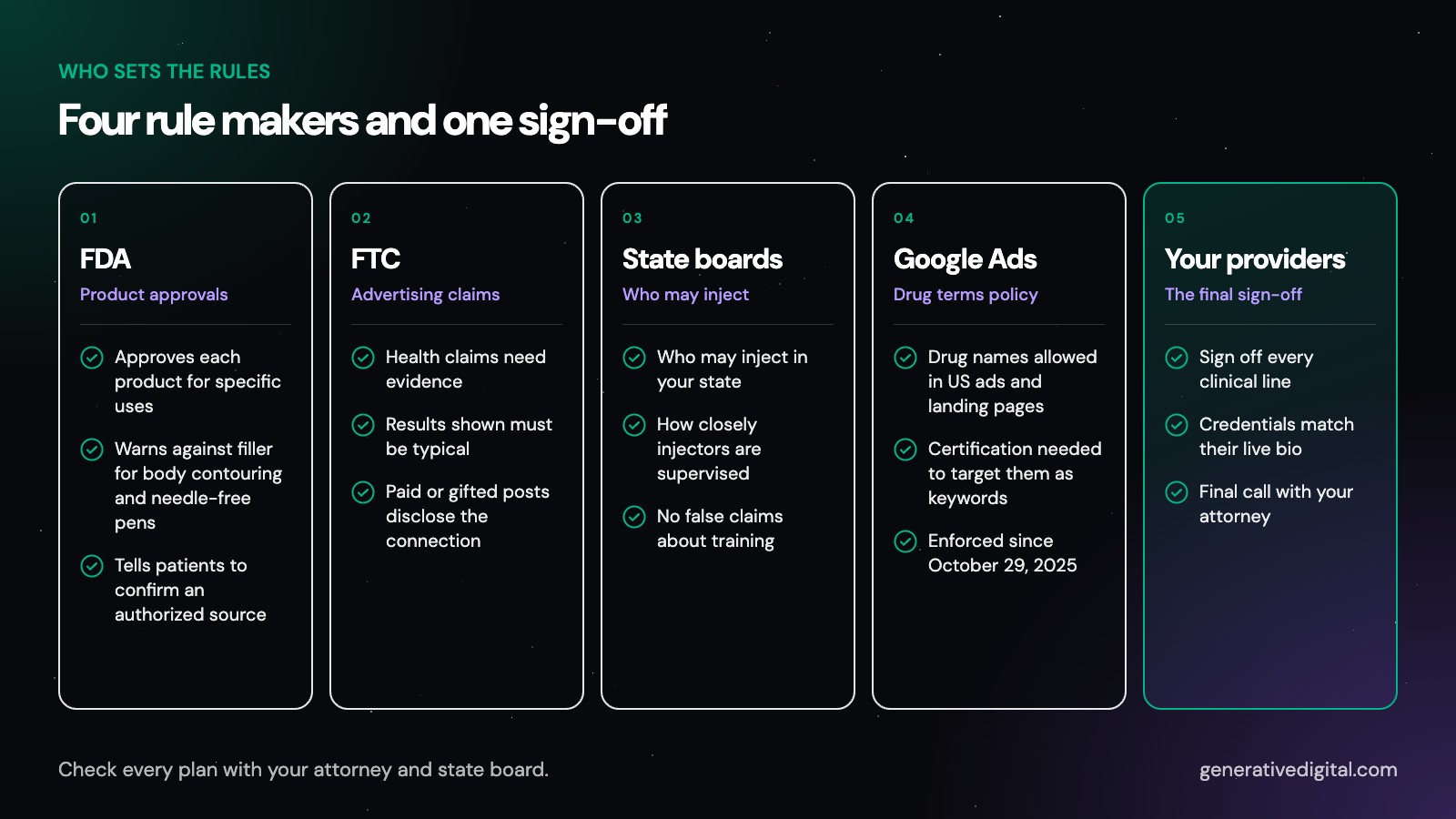
No single agency writes every rule. Three sets of regulators each own a piece, Google owns its ad rules, and your own providers have the last word on anything clinical.
What does the FDA cover?
The FDA approves botulinum toxin products and dermal fillers, each for specific uses. Its page on dermal fillers lists approved uses such as adding volume to the lips, cheeks, chin and back of the hand, in adults 22 years of age or older. The same page recommends against using any injectable filler to enlarge the breasts or buttocks, and it says needle-free devices are not approved for injecting fillers. A treatment page should never market a use the FDA warns against.
The FDA has also warned about fake and unapproved botulinum toxin. In April 2024 it reported counterfeit versions of Botox in multiple states, along with adverse events linked to them. In November 2025 it sent 18 warning letters to websites that were illegally selling unapproved and misbranded botulinum toxin products. Its advice to patients is to confirm the product comes from an authorized source and to ask whether the person injecting is licensed and trained. Both patients and healthcare professionals are asked to report adverse events to the FDA’s MedWatch program.
The FDA’s own advertising rules for prescription drugs are written around the ads that drug companies create. For a practice promoting its own services, the FTC’s truth-in-advertising rules and your state’s rules are the ones to plan around. Your attorney should confirm which ones apply to you.
What does the FTC cover?
The FTC’s guidance on health products says health-related claims generally need competent and reliable scientific evidence behind them. It defines advertising broadly, including social media and influencer marketing, so a social media caption is held to the same standard as a printed ad.
Two parts of that guidance shape injectables marketing most:
- Typical results. A patient story that shows results more dramatic than most patients can expect is likely deceptive, and a “results not typical” line does not fix it. The FTC wants a clear statement of what a typical patient can actually expect.
- Paid or gifted posts. The FTC’s guidance for influencers says a post should make the relationship obvious when there is a material connection, such as payment, free or discounted products, or a family or work relationship. A free treatment given to a local creator counts.
What do state boards cover?
Who may inject, and how closely they must be supervised, depends on your state. A 2024 review in the journal Dermatologic Surgery found that state rules on supervision at medical spas vary widely from one state to another. State medical boards also discipline false claims about a provider’s training, which is why every credential on your site should be copied word for word from the provider’s own live bio. Fellowship-trained is never written as board-certified.
Before you plan an event, a promotion or a new ad, check it with your state board’s rules and your attorney. They, along with your malpractice carrier, decide what you may publish.
Can you run Google Ads for Botox and dermal fillers?
Yes, with limits. Botox is a prescription drug name, so it falls under Google’s restricted drug terms policy.
Google’s October 2025 update says US advertisers may use prescription drug terms for promotional purposes in line with local laws, and do not need to be certified to use them in ad text and on landing pages. Keyword targeting is the exception. Bidding on those terms as keywords requires certification. Google began enforcing that update on October 29, 2025.
What that means for a practice:
- Ask Google before you bid on drug names. The policy does not spell out which certification an in-office practice needs, so confirm it with Google Ads support before launch.
- Build campaigns around treatments and consults. Searches for wrinkle relaxer injections, dermal filler injections or a consult with an injector can carry a campaign while any certification is pending.
- Send each ad to its matching treatment page, never to your homepage.
- Count form fills, not clicks. Mark each consult request as a key event in Google Analytics, then compare the search terms that bring in patients seeking a real appointment.
Generative Digital runs paid search, and we set these limits into the campaign plan before the first ad goes live.
Should your pages say “Botox” or name the treatment type?
Both, with care. Patients type “Botox” into search, so the word belongs on your site when it is a product your practice actually uses. Three rules keep it honest:
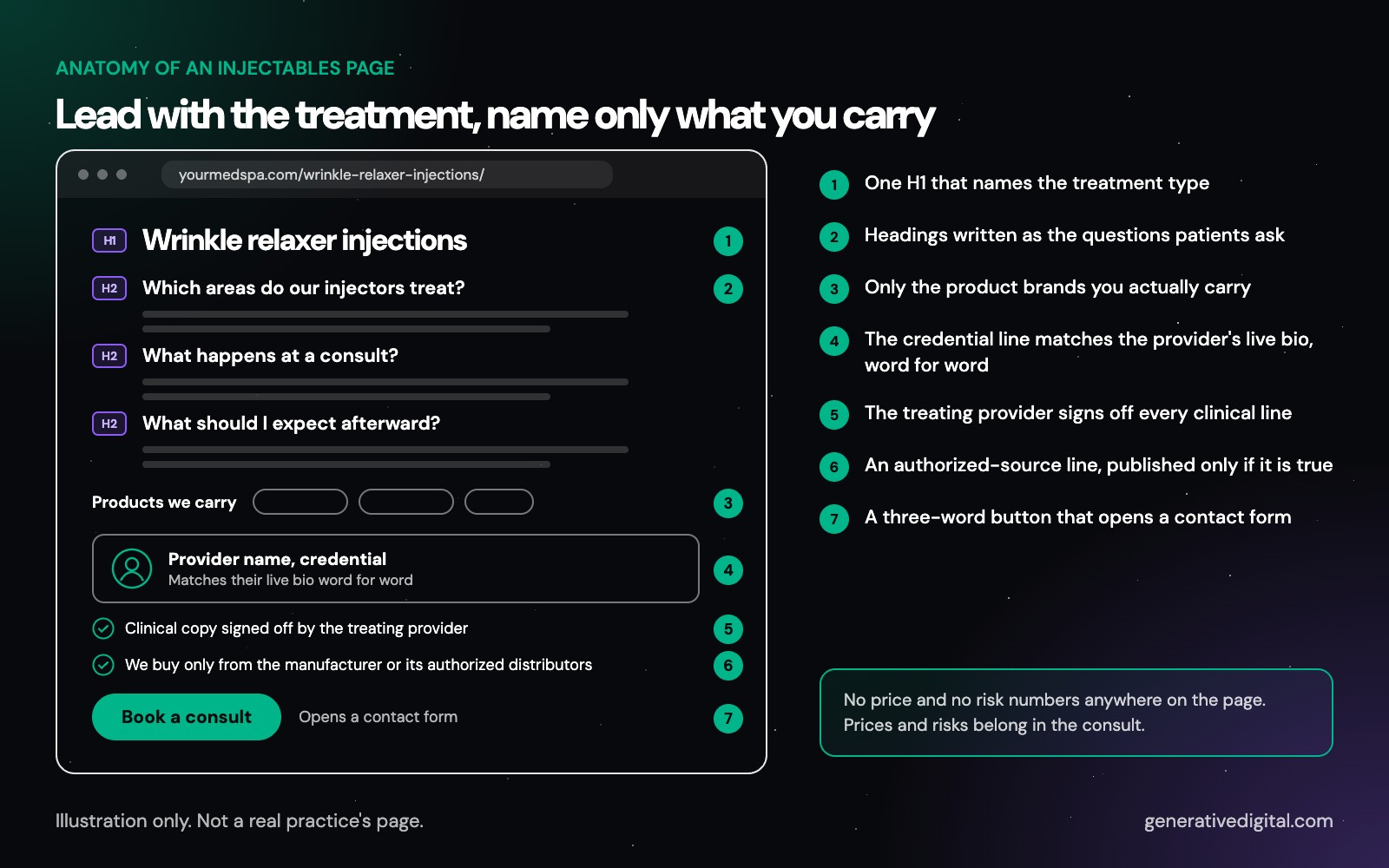
- Lead with the treatment type. Put “wrinkle relaxer injections” or “botulinum toxin injections” in the H1, and name the product brands you carry inside the page. The page keeps working when you add or switch a product.
- Name only what you use. A page that names a product you do not carry misleads the patient who booked because of it.
- Use plain words for the technique. “Hyaluronic acid filler” tells a patient more than a product code, and it reads cleanly when an AI tool quotes it.
What should a Botox or dermal filler treatment page include?
Give each main injectable its own page. One page for wrinkle relaxers and one for fillers is the minimum. A practice that offers lip augmentation and cheek filler as separate services can give each one its own page as well.
How should an injectables page be structured?
- One H1 that names the treatment type.
- Question headings that match what patients ask: what the treatment is, which areas your providers treat, what happens at a consult and what to expect afterward.
- A provider block with each injector’s name and credentials, copied from their live bio.
- Approach language, not promises. Describe how your practice works in most cases. Never write “guaranteed”, “permanent” or “painless”.
- A “Book a consult” button that opens a contact form, with your phone number nearby for patients who would rather call.
- No prices and no risk or complication numbers. Those belong in the consult.
Which claims need provider sign-off?
Every clinical line. How a product works, which areas it is used for, how long results tend to last and what recovery looks like all need sign-off from the treating provider before the page goes live.
A plainly generic example of approach language: “In most cases, our injectors start with a conservative amount and review it with you at a follow-up visit.” Even that sentence should only go live if your providers confirm it describes how they work.
Should the page say where your products come from?
Often, yes. The FDA tells patients to confirm with their provider that the product comes from an authorized source. A short line such as “We buy our injectables only from the manufacturer or its authorized distributors” answers that question before a patient has to ask it. It is a patient safety question as much as a marketing one. Publish the line only if it is true and your practice confirms it.
How is dermal filler marketing different from Botox marketing?
Dermal filler marketing follows the same honesty rules, with three differences worth planning for:
- Approved uses are tied to areas of the face and hand. Your pages and ads should stay inside the areas your providers treat and the FDA has approved.
- Age matters. The FDA’s approval covers adults 22 and older, so keep filler ads, content and targeting aimed at adults.
- Some requests should never be marketed. Filler for body contouring and needle-free “pen” injections are on the FDA’s list of things to avoid. If a trend video makes them popular, your page is a good place to explain why your practice does not offer them.
Lip augmentation is a common candidate for its own page. Check your own search terms before you build it.
Which Botox marketing ideas are worth your time?
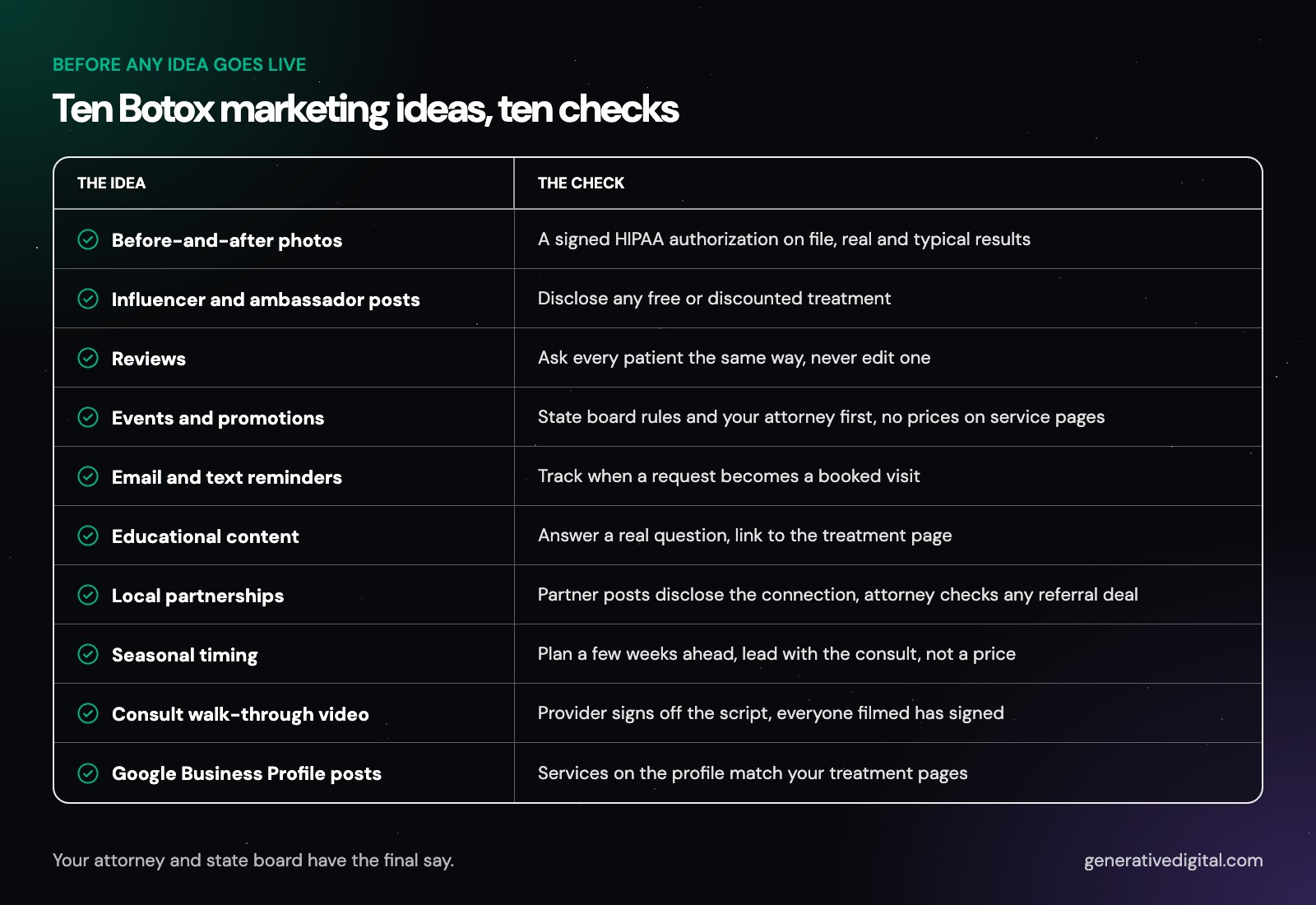
Most lists of Botox marketing ideas repeat the same handful. Here are ten, each with the check that keeps it inside the rules.
Before-and-after photos
Our position is that no patient photo goes on your site or social media platforms without a signed HIPAA authorization on file. Use real, unedited photos that show typical results.
Influencers and patient ambassadors
Any free or discounted treatment is a material connection. The post should say so in plain words.
Reviews
Ask every patient the same way, never edit or touch a review, and draft replies for the practice to approve.
Events and promotions
Check the format with your state board’s rules and your attorney first, and keep promotional prices off your service pages.
Email and text reminders
Useful for repeat visits. We do not run email or SMS, but we make sure your tracking shows when a website request turns into a booked visit.
Educational content
Answer the questions people ask before a first visit, then link back to the treatment page where they can book.
Local partnerships
A nearby salon, bridal shop or gym can share your consult card or co-host an event. A free treatment given to a partner is a material connection, so their posts disclose it, and any referral arrangement gets checked with your attorney first.
Seasonal timing
Patients plan around weddings, holidays and summer. Refresh your treatment pages and set ad budgets a few weeks ahead of those dates, and keep the offer about the consult rather than a price.
A consult walk-through video
A short video of what happens at a first consult answers a nervous patient’s questions before they call. Your provider signs off the script, and anyone filmed has signed an authorization.
Google Business Profile posts
Post a short update when you add a treatment or a provider, and keep the services on your profile identical to your treatment pages.
How do injectables show up in Google search and AI answers?
Google says there are no extra requirements or special optimizations needed to appear in its AI Overviews or AI Mode. A page that is indexed and eligible for a snippet in regular search is eligible there too. So the ranking work and the AI work start from the same place.
Injectables do bring their own set of questions. People ask AI tools whether a treatment is safe, how long fillers last and how to choose an injector. A page that answers those questions in short, provider-approved passages gives AI tools something accurate to quote. Three more habits help:
- Keep your product list identical everywhere. Your treatment pages, your Google Business Profile services and your schema markup should list the same injectables, and only the ones you offer.
- Keep provider details identical too. The same name and the same credential wording on every page and listing.
- Run the same patient questions through AI tools every month and note whether your practice is named.
The full method is in our guide to answer engine optimization. Plastic surgeons and dermatologists who offer injectables face the same questions, so the same approach carries over to plastic surgery practices and dermatology practices.
How do you know if your Botox marketing is working?
Rankings are only a first sign. The numbers that matter are consult requests and booked visits. A simple setup:
- Form fills as key events in Google Analytics, by page and by channel.
- Calls from the website and from Google Ads, tracked separately.
- Visits from AI tools, reported as their own group where each platform allows it.
- Booked consults matched back to the source, to the extent your booking system and front desk can report it.
Repeat visits are your practice’s own data. We do not guess at them, and we never report a number we have not measured.
months
When should you expect to see movement?
Search takes time. Expect three to four months, as a general guide, before rankings and consult requests from search move in a way you can measure. A crowded local market or a young website adds to that. Paid search can bring in consult requests sooner, once your ads and any certification Google requires are approved.
Nobody controls whether Google or an AI tool shows your practice for a given search, so be wary of anyone who promises it. What we can promise is careful work, honest reporting and a plain answer about what is moving.
What else do practices ask about Botox and filler marketing?
Is it illegal to advertise Botox treatments?
In general, no. Many practices advertise botulinum toxin treatments. The rules decide how: claims must be truthful and backed by evidence, Google limits keyword targeting on drug names, and your state decides who may inject. For your own practice, the final call belongs to your attorney and your state board.
Can I use the word Botox in Google Ads?
In the US, Google’s policy since October 2025 lets advertisers use prescription drug terms in ads and on landing pages for promotional purposes, in line with local laws. Targeting those terms as keywords requires certification. Confirm what your account needs with Google before you bid.
Can I post before-and-after photos of filler patients?
Only with the patient’s signed HIPAA authorization on file. That is our position for every patient photo. Use real, unedited photos that show results a typical patient can expect.
Should I put injectable prices on my website?
We advise against prices on service pages. Prices change, they depend on the patient, and the consult is the right place for that conversation.
How long does Botox marketing take to work?
Three to four months is a fair general guide for search to show measurable movement. Paid search can bring in consult requests sooner, once ads and any required certification are approved.
See where your injectables pages stand today
Whether you run a med spa or another aesthetic practice, the fastest way to know what to fix is to look. Our free digital audit reviews your website, your index status and how AI tools see your med spa, then shows you what to fix first. It costs nothing, and most audits come back within 48 hours.
Get startedWorking with businesses across the US
© 2026 Generative Digital LLC