Med spa SEO: how med spas get found on Google and in AI answers
Med spa SEO is the work of helping people find your med spa when they search Google, check Google Maps or ask an AI tool like ChatGPT where to get a treatment, and then giving them a clear, honest page to book from. It covers your Google Business Profile, your treatment pages, your reviews, the technical health of your website and how AI tools read it. This guide walks med spa owners through each part, in plain language, with the rules that make a med spa different from other local businesses.
Think of your website as the front desk that never closes. A good front desk greets people fast, answers the obvious questions, gets every fact right and hands the visitor to the right person. Medical spa SEO is making sure Google and AI tools can find that front desk, and that it says only what your providers stand behind.
This guide is one part of our wider med spa marketing page, which covers digital marketing beyond search: Google Ads, tracking and how to judge an agency. Here we go deep on the search side.
What is med spa SEO, and how is it different from local SEO?
Med spa SEO, also called medical spa SEO, is search engine optimization for a medical spa. It uses the same local SEO basics as any business with a storefront: an accurate Google Business Profile, a fast website, clear service pages and real online reviews. The difference is what sits on top of those basics.
A med spa sells medical treatments. That changes four things:
Claims carry rules.
Treatment copy is medical advertising. What you say about results has to stay inside what your providers can support.
Credentials have to be exact.
Patients, search engines and AI tools all check who performs a treatment. A credential that is close but not exact is a problem.
Locations have to be real.
Google lists you where you actually see patients, and nowhere else.
Patient privacy reaches into marketing.
Reviews, replies and before-and-after photos all touch patient information.
Why does search matter so much for a med spa?
People who search for a treatment usually have a reason to act soon. A search such as “laser hair removal near me” or “best med spa near me” shows a map with a few businesses first, then the regular search results, and more and more often an AI answer on top.
Google says its AI Overviews and AI Mode may use a technique it calls query fan-out, issuing several related searches across subtopics before it writes an answer. So one question about a chemical peel can turn into searches about what it involves, who performs it and how to prepare. A med spa with a clear page for each of those questions gives those searches something to find.
Organic search also keeps working between campaigns. Paid ads stop the day the budget stops. Organic traffic from a strong treatment page that ranks in the search results keeps arriving, which is why many med spas run both.
How do you set up a Google Business Profile for a med spa?
Your Google Business Profile is the listing that shows on Google Maps and in local search results. For many med spas it is the most visible listing they have, so Google Business Profile optimization comes first.
Which name and address should the profile use?
Google says your business name should reflect your real-world name, as used on your storefront, website and stationery. Google’s own examples leave service details and location details out of the name, so keep treatment words and place names out of yours.
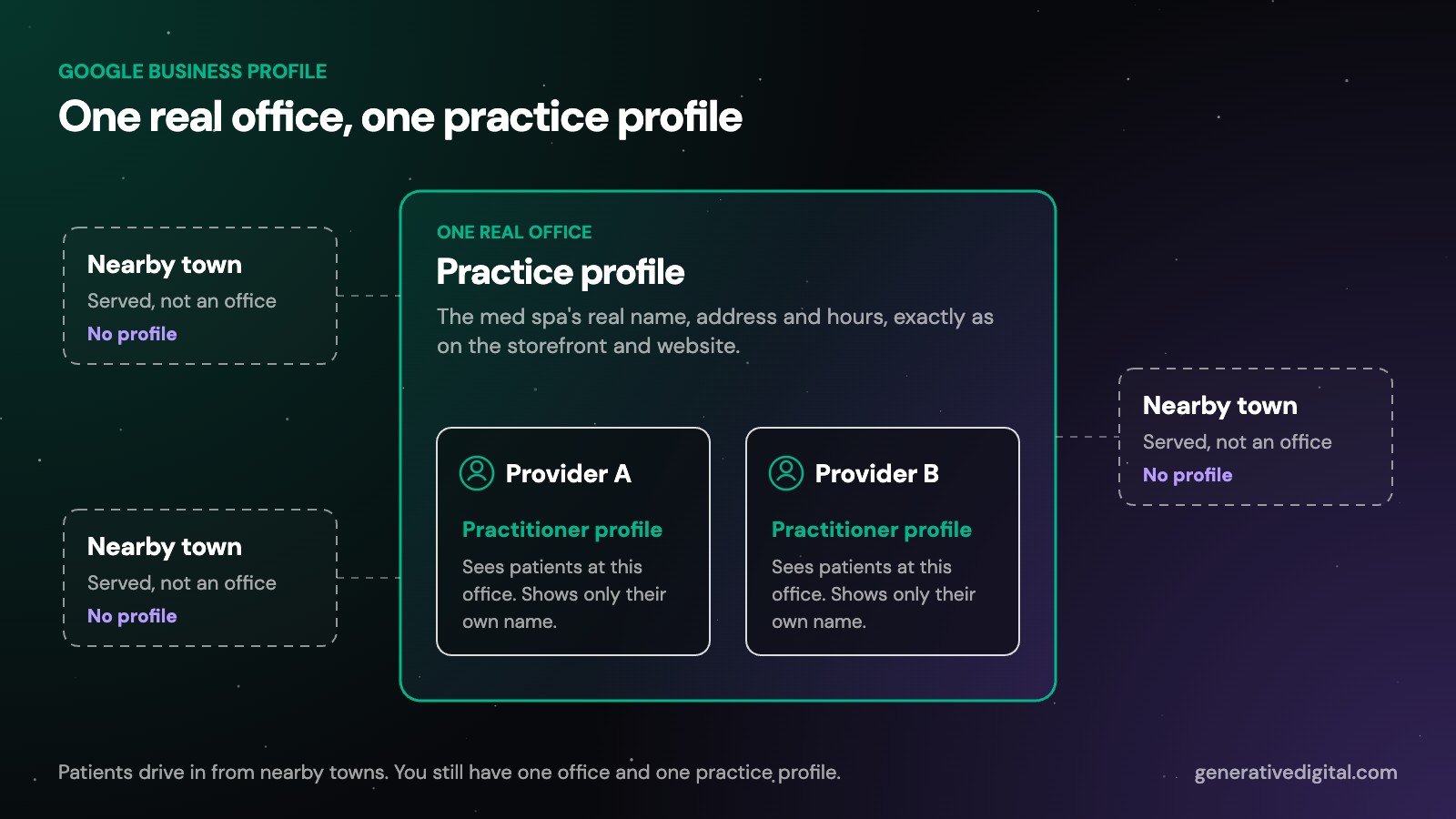
Google also says to create your profile for your actual, real-world location. A rented mailing address where you do not operate, which Google calls a virtual office, is not eligible. That leads to the most important location rule in med spa SEO: never claim an office in a city you only serve. If patients drive in from three nearby towns, you still have one office and one profile, not four.
Should each provider have their own profile?
Sometimes. Google treats doctors as individual practitioners. A practitioner can have their own profile if they are public facing and can be reached directly at that location during stated hours. When several practitioners share one location, Google says the organization should have its own profile, separate from theirs, and each practitioner’s profile should carry only their name.
For a single location med spa with one medical director, that usually means one profile for the med spa and, if it fits, one for the director. For multi location practices it means mapping every provider to the office where they actually see patients.
What should a med spa treatment page include?
Treatment pages are where med spa SEO wins or loses. One page that lists every treatment rarely ranks for any of them. One clear page per main treatment, such as laser hair removal, dermal fillers, chemical peels and other laser treatments, gives each one a real chance. Injectables carry extra rules, covered in our Botox marketing guide. Laser and body contouring clinics can also read our guide to body contouring marketing.
Keyword research tells you how patients phrase things. Long tail keywords, the longer and more specific searches like “how many laser hair removal sessions do I need”, are often the questions a treatment page should answer directly.
How should a treatment page be structured?
Use the same structure on every treatment page:
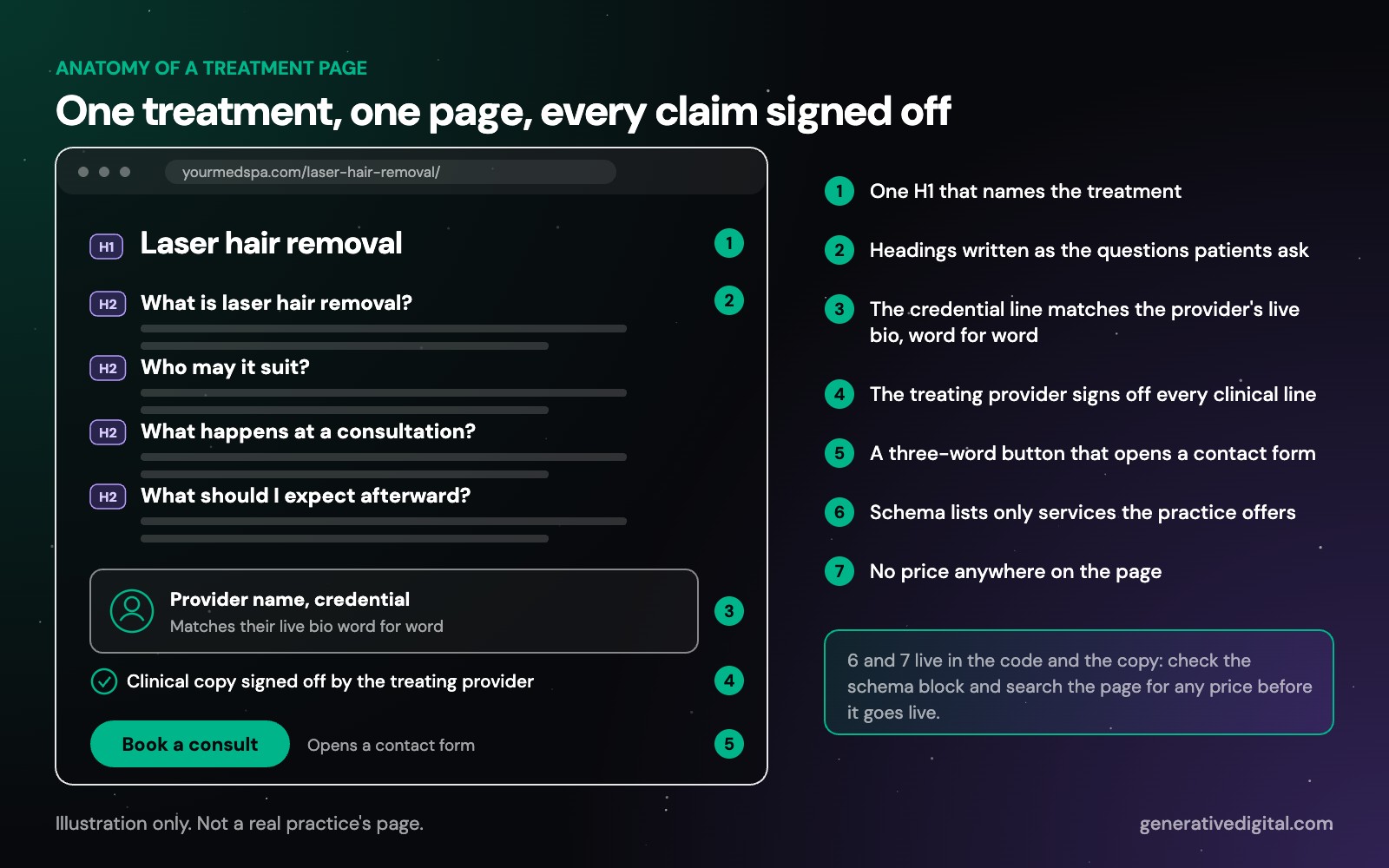
- Exactly one H1 that names the treatment.
- Headings written as questions patients actually ask: what the treatment is, who it may suit, what a consultation involves and what to expect afterward.
- No skipped heading levels. An H2 is followed by H3s, never straight to an H4.
- No “Key Takeaways” box. Answer the question in the first lines under each heading instead.
- Plain language. Name the technique, not the device brand. A page about a technique still works when you replace the machine.
- No prices on service pages. Pricing changes, varies by patient and is better handled at the consultation.
Who signs off on clinical claims?
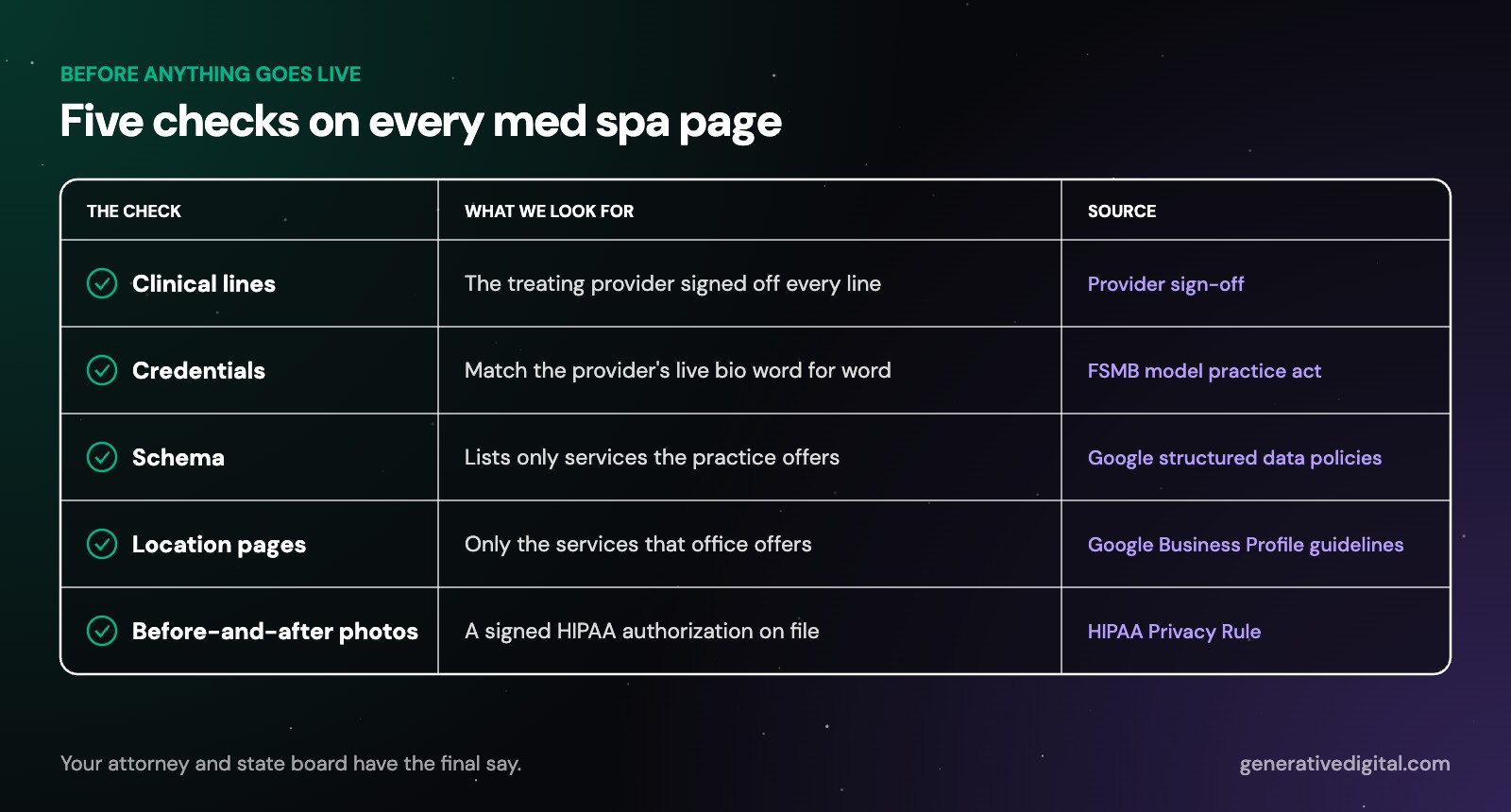
Your providers do. Anything clinical on a treatment page, such as how a treatment works, who it may suit or what recovery looks like, needs sign-off from the treating provider before it goes live.
Write an approach as what your practice uses in most cases, never as a promise. “Our providers usually start with a consultation to see whether this approach suits you” is honest. A promise of a set result is not, and the FTC’s guidance on health products says testimonials that report results more dramatic than people can generally expect are likely to be deceptive, and that a “results not typical” note does not fix it.
Never publish complication or risk numbers in marketing copy. That conversation belongs with the provider.
Where should the booking button go?
Keep every button label to three words or fewer, such as “Book a consult” or “Get started”. Point the main button to a contact form. A form fill enters your CRM and can be tracked as a key event in Google Analytics, so you can see which page and channel brought the request in. Keep your phone number on the page too, for patients who would rather call.
How should med spa SEO handle credentials and schema markup?
Credentials are where small wording slips turn into real problems. The Federation of State Medical Boards’ model practice act lists claiming a specialty certification from a recognized certifying board that is not true as grounds for discipline. Our rules for every credential, in website copy and in schema:
- Match the provider’s own live bio word for word. If the bio says “fellowship-trained”, the page says “fellowship-trained”, never “board-certified”.
- Leave out any membership that is not on the bio.
- Update the bio first, then the pages, when a credential changes.
Schema markup is a small block of code that labels facts for search engines and AI tools. Google’s structured data policies say not to mark up content that is not visible to readers or that is misleading. For a med spa, that means the schema lists only services the practice actually offers, at the locations where it offers them, with provider details that match the visible page.
How do location pages work for a med spa with more than one office?
Location pages help each office show up in its own local market. They also create the easiest way to overstate what you offer. Two rules keep them honest:
- One location page per real office. A service area is not an office.
- Only the services that office offers. Never build a city page for a treatment that city’s office does not provide.
A single location med spa does not need location pages at all. Its homepage, contact page and Google Business Profile carry the location.
How should a med spa handle reviews and before-and-after photos?
Reputation management for a med spa comes down to two things: real reviews and careful replies.
- Ask every patient the same way. The FTC’s rule on consumer reviews and testimonials took effect October 21, 2024. It bans fake reviews, buying reviews that must say something positive or negative, and suppressing reviews. The FTC says the rule exempts generalized requests sent to all customers.
- Never edit or touch a patient’s review or testimonial. Not to fix a typo, not to shorten it.
- Draft replies for the practice to approve. A reply should thank the patient and share nothing about their care. HHS reached a $23,000 settlement with a dental practice whose replies to online reviews disclosed patient information.
Some guides talk about review velocity, meaning how fast new reviews come in. A steady, honest ask to every patient takes care of that and stays inside the rule.
Before-and-after photos need one more step. Our position is simple: no patient photo goes on the website without a signed HIPAA authorization on file. HHS says the HIPAA Privacy Rule requires authorization for all marketing uses of protected health information, with two narrow exceptions, and a recognizable patient photo is not worth the gamble.
What technical SEO does a med spa website need?
Technical fixes are the plumbing. Med spa websites usually need the same short list:
- Pages that search engines can index. Google says a page must be indexed and eligible to show with a snippet to appear as a supporting link in AI Overviews or AI Mode.
- A fast, steady mobile experience, since many patients search for treatments on a phone.
- Clear title tags and meta descriptions for each treatment page.
- Internal links from each treatment page to the related treatments and the providers who perform them.
- Photo galleries that load fast and carry useful alt text.
Our GEO audit checklist lays out the technical checks we run, step by step.
How do med spas show up in ChatGPT and Google AI Overviews?
Google says there are no additional requirements to appear in AI Overviews or AI Mode, so strong SEO is the foundation. On top of that:
- Write passages that stand on their own. AI tools quote a sentence or a paragraph, not a whole page.
- Keep your facts identical everywhere. Your name, address, hours, services and provider credentials should match on your website, your Google Business Profile and other sites that list you.
- Answer the questions patients ask AI tools, such as what a treatment involves and how to choose a provider, on the page for that treatment.
- Check, on a schedule, how often AI tools name your med spa for real patient questions.
Our guide to answer engine optimization explains the method in depth.
Where do blog posts and link building fit?
Treatment pages come first. Blog posts support them. A good content strategy for a med spa uses educational content to answer the questions that do not fit on a treatment page, then links back to the page where a patient can book. Creating content for its own sake, such as weekly posts with no question behind them, rarely helps. Email marketing keeps past clients coming back, but it does not help new clients find you in search, so treat it as a separate job.
Link building works the same way. The useful links come from other sites that already know you, such as local business groups, community event pages and the makers of products you carry. Skip any link scheme that promises a number of links for a fee.
Some SEO guides talk about an 80/20 rule, the idea that a small share of the work drives most of the results. For a med spa, that small share is usually the Google Business Profile, the main treatment pages and reviews.
Should you hire a med spa SEO company?
Hire help when no one on your team can keep the work going every month, or when the technical and AI search side needs more depth. Before you sign with anyone, run through the questions in our guide to choosing a med spa marketing agency.
Generative Digital is a single-operator practice. The person who audits your site is the person who does the work and answers your email.
We work with med spas and aesthetic practices across the US, including plastic surgery practices and dermatology practices.
months
When should you expect to see movement?
As a general guide, measurable movement in search takes about three to four months. Med spas in crowded markets, and newer websites, usually take longer. Paid ads such as Google Ads can bring in consultation requests sooner, because ads show as soon as they are approved.
No one can guarantee first page rankings or that any AI tool will name your med spa. A good monthly report shows you which pages, calls and form fills are moving, so you can judge the progress yourself.
What else do med spa owners ask about SEO?
What is med spa SEO?
Med spa SEO is search engine optimization for a medical spa. It helps your med spa show up in Google search, Google Maps and AI answers when people look for the treatments you offer, and it gives them an accurate page to book from.
How long does med spa SEO take to work?
As a general guide, plan on three to four months before you see measurable movement. Crowded markets and newer websites usually take longer.
Should a med spa start with SEO or Google Ads?
Many med spas run both. Google Ads can bring in requests soon after approval, while SEO builds over months and keeps working without paying for each click. Fix your Google Business Profile and main treatment pages first, because those pages often double as the landing pages your ads send people to.
Can a med spa do SEO in-house?
Yes, if someone on your team has the time and knows the rules. The basics, such as your Google Business Profile, asking every patient for reviews and one clear page per treatment, are within reach for many teams. An outside partner makes sense when no one has time to keep it going, or when the technical and AI search work needs more depth.
Can ChatGPT do SEO for my med spa?
It can help draft and organize ideas, but it cannot check a provider’s credentials against their bio, approve clinical claims or fix your Google Business Profile. Treat anything it writes as a first draft for your team to check.
See where your med spa stands today
The easiest first step is a clear look at how patients find your med spa now. Our free digital audit reviews your website, your index status and how AI tools see your med spa, then shows you what to fix first. It costs nothing, and most audits come back within 48 hours.
Get startedWorking with businesses across the US
© 2026 Generative Digital LLC