Body contouring and laser clinic marketing for Google, AI answers and ads
Body contouring marketing means helping people discover your laser or body contouring clinic, believe what your pages say, and ask for a consult, whether they start on Google, in Google Maps or by asking an AI tool like ChatGPT. Generative Digital builds body contouring and laser clinic marketing from four things we run ourselves: SEO, AI search, Google Ads and the website that ties them together. We work with laser and body contouring clinics across the US.
Choosing a laser clinic is a bit like choosing a gym. Nobody signs up for a series of sessions after one glance. People look at the equipment, ask who will be working with them, read what other members say, and want to know how many visits it takes before anything changes. Your website has to answer those questions before the patient ever walks through the door.
This guide sits under our med spa marketing page, which covers the questions every aesthetic practice should ask before hiring an agency. Here we stay on what is specific to lasers and body contouring: the words you can safely use, the limits on ads, and the months when demand rises and falls.
What is laser clinic marketing, and what makes it different?
Laser clinic marketing uses the same channels as any aesthetic practice. Three things set it apart:
Patients buy a series, not a single visit.
One of the first questions a patient asks is how many sessions they will need and how long the effect lasts. The FDA tells patients to ask exactly that, so your pages should help them ask it well.
The equipment changes.
Clinics add, upgrade and retire devices every few years. A page built around a technique, such as laser hair removal or fat freezing, keeps its value long after a single machine is gone.
The words carry weight.
“Permanent”, “FDA approved” and “weight loss” each mean something specific to a regulator or to Google. Picking the wrong one is the quickest way to get an ad rejected or a page questioned.
Generative Digital handles SEO, AI search optimization, Google Ads and websites. The full list is on our services page.
How do people choose a laser or body contouring clinic?
Most patients research for a while before they book. Along the way they tend to:
- Compare techniques. The FDA sorts non-invasive body contouring into cold-based methods such as cryolipolysis, often called fat freezing, heat-based methods such as radiofrequency, lasers, IPL and ultrasound, and non-thermal methods. Patients search with those same words, so your pages should too.
- Ask about sessions and staying power. How many visits, how far apart, and how long the change lasts. These are clinical answers, so they come from your providers.
- Check who holds the device. Patients want to know the person treating them is trained and allowed to do it.
- Look for proof. Reviews, photos and the provider’s own background carry a lot of weight.
- Confirm the office near them has the treatment. A clinic with several offices may not have the same equipment in every one.
A clinic that answers each of those steps plainly, on its own pages, gives the patient a reason to stay instead of going back to the map.
Which pages does a laser and body contouring clinic need?
Should treatment pages be built around the technique or the device?
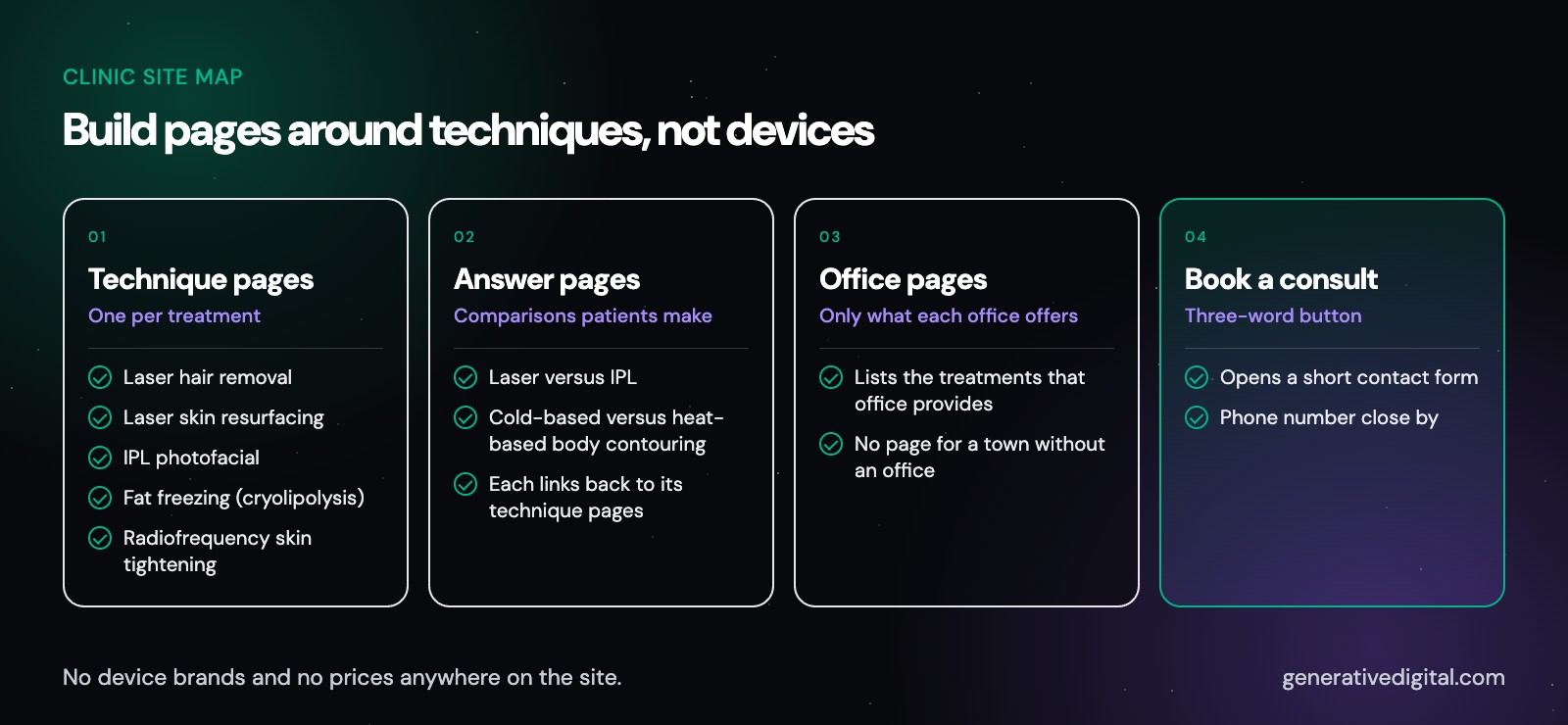
The technique. Give each one patients search for its own page, for example laser hair removal, laser skin resurfacing, IPL photofacial, fat freezing (cryolipolysis) and radiofrequency skin tightening. If you want to name the device you use, mention it inside the page body rather than in the title or the URL. That way the page, its links and its rankings survive the day you change equipment.
Add a short set of plain answer pages for the comparisons patients make most, such as laser versus IPL, or cold-based versus heat-based body contouring. Link each one back to the matching treatment pages.
Which lines need sign-off from your provider?
Every clinical statement does. How a treatment works, who may be a good candidate, how many sessions are typical, what downtime looks like, which side effects can happen and how long results last are all clinical, so the treating provider reviews and approves each line before the page goes live. Describe your approach as what your clinic does in most cases, never as a promise. A plainly generic example: “In most cases, your provider reviews your skin and hair type at the consult before recommending a treatment plan.” Even that line should go live only if your provider confirms it is how they work.
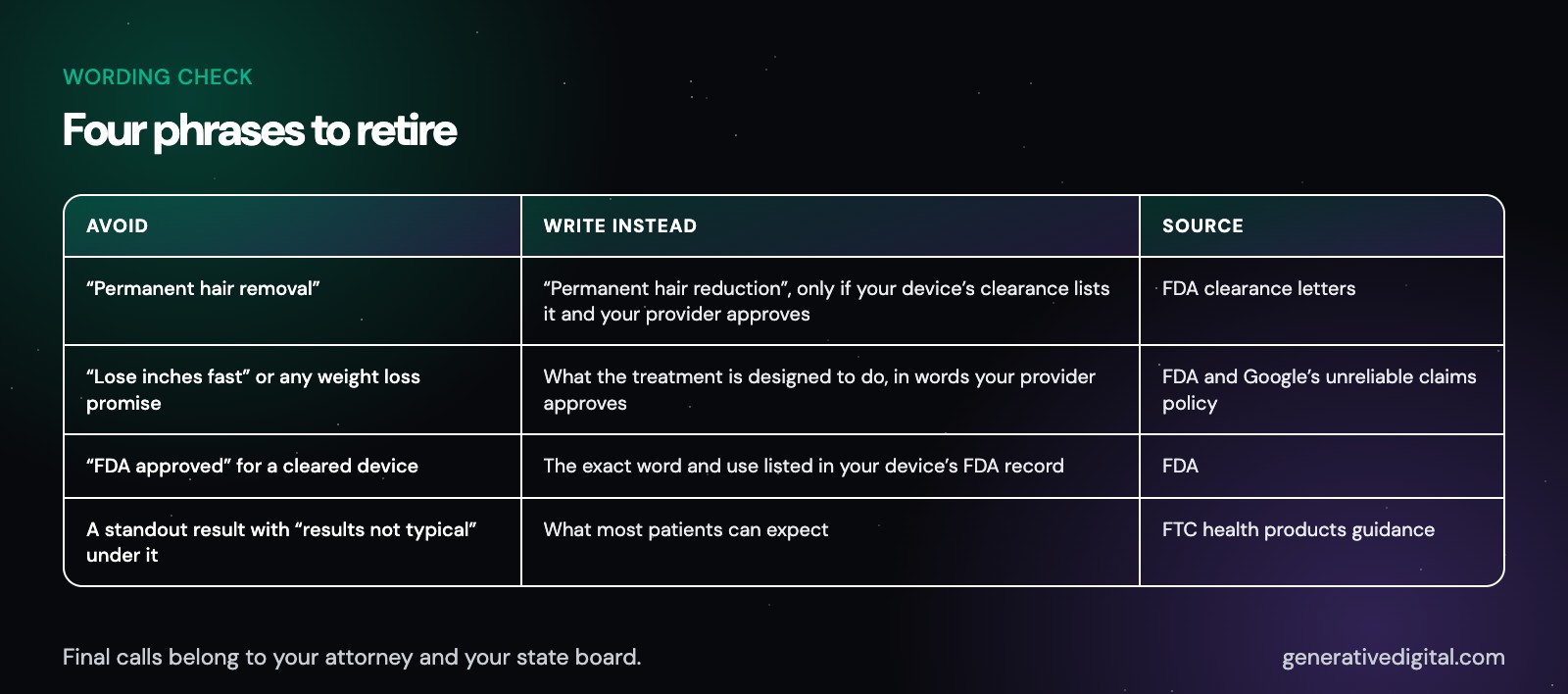
Words to keep off the page entirely: “guaranteed”, “painless”, “no downtime” and “permanent hair removal”. Leave out risk or complication numbers too. Those belong in the consult.
What should the consult button do?
For body contouring and any treatment that starts with a consult, we recommend the main button opens a short contact form rather than a phone link. A submitted form lands in your CRM and can be counted as a key event in Google Analytics, which ties every consult request to the page and the channel behind it. Keep the label to three words, such as “Book a consult”, and keep a visible phone number on the page for patients who would rather call.
What can a laser clinic say about results?
This is where laser and body contouring marketing most often goes wrong. Final calls on what you publish belong to your attorney and your state board, but these are the lines we plan around:
- “Permanent” has a defined meaning. FDA clearance letters for hair removal lasers use the phrase permanent hair reduction, and define it as a long-term, stable reduction in the number of hairs regrowing, measured at 6, 9 and 12 months after a treatment regime. That is reduction, not removal. Use “permanent hair reduction” only when your own device’s clearance lists it and your provider approves the wording.
- Body contouring is not weight loss. The FDA says non-invasive body contouring does not treat obesity or improve your health, and that it will not result in weight loss. Google’s unreliable claims policy separately bars unrealistic weight loss claims within a specific time frame or requiring little effort. Describe what the treatment is designed to do, in words your provider approves, and never promise pounds or inches.
- Cleared and approved are different words. The FDA reviews each device for specific intended uses, and it uses “cleared” and “approved” for different review paths. Use the exact word in your device’s FDA record, for the exact use it lists, and never stretch it to another body area. The FDA notes that no non-invasive body contouring device is cleared or approved for treating the breasts.
- A disclaimer does not make an unusual result typical. Google requires a visible note that results vary when a testimonial claims a specific result. The FTC goes further: a patient story showing a better result than most people get is likely deceptive even with a “results not typical” line under it. Meeting Google’s rule does not meet the FTC’s.
- Photos need a signed authorization. We hold one line on this: a patient photo appears on your website, ads or social media only when that patient’s signed HIPAA authorization is on file. Use unedited photos taken in the same light and from the same angle, and have the provider approve each caption.
- Reviews stay untouched. Ask every patient for a review the same way. Patient reviews are never edited or changed in any way, and any reply we write is a draft your clinic approves before it is posted.
What does body contouring marketing look like on Google Ads?
Google Ads puts your clinic in front of people searching for a treatment right now, while your organic rankings build. Body contouring marketing on Google comes down to four habits:
- Sell the consult, not the outcome. Ad copy names the technique and invites a consult. It never promises weight loss, a number of inches or a result by a date.
- Send each ad to its own page. A fat freezing ad lands on the fat freezing page, never the homepage.
- Watch for prescription drug terms. If your clinic also offers injectable treatments, their product names can fall under Google’s prescription drug terms policy. Our guide to Botox and filler marketing explains what that policy allows.
- Count form fills, not clicks. Judge each campaign on consult requests.
Can laser hair removal ads use remarketing?
Google’s personalized advertising policy treats Health as a sensitive interest category, and its Health list names invasive medical procedures, including cosmetic surgery, surgical procedures or injections. Ads in that category cannot use advertiser-curated audiences such as customer match or your data segments, which Google used to call remarketing. The list does not name laser hair removal or non-invasive body contouring.
Because the policy text does not settle it, our planning position is to keep your own audience lists out of any campaign that also promotes injections or surgery, and to confirm with Google Ads support before using them for a laser-only or non-invasive campaign. Search intent carries the campaign in either case. Build ad groups around the treatments and questions people type, and the campaign does not depend on remarketing to work.
How should a laser clinic plan for busy and slow months?
Demand for body contouring is not flat across the year, and your own data shows your clinic’s pattern better than any national figure. Look at consult requests and search traffic by month for the last two years, then plan around the busy months you actually see.
A simple way to plan around it:
- Before your busy months: refresh treatment pages and comparison answers, and have provider sign-off done before the rise begins.
- As demand builds: set ad budgets so campaigns are approved and learning before searches climb.
- Quieter months: fix technical issues, build the pages you are missing and gather reviews.
Keep the message about planning a series with a provider, not about a discount. A promotion built on a price brings in shoppers, while a consult brings in patients.
How does local search work when only some offices have the lasers?
Your Google Business Profile drives the map results, and our med spa SEO guide walks through setting one up correctly. Lasers and body contouring add one wrinkle: equipment can differ from office to office. Three rules follow from that:
- List only what each office can deliver. Each office page and each profile names only the treatments that office’s devices and staff provide.
- Build a city page only for what that office offers. A treatment page for a city should never suggest a device that lives somewhere else.
- Never suggest an office in a town where you have none. Patients who travel in for treatment are welcome, and they deserve to know where they are driving.
Who may operate the laser, and how should provider pages say it?
Who may perform laser and body contouring treatments, and under whose supervision, is set by your state’s laws and your state board, not by your marketing. Your provider pages should state each person’s role accurately and leave the legal question to your attorney.
Three habits keep provider pages and schema markup honest:
- Copy credentials word for word from each provider’s own live bio, in the page text and in the schema. A fellowship is described as a fellowship, never as board certification, and a membership missing from the bio stays off every other page too.
- Name the role, not a title the person does not hold. A trained laser technician is described as exactly that.
- List only services you offer in your structured data, so search engines and AI tools never pick up a treatment you do not provide.
How do AI tools describe a laser clinic?
Google says no special code or extra optimization is needed for AI Overviews or AI Mode, and a page can appear as a supporting link only if it is indexed and eligible to show in Search with a snippet. Google adds that these features can use query fan-out, running several related searches across subtopics before they answer. A patient asking about body contouring might set off searches on fat freezing, on radiofrequency and on how to compare clinics. A clear, provider-approved page for each gives those searches something accurate to find.
Three habits help AI tools describe your clinic the way you would:
- Use the same technique names everywhere. Your homepage, treatment pages, Google Business Profile and schema should call each treatment by the same name.
- Answer the comparison questions directly. A short, plain answer near the top of each comparison page is easy for an AI tool to quote correctly.
- Check the answers every month. We run a fixed set of patient questions through the AI tools your patients use and note whether your clinic is named, and how.
Our answer engine optimization guide explains the wider method. If your clinic also treats skin conditions, our page for dermatology practices covers that side.
How do you measure laser clinic marketing?
Rankings and visits are early signals. What matters is how many people ask for a consult, and how many of them go on to book a treatment plan. The reporting we build includes:
- Consult form submissions, marked as key events in Google Analytics and broken out by page and channel.
- Phone calls, with website calls and Google Ads calls counted separately.
- Visits from ChatGPT, Perplexity and other AI tools, split out wherever the platform passes that information along.
- Consults traced to a booked series, to the extent your booking software and front desk notes allow.
If a figure has not been measured, our reports say so instead of estimating it.
months
How long before laser clinic marketing shows results?
Three to four months, as a general guide, is a fair window before search brings changes you can measure. A new website, a crowded market or a missing set of treatment pages stretches that. Google Ads can bring in consult requests sooner, once campaigns are approved.
No agency controls whether Google or an AI tool names your clinic, so a promise like that is a warning sign. What we commit to is careful work, plain reporting and a clear account each month of what changed.
What else do laser and body contouring clinics ask?
Is laser clinic marketing different from med spa marketing?
It is a part of it with a few extra rules. Lasers and body contouring add device claim wording, seasonal demand and equipment that can differ from office to office, so the treatment pages, the ad plan and the location pages need more care.
Can we say laser hair removal is permanent?
Not as permanent hair removal. FDA clearance letters for hair removal lasers use the phrase permanent hair reduction, meaning a long-term, stable reduction in the number of hairs regrowing. Use that phrase only if your device’s clearance lists it and your provider approves the wording.
Can we advertise body contouring as a weight loss treatment?
No. The FDA says non-invasive body contouring does not treat obesity and will not result in weight loss, and Google’s ad policies bar unrealistic weight loss claims. Describe what the treatment is designed to do, in words your provider approves.
Should we put package prices on our website?
We recommend keeping prices and package deals off your service pages. The number of sessions depends on each patient, so the consult is where cost belongs.
How long does laser clinic marketing take to work?
For search, three to four months is a general guide before movement you can measure. Google Ads can bring in consult requests earlier, as soon as campaigns are approved.
See where your clinic stands today
A short look at your site now beats guessing at what to fix. Our free digital audit reviews your website, your index status and how AI tools see your clinic, then shows you what to fix first. It costs nothing, and most audits come back within 48 hours.
Get startedWorking with businesses across the US
© 2026 Generative Digital LLC