How to choose an AI SEO agency: the questions to ask before you hire
To choose an AI SEO agency, ask each one to show you three things: how it will make your site easier for search engines and AI tools to read, how it will check whether ChatGPT, Perplexity and Google AI Overviews name your business, and what it refuses to promise. A good agency answers all three in plain words, looks at your site before it quotes a price, and treats regular SEO as the base of the work. A weak one sells a secret method or a sure spot in AI answers.
A fair warning first. Generative Digital is an AI SEO agency, so we have a stake in this topic. We wrote the guide we would want a buyer to use on us, including the questions that could rule us out.
If you want to see how we answer them, our AI SEO agency page lays out the work we do.
What should an AI SEO agency actually do for you?
The phrase covers two different offers, so start by asking which one you are buying. One is ordinary SEO produced with help from AI writing and research tools. The other is work aimed at getting your business named inside the answers AI tools write. Plenty of vendors sell the first one under the name of the second.
The second kind is what most buyers are after. It should include:
- Access for the right crawlers.
Search engine crawlers, and the crawlers behind AI search tools, need to reach your pages and read the text.
- Pages built to be quoted.
A direct answer near each heading, in a passage that still makes sense when an AI tool lifts it out on its own.
- Business facts that agree everywhere.
Your business name, list of services and phone number should agree on your site and on the outside listings AI tools read.
- Tracking you can check.
A fixed set of buyer questions run through each AI tool on a schedule, plus reports on visits that come from AI tools.
If the letters GEO and AEO keep coming up on sales calls, our side-by-side page on GEO vs SEO vs AEO sorts out what each one means.
How do you choose an SEO agency when AI search is part of the job?
Most of what made a good SEO agency a few years ago still holds. Google’s own page on hiring an SEO tells you to ask for examples of past work, how results will be measured, how the agency will keep in touch, and whether it will explain every change it makes to your site. It also says, in plain words, “No one can guarantee a #1 ranking on Google.”
What changed is a new question on that same page. Google now asks buyers to check whether an agency’s advice on AI search, sold as “AEO” or “GEO” services, lines up with Google’s own guidance. That guidance is direct. Google says “optimizing for generative AI search is optimizing for the search experience, and thus still SEO.”
So the first filter is simple. An agency that cannot do solid technical SEO cannot do AI SEO either, because AI answers draw on pages that search already reads well. Ask to see the technical side of its work before you hear about the AI side.
What questions should you ask an SEO company before you sign?
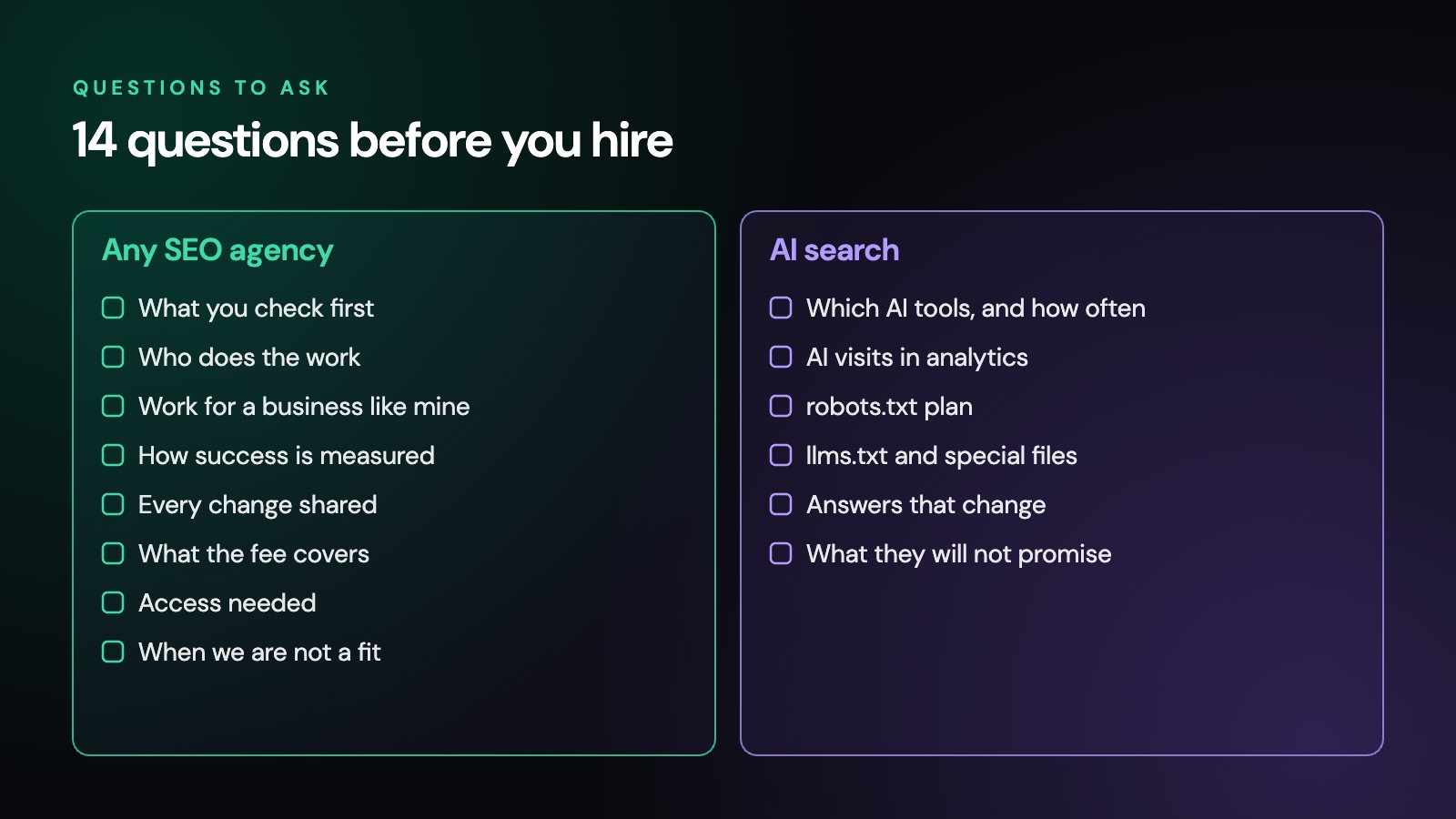
Think of this like hiring a home inspector before you buy a house. A good inspector tells you what was checked, what was found and what could not be seen. A poor one hands you a glossy report and a reassuring smile. These eight questions help you tell the two apart.
- 1. What will you look at before you send a proposal?
A good answer: your site, which of your pages Google has indexed, and how you show up in AI answers today. A weak answer: a price before anyone has opened your site.
- 2. Who will do the work each month?
A good answer names the people, says what is done in-house, and says what is handed to outside contractors.
- 3. Can you show me work for a business like mine?
Look for examples from businesses that win customers the same way you do, by calls, bookings or online orders, with an explanation of what was done. A wall of logos tells you very little.
- 4. How will you measure success, and what can you not measure?
A good answer ties the work to leads, calls or sales and is open about the parts of AI search that are still hard to track.
- 5. Will you share every change you make to my site, and why?
This one comes straight from Google’s list. The answer should be yes, with a running log you can read.
- 6. What does the monthly fee cover, and what costs extra?
You want the scope in plain language: which pages, how much content, what technical help, and what happens when a task falls outside the plan.
- 7. What access do you need from me?
To start, view-only access is enough. Google’s advice is to “only grant read access to Search Console (at this stage, don’t grant them write access).”
- 8. When would you tell me you are not the right fit?
An agency that has never turned down a client either has a very narrow offer or is not being straight with you.
What AI search questions should you add to the list?
The standard checklist barely touches AI search, so add these six. If you want the background first, our guide to answer engine optimization explains where AI answers appear and how sources get picked.
- 1. Which AI tools do you check, and how often?
Listen for the tools your own buyers use, a fixed list of questions, and results saved over time so you can see a trend. One screenshot from one day proves almost nothing.
- 2. How will you separate visits from AI tools in my analytics?
A good answer explains the setup and admits where the data is patchy, because AI tools do not all report visits the same way.
- 3. What will you change about my robots.txt file?
The answer should be a decision made with you, crawler by crawler, that keeps search crawlers apart from crawlers that only collect training data.
- 4. What do you think of llms.txt and other special AI files?
Google says it ignores llms.txt files and that you don’t need new AI text files or markup to appear in its AI features. An agency that sells one as the main fix is selling the wrong thing. Our page on the llms.txt file covers when one is worth having.
- 5. How do you handle answers that change from one try to the next?
AI tools can give a different answer to the same question on a different day. A careful agency repeats its checks and reports the pattern, not a single lucky result.
- 6. What will you not promise me?
Listen for a named spot in ChatGPT, Perplexity or AI Overviews on that list, because no outside agency controls what those tools cite.
What red flags should make you walk away?
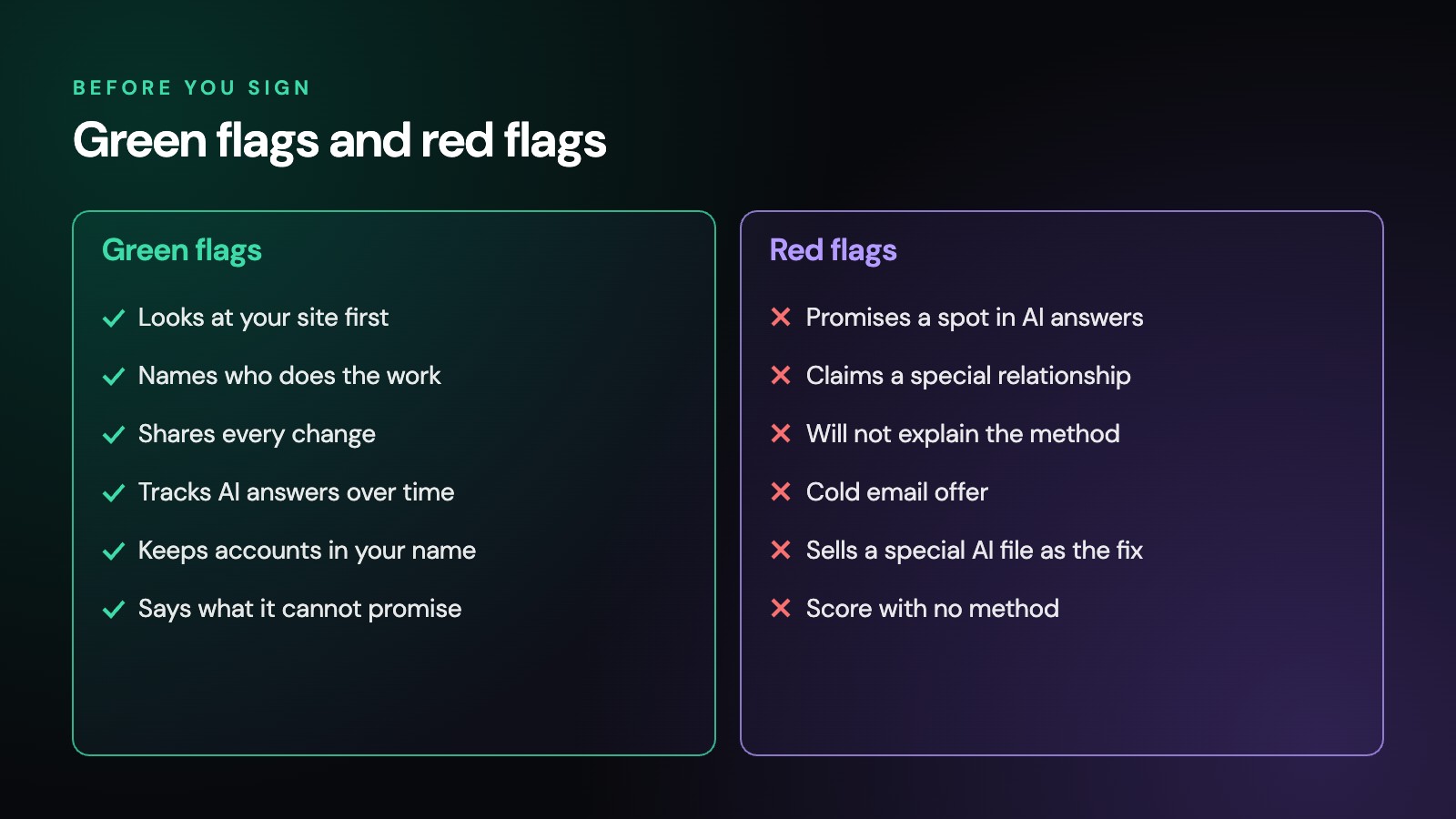
Most red flags come down to secrecy or promises nobody can keep. Google’s hiring page names several of them directly.
- A sure spot in AI answers.
No vendor controls what an AI tool cites, any more than an SEO agency controls the first result on Google.
- A “special relationship” with Google or an AI company.
Google’s hiring page warns about agencies that claim to have one.
- A method they will not explain.
Google says to “Be careful if a company is secretive or won’t clearly explain what they intend to do.”
- Offers that arrive out of nowhere.
Google says to “Be wary of SEO firms and web consultants or agencies that email you out of the blue.”
- A special file or plug-in sold as the whole solution.
Google says its search does not use AI text files at all.
- Shortcuts on links or content.
Google warns against agencies that talk about link schemes, and says “If an SEO creates deceptive or misleading content on your behalf, your site could be removed entirely from Google’s index.”
- An AI visibility score with no method behind it.
If the agency cannot tell you which questions, which tools and which dates produced the number, the number is decoration.
- Requests to own your accounts.
Your website, Search Console, analytics and Google Business Profile should stay in your business’s name.
What should you see before you sign?
Before you commit, ask for these in writing:
- A first look at your site.
Even a short review shows you how the agency thinks and whether it found anything real.
- A plain scope of work.
What gets done each month, in words you could repeat to a colleague.
- A sample report.
Seeing one before you sign tells you what you will be reading every month after.
- Your point of contact.
The name of the person you will talk to, and how quickly they usually reply.
- Who owns what.
The content written for you, and every account set up for you, should belong to your business when the work ends.
How will you know if the agency is working?
Judge the first month by the work that shipped, not by rankings or citations. Pages fixed, crawler settings decided and tracking set up are all things you can see right away.
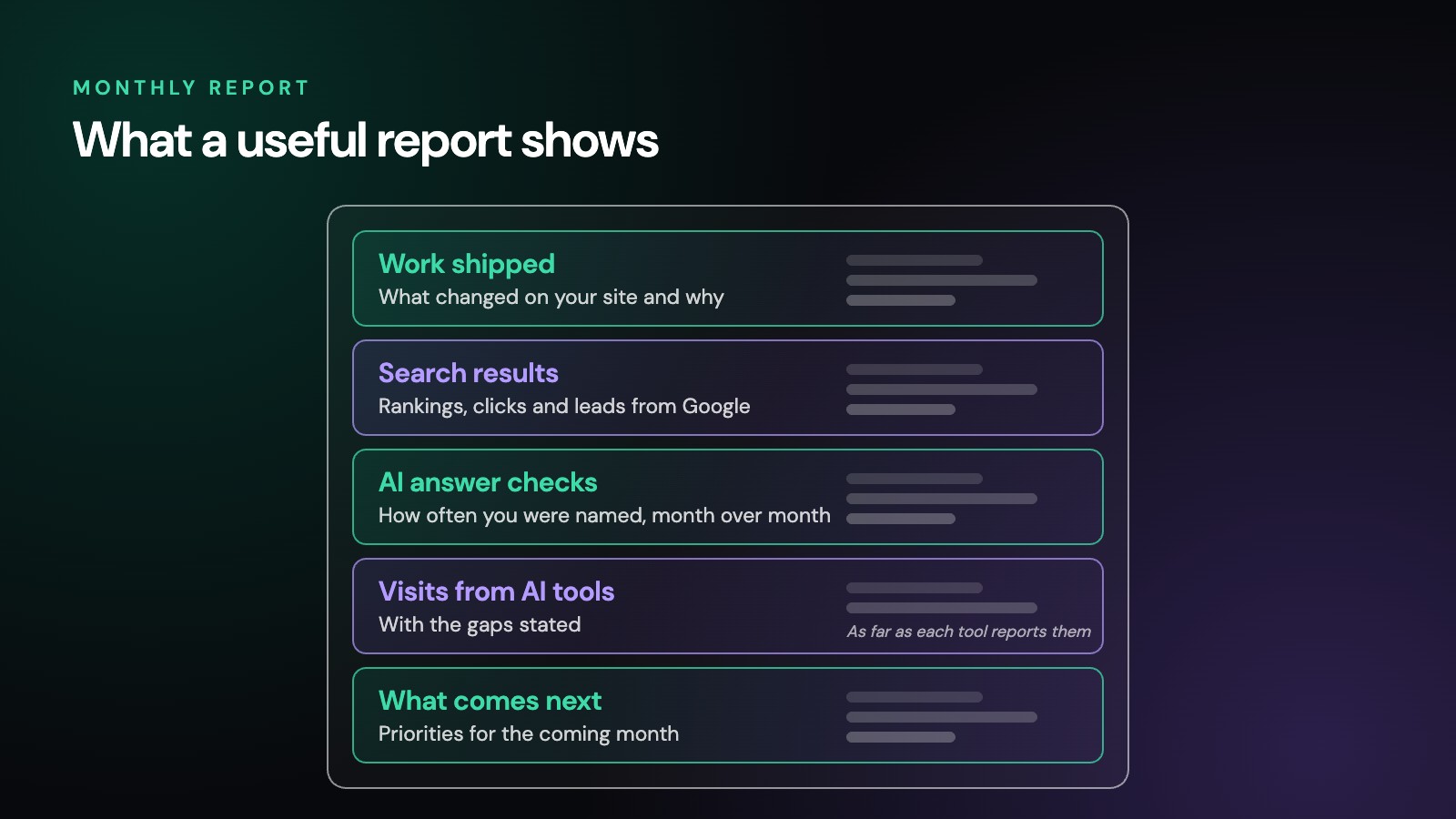
Judge results on a longer clock: three to four months as a general guide, and often longer for new sites or crowded markets. By then a monthly report should show:
- Work shipped.
What changed on your site and why.
- Search results.
Rankings, clicks and leads from regular Google search.
- AI answer checks.
How often your business was named for the same set of questions, compared with earlier months.
- Visits from AI tools.
As far as each tool reports them, with the gaps stated.
- What comes next.
A short list of priorities for the coming month.
Is a large agency or a single operator a better fit?
Both can do good work. The question is which trade-off suits you.
- A larger agency
A larger agency has more people and more skills in-house, and can produce a lot of content at once. The cost is often an account manager standing between you and the people doing the work.
- A single operator
A single operator gives you the same person from audit to execution, so nothing gets lost in a handoff. The cost is capacity, because one person has a fixed number of hours.
Generative Digital is a one-person practice, so weigh that honestly. If you need dozens of new pages every month, a larger team may suit you better. If you want the person who found the problem to be the person who fixes it, read about who runs Generative Digital and decide for yourself.
What should you get ready before you talk to agencies?
A little prep makes every sales call more useful:
- Your goal in one sentence.
More calls, more bookings, more online sales, or more leads for one service.
- Access ready to share.
Read-only access to your Search Console and analytics accounts, if you have them.
- The questions buyers ask you.
These are the same questions people now type into AI tools.
- The competitors who keep getting named.
Ask a few AI tools about your field and note who shows up.
- Your own first check.
Run our GEO audit checklist on your site first, so you can judge whether an agency’s audit found more than you did.
What else do people ask about choosing an AI SEO agency?
Can any agency guarantee my business will show up in AI answers?
No. None of the AI companies explains exactly how its tool picks sources, and one question can bring a different answer from one day to the next. An honest agency promises the work and the reporting, never the citation.
Do I need a separate agency for AI search and for SEO?
Usually not. Most AI search work is SEO work aimed at a new kind of result, and Google describes it the same way. Hiring two vendors often means two audits of the same site and two teams editing the same pages.
What access should I give an AI SEO agency at first?
Read-only access to your Search Console and analytics accounts is enough to start. Google advises giving read access to Search Console at first, not write access. Keep every account in your business’s name.
Is it a red flag if an agency uses AI tools to do the work?
Not by itself. Many good agencies use AI tools for research and first drafts. Ask who checks the work, who learns your business, and whether a person reads every page before it goes live.
How long should I give an AI SEO agency before I judge it?
Judge the first month by the work that shipped. Judge results over three to four months as a general guide, and allow longer for new sites or crowded markets.
Want a second opinion before you hire anyone?
Our free digital audit shows how search engines and AI tools see your site today, so you can measure any agency’s pitch, ours included, against real findings.
Get startedWorking with businesses across the US
© 2026 Generative Digital LLC