GEO vs SEO vs AEO: what is the difference?
GEO vs SEO comes down to what you are trying to win. SEO (search engine optimization) earns your page a spot in a list of search results. GEO (generative engine optimization) earns your business a mention inside an answer that an AI tool writes, such as ChatGPT or Google AI Overviews. AEO (answer engine optimization) is the wider term for earning the answer itself, wherever it appears, from featured snippets and voice assistants to AI tools. All three run on the same website, and most of the work is shared.
Picture asking for a good pizza place. A map app that shows a long list of nearby spots is classic search, and SEO is how you get onto that list. A sign on the corner that points to one shop is like a featured snippet: one answer, no list. A friend who has read the reviews and says “try these two, and here is why” is like an AI answer. AEO covers the sign and the friend. GEO is the friend.
This page puts the three side by side in one table and helps you decide where to start. For the deeper look at the AI side, see our generative engine optimization services.
How do SEO, AEO and GEO compare side by side?
The quickest way to see the difference is one row at a time.
| SEO | AEO | GEO | |
|---|---|---|---|
| What you win | A spot in the list of results | The answer itself, wherever it appears | A mention or citation inside an AI-written answer |
| Where it shows up | Google and Bing results pages | Featured snippets, People Also Ask, voice assistants and AI tools | ChatGPT, Perplexity, Google AI Overviews and AI Mode, Microsoft Copilot |
| What gets picked | A whole page | A short passage that answers one question | A short passage, often blended with other sources |
| How many get picked | Many, in ranked order | Often just one | A few sources per answer |
| Do people click? | Usually. The click is the goal | Sometimes. A short answer can end the search | Sometimes. Being named can matter even without a click |
| How you see results | Rankings, impressions and clicks in Search Console | Search Console plus hands-on question checks | Partial analytics data plus hands-on question checks |
| What it rests on | Pages search engines can crawl, index and trust | Everything SEO needs, plus answer-first writing | Everything SEO needs, plus open access for AI crawlers and clear facts about who you are |
Read the last row first. The foundation is the same for all three. Google’s own guidance for its AI features tells site owners to use the same foundational SEO best practices they use for the rest of Google Search. Google says a page qualifies as a supporting link in its AI features when it is indexed and able to appear with a snippet, with no additional technical requirements.
How do the three terms fit together?
Think of them as layers stacked on one site, not three separate services. SEO is the base. AEO sits on top of it and covers any search feature that gives one answer instead of a list. GEO is the part of AEO where an AI model writes that answer in its own words and names a few sources.
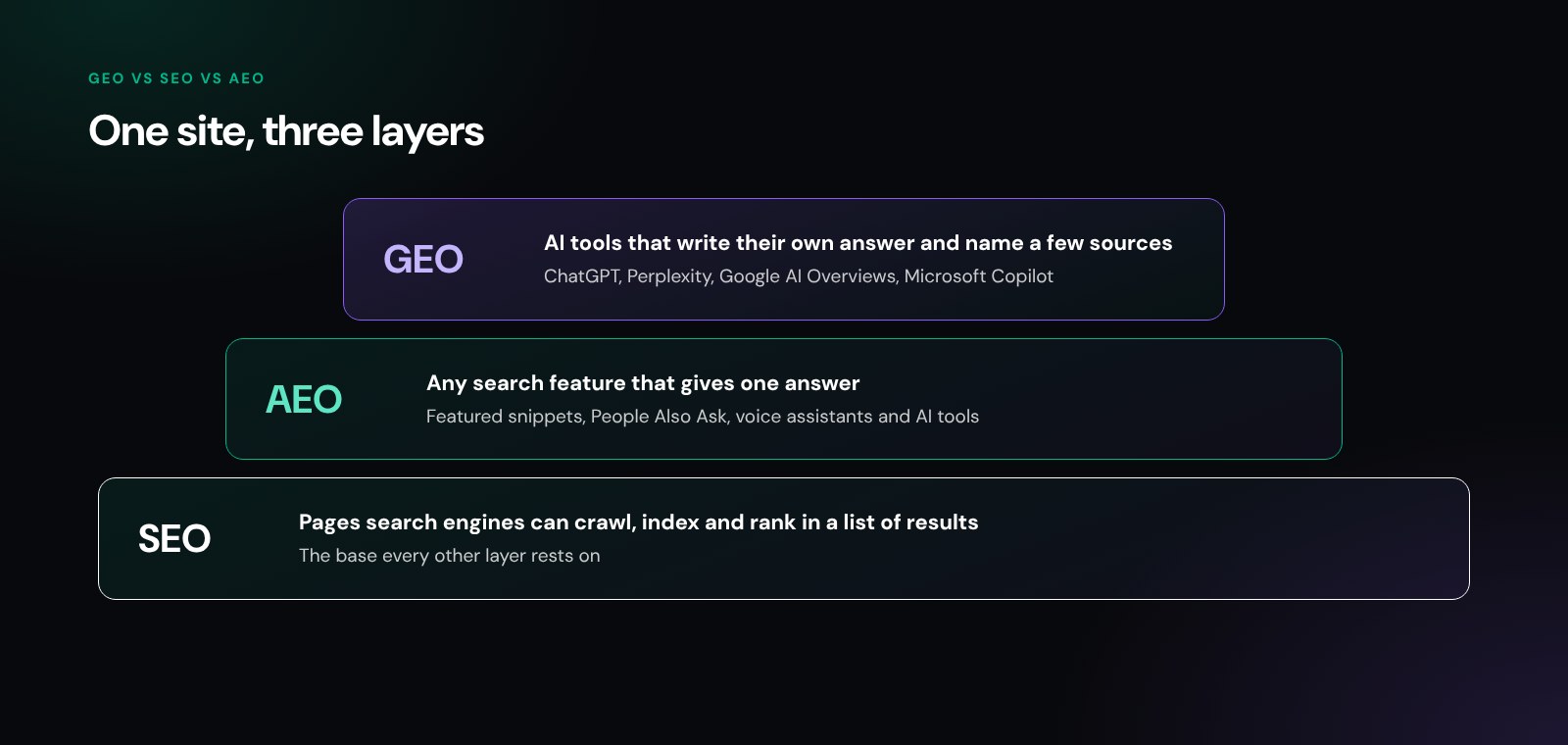
That is how our own pages use the words. We say GEO for our AI search work, because it names the part that changed the most. Some agencies say AEO for the same work, and you will also see AI SEO, LLMO and AIO. The label matters less than the list of tasks behind it. The definitions get a fuller treatment in our explainer on what generative engine optimization is.
AEO vs SEO: what changes when you aim for the answer?
AEO vs SEO is a change in the finish line, not the track. SEO is done when your page ranks and earns the click. AEO is done when a passage from your page becomes the answer a person sees or hears.
That changes how you write more than how you build:
- Lead with the answer.
Put a direct reply in the first sentence under each heading, then add the detail.
- Use real questions as headings.
Write them the way buyers ask them, not the way your team talks internally.
- Keep each passage complete on its own.
A machine may lift two sentences out of the middle of your page.
- Check your snippet settings.
Google says nosnippet, data-nosnippet, max-snippet and noindex are the controls that limit what it shows from your pages in Search, so a setting added for one reason can quietly hide your best answer.
One thing AEO cannot do is force the result. Google says you cannot mark a page as a featured snippet. Its systems decide which page makes a good one. The work is making your page the easiest good answer to pick.
AEO vs GEO: are they the same thing?
In day-to-day work, mostly yes. The difference is scope. AEO also covers answers no AI wrote, like a featured snippet pulled straight from your page or a voice assistant reading one result out loud. GEO covers only AI tools that write a new answer and name their sources.
If your buyers mostly ask ChatGPT or Perplexity, the two words describe the same job. If featured snippets still bring you a lot of visits, AEO is the more complete word.
One difference shows up on your server. Each AI company runs its own crawlers, and each one needs its own decision. OpenAI, for example, says a site that opts out of OAI-SearchBot is left out of ChatGPT search answers, while GPTBot is a separate crawler tied to model training, and each setting works independently of the other. A featured snippet only needs Googlebot.
What work do all three share?
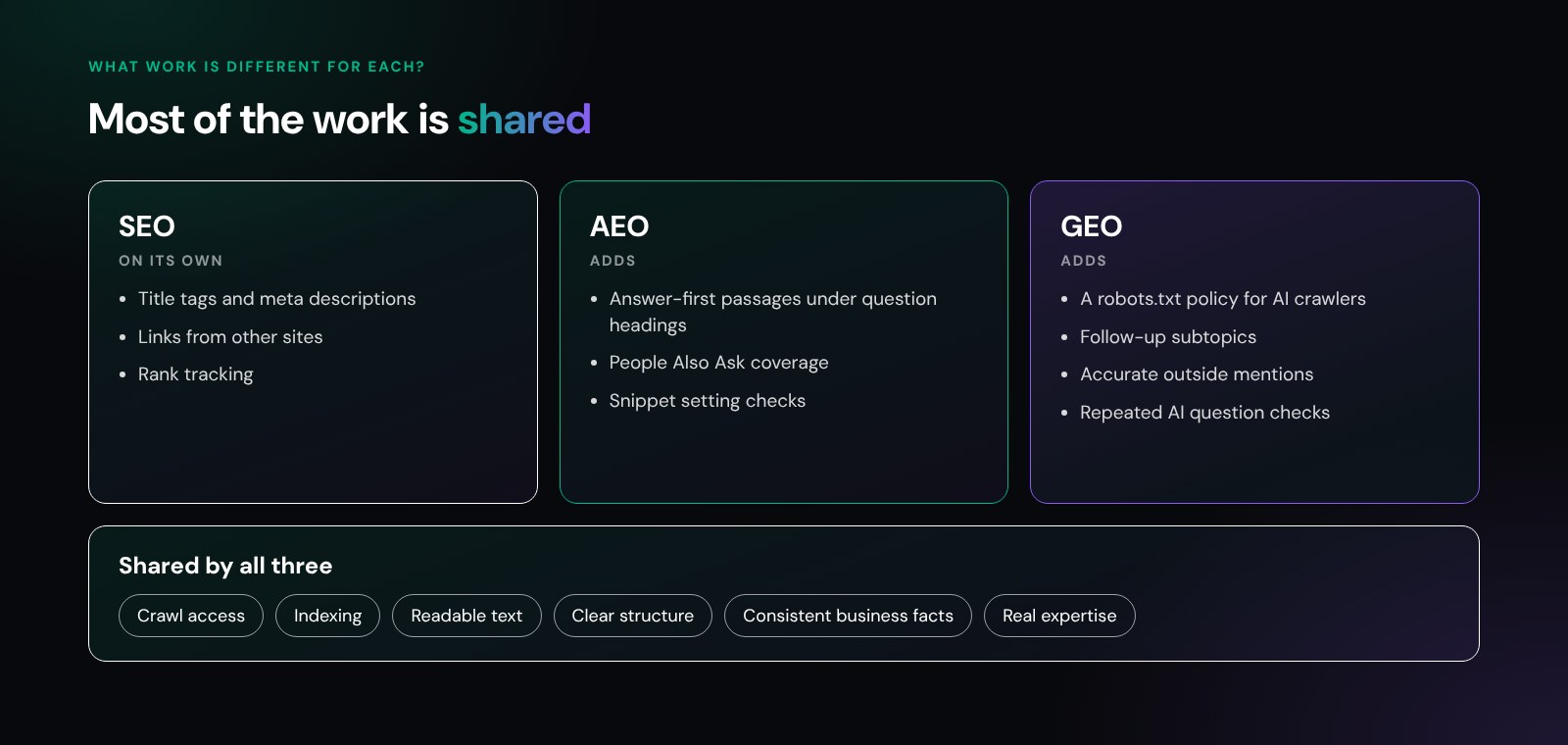
Most of it. If any of these is broken, fixing it helps SEO, AEO and GEO at the same time:
- Crawl access.
Search engines and AI crawlers can reach the pages you want found.
- Indexing.
Your key pages are actually in Google’s and Bing’s index.
- Readable text.
Headings and answers are in the page code itself, not loaded later by scripts.
- Clear structure.
One topic per page, sensible headings and links between related pages.
- Consistent facts.
Your business name, services and contact details read the same on your site and in outside directories.
- Real expertise.
Content written or checked by someone who knows the subject.
What work is different for each?
The extra work for each term is a short list.
- SEO on its own:
- Title tags and meta descriptions written to earn the click.
- Links from other sites that help pages rank.
- Rank tracking for the phrases that bring buyers.
- AEO adds:
- Answer-first passages under question headings.
- Coverage of the related questions that appear in People Also Ask.
- A check of snippet settings, so nothing hides a good answer.
- GEO adds:
- A deliberate robots.txt policy for each AI crawler.
- Coverage of follow-up subtopics. Google describes a query fan-out technique, where AI Overviews and AI Mode can issue multiple related searches across subtopics to build a response. More on that in AI Overview optimization.
- Accurate mentions on outside sites that AI tools read.
- Repeated checks of the same buyer questions in AI tools, because the same question can get a different answer on another day.
Which one should your business focus on first?
Start with SEO if search engines cannot crawl your site, key pages are missing from the index, or your pages load slowly on phones. Nothing else works until that is fixed.
Add AEO when you rank well for buyer questions but another site holds the featured snippet or the People Also Ask answer.
Add GEO when your buyers ask AI tools for recommendations in your field, or a competitor keeps getting named and you do not.
For most businesses, the answer is all three, in that order, as one plan. The order matters because each layer depends on the one below it.
Do you need a separate agency for each?
No. Splitting SEO, AEO and GEO across three vendors usually means paying three times for the same audit, the same crawl fixes and the same content edits. Ask any agency that pitches one of them what work it does that the other two would not. If the answer is a new name for the same tasks, keep it in one program. Our guide to choosing an AI SEO agency covers the other questions worth asking.
Generative Digital runs SEO and AI search together through our AI SEO agency services, for businesses across the US. For the full AEO picture, including how to measure it, read our guide to answer engine optimization. Want to check your own site first? Our GEO audit checklist lists the checks in order. Paid search and web builds are part of our digital marketing services too.
What else do people ask about GEO, SEO and AEO?
Is GEO replacing SEO?
No. AI tools draw on pages that search engines can already find and read, and Google tells site owners to use the same foundational SEO practices for its AI features. GEO adds a new goal on top of SEO. It does not remove the old one.
Is GEO a part of SEO?
It grew out of SEO and shares most of its groundwork, so many people treat it as a branch of SEO. What is new is the goal: being named inside an AI answer instead of ranking in a list. We run the two as one program, not as separate services.
Is AEO a part of SEO?
In practice, yes. AEO started with featured snippets and voice answers, which come straight from search results. It uses the same pages and the same signals, with extra care for short, direct answers.
Is AI SEO the same as GEO?
Often, but ask what the seller means. Some people mean AI software that does SEO tasks faster. Others mean getting found in AI answers, which is what GEO means. Our own AI SEO services use the second meaning.
Which should I work on first?
SEO, because AEO and GEO both depend on it. Once your key pages are indexed and readable, add answer-first writing and AI crawler checks. Measurable movement usually takes three to four months as a general guide.
Find out which of the three your site is missing
The fastest way to know where you stand is to look. Our free digital audit checks how search engines and AI tools see your site today and what to fix first.
Get startedWorking with businesses across the US
© 2026 Generative Digital LLC