Generative Engine Optimization Services
Generative engine optimization (GEO) is the work of getting your business named and cited in AI-written answers from tools like ChatGPT, Perplexity, Google AI Overviews, Copilot and Claude. Classic search gives you a ranked spot on a page. An AI answer has no spots at all. Either it names you or it does not. We are a generative engine optimization agency working with businesses across the US. We run GEO and technical SEO as one practice, because the same site problems hurt both.
What generative engine optimization is
GEO means making your site easy for AI tools to read, understand, credit and trust, so they pull your page into the answers they write. The nuts and bolts will feel familiar to anyone who has done technical SEO. What counts as winning is different.
When an AI tool writes an answer, it lifts a short passage of text. It does not rank whole pages. So clear, self-contained passages matter more than how often a keyword shows up on the page. A direct answer near the top of a section gets picked up more easily than the same answer buried under three paragraphs of setup. For the full explanation, start with our guide to what generative engine optimization is.
Why this is not just SEO with a new name
Because what you compete for has changed. Here are four differences that really matter:
There is no ranking to win
An AI answer has no first result. You are either cited or you are not, and that gap is what counts.
AI reads passages, not pages
A page can rank well and still never offer a clean, quotable passage for the AI to use.
Trust from other sites counts differently
A mention somewhere the AI already relies on, like an established publication, a credible directory or a review platform, adds to the same trust your own site builds.
Thin content hurts
Each page has to earn its place as a source on its own. Twenty shallow pages give the AI twenty reasons to skip you.
What carries over from SEO: a site search engines can easily move through, a clear structure, consistent details about who you are, real author credentials and stable pages. If search engines struggle to get through your site, that is a technical project first. We will tell you so rather than sell you the newer-sounding service.
What we actually do in an engagement
Here is what the work includes:
- Technical crawl and index review. Which pages search engines can reach, which are indexed, and which are blocked, duplicated or dropped.
- Entity and schema work. We add and test Organization, Person, Service, FAQPage and BreadcrumbList JSON-LD. That is behind-the-scenes code that tells machines exactly who you are and what you sell, with no guessing.
- Content rebuilt around passages. Headings written as questions, paragraphs that lead with the answer, terms explained the first time they appear, and lists for anything that can be listed.
- A clear AI crawler policy. A deliberate robots.txt setting for GPTBot, ClaudeBot, PerplexityBot and Google-Extended, plus an llms.txt file where it is worth having.
- An AI visibility baseline. We run a fixed set of buyer questions through ChatGPT, Perplexity, AI Overviews and Copilot and record the results. Then we re-run them on a schedule, so progress is measured instead of assumed.
- Measurement setup. Analytics set up to separate visits from AI tools from the rest, as far as each platform allows. Method: how to track AI search traffic in GA4.
- Work on other sites. Profiles, directories and review platforms that AI tools already read, with the same name, location and description on every one.
We are a single operator by design. When you hire us, you work with the person doing the work, from strategy and communication through execution. Read more on our about page, and see everything we offer on our services page.
Who this is for
- Professional services firms where one new client is worth so much that a few inquiries from AI tools can change the year. Law firms and medical practices are the clearest examples, which is why we have guides on GEO for law firms and GEO for healthcare practices.
- Businesses whose buyers research by asking questions rather than searching product names. Those are the questions people now ask an AI assistant instead of typing into a search box.
- Sites that already rank well in classic search but are missing from AI answers about their own category.
- Agencies that want a GEO offering they can put their own name on.
Who it is not for: anyone shopping only for more traffic. GEO is about being cited and being seen as credible.
If you want SEO and AI search handled as one program, see our AI SEO agency services.
How it is measured, and what is honestly hard to measure
Measurement is the least settled part of this field. Anyone who says it is solved is selling something. Here is what can really be measured today:
- Whether you are cited for a fixed set of questions, tracked over time. Manual, repeatable, and the most honest signal we have.
- Visits that come from AI tools, as far as each platform chooses to report them.
- Classic search performance, which still matters.
- Technical health: whether search engines can get through the site, whether the schema code is valid, and which pages are indexed. It either passes or fails. It is not opinion.
What is hard: data on visits from AI tools is partial and differs from one platform to the next. Answers change between users, sessions and wording, so one check proves very little. And no one outside those companies knows what any specific AI tool weighs when it picks sources. When we describe a factor, it is our read on observed behavior, and we say so. For help setting a budget, read how much GEO costs.
Where to go next on this topic
- Answer engine optimization. How AEO covers featured snippets, voice and AI answers, and how to measure it.
- GEO vs SEO vs AEO. The three terms side by side, and which to work on first.
- How to rank in ChatGPT. What OpenAI says about ChatGPT search, and the steps that help you get named.
- How to rank in AI Overviews. What Google says it needs, and how to track your AI Overview results.
- Perplexity SEO. How Perplexity picks its sources, and how to let its crawler in.
- What is generative engine optimization? A plain definition, and how AI answers get put together.
- The GEO audit checklist. The checks we run, in order, so you can run them yourself.
- How to choose an AI SEO agency. The questions to ask before you hire, and the red flags to avoid.
- The GEO readiness checklist. Fourteen quick pass or fail checks you can run in one sitting.
- What is llms.txt. What the file does, and whether your site needs one.
- Schema markup for AI search. Which structured data helps, and what Google and Bing say about it.
- How to track AI search traffic in GA4. Segments, filters, and what the data will not tell you.
- How much does GEO cost? What drives the price.
- GEO for law firms. What earns citations in a regulated field.
- GEO for healthcare practices. Credentials, clear business details, multiple locations.
Common questions
Does GEO replace SEO?
No. It builds on top of it. Almost every GEO gain depends on something classic SEO already cares about: a site search engines can get through, a clean structure and credible authors. Running the two separately means paying twice.
How long before we show up in AI answers?
It depends on how much of the work is technical repair versus content, and on how established your site already is. As a general guide, most sites see measurable movement in Google search in three to four months. AI answers draw on much of the same indexed content, so that is a fair starting expectation there too. Competitive keywords and newer sites take longer. We give you a range for your site after the audit, not before it.
Do you work alongside an existing agency or marketing team?
Yes, that is common. We can own the GEO plan and hand off the hands-on work, or do it ourselves.
See where you stand today
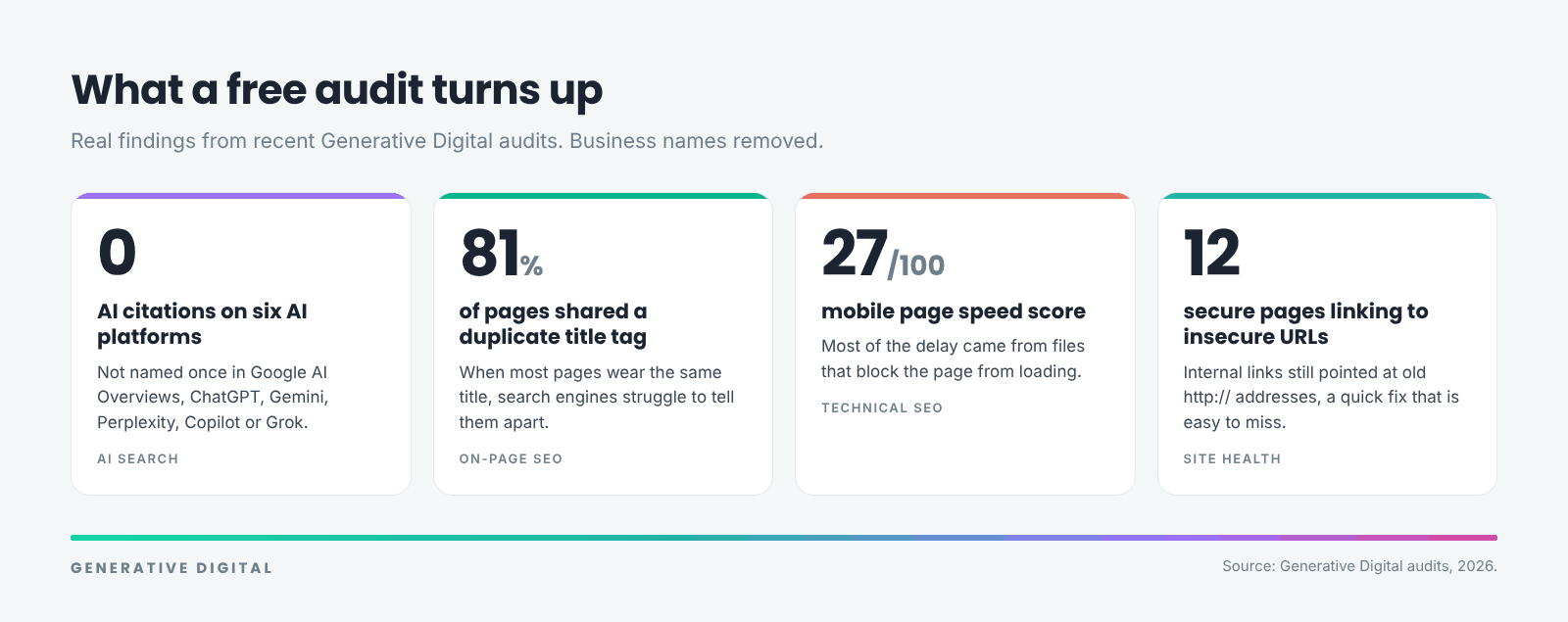
The easiest next step is a look at your site. The free digital audit includes a technical crawl, a review of which pages are indexed, and a read on how visible you are in AI answers today. There is no cost.
Get a free digital auditWorking with businesses across the US
© 2026 Generative Digital LLC