Perplexity SEO: how to rank in Perplexity and get cited
Perplexity SEO means getting your website listed among the numbered sources Perplexity cites when it answers a question. Perplexity searches the web each time someone asks, writes a short answer and lists the pages it used. To rank in Perplexity, PerplexityBot has to be allowed to reach your pages, and those pages need clear, current passages that answer the question better than anyone else’s.
Think of Perplexity as a reporter on deadline. It makes a few quick calls, quotes the sources who gave a clear and checkable answer, and lists them at the bottom of the story. A source who rambles, or who never picks up the phone, does not make the article.
Perplexity is only one of the AI tools people now ask for answers, and this guide covers it alone. Our generative engine optimization services cover the full set as one program.
What is Perplexity SEO?
Perplexity is an AI search tool. Its help center says it reads your question, searches the internet in real time, sums up what it finds and adds numbered citations that link to the original pages. Ranking in Perplexity means one of your pages is among those numbered citations, or your business is named in the answer itself.
Two things make Perplexity different to work on:
- Every answer shows its sources.
Perplexity calls this source transparency. You can see exactly which page was cited, which makes it easy to learn from.
- The answer is built fresh.
Because Perplexity searches at the moment of the question, a page it can reach is in the running the next time someone asks. A page it cannot reach is simply not in the running.
How does Perplexity choose the sources it cites?
Perplexity has not published a list of ranking factors, so any list you read online, this one included, is a read on what Perplexity documents and what can be observed. What Perplexity does say:
- It runs its own search index.
Perplexity says PerplexityBot exists to surface and link websites in its search results, and that it indexes pages in a similar way to other search engines. It also works with outside crawlers to help build that index.
- It uses large language models to understand and write.
Its help center names models such as GPT-5 and Claude, used to work out what a question means and to write the answer once the search is done.
- It digs deeper on harder questions.
Pro Search does more thorough research across multiple sources, and Perplexity says its Research mode runs dozens of searches and reads hundreds of sources for a single report.
- Answers are not for sale.
When Perplexity tested ads in November 2024, it said the content of its answers would not be influenced by advertisers.
That last point is worth holding onto. If the answer cannot be bought, the way in is to be the most useful page Perplexity can reach.
Can Perplexity reach your website?
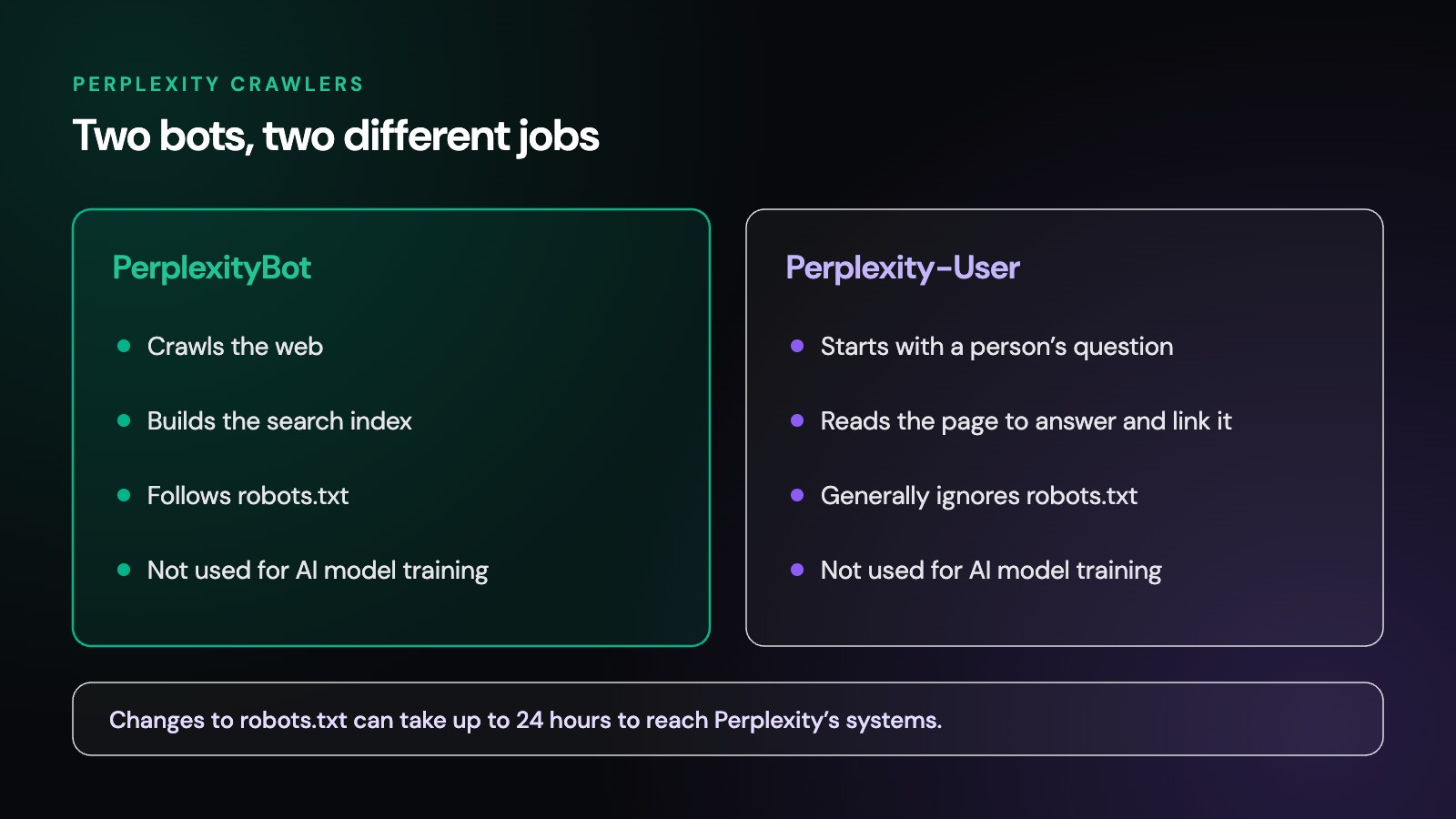
Check access before you rewrite a single page. Perplexity’s crawler documentation names two user agents, and they do different jobs:
- PerplexityBot
Crawls the web for Perplexity’s search results. Perplexity says it is not used to crawl content for AI foundation models, and it recommends allowing PerplexityBot in robots.txt if you want to appear in its results.
- Perplexity-User
Visits a page when a person asks Perplexity a question and it needs to read that page to answer. Perplexity says this fetcher generally ignores robots.txt, because a user asked for the visit.
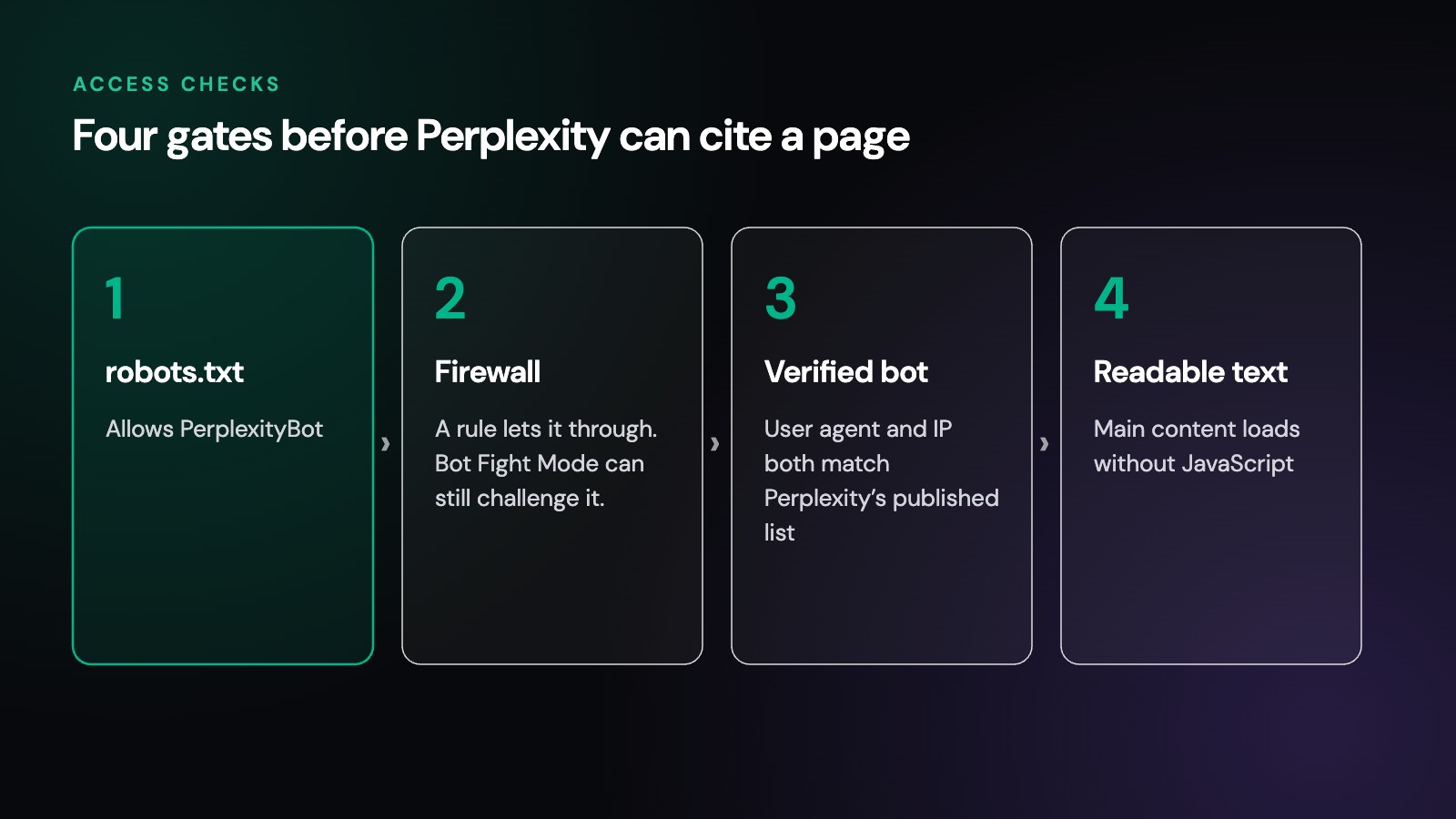
Three more checks catch most access problems:
- Your firewall lets it through.
Perplexity’s docs say a web application firewall may need a rule that explicitly allows its bots. It gives steps for Cloudflare and AWS and warns that Cloudflare’s Bot Fight Mode can still challenge its bots even with a skip rule in place.
- The requests are real.
Perplexity publishes the IP addresses for each bot as JSON files and says to match the user agent and the IP address together. Anyone can fake a user agent. The IP list is how you tell the real bot from an impostor.
- Your key text loads without scripts.
If the main content only appears after JavaScript runs, a crawler may see an empty page.
Perplexity says changes to robots.txt can take up to 24 hours to show up in its systems.
A partial block is not a clean exit either. Perplexity says that if a page is blocked, it may still index the domain, the headline and a brief factual summary. Our GEO audit checklist walks through these access checks step by step, plus the matching checks for ChatGPT, Google and the rest. An llms.txt file is a separate question, covered in our guide to what llms.txt is and whether you need one.
How do you write pages Perplexity will cite?
Perplexity pulls passages to back up specific points in its answer, so each section of your page has to make sense on its own.
- Lead with the answer.
State the answer right after each heading, in plain words, and let the supporting detail follow.
- Match the question to the heading.
Write headings the way a buyer would phrase the question, so the passage under it is an obvious match.
- Be specific and checkable.
Name the thing, give the step, state the condition. Vague claims give Perplexity nothing worth quoting.
- Cover the next question too.
Pro Search and Research mode look across many sources, so a page that also answers what it costs to get started, how long it takes and what can go wrong gives Perplexity more reasons to come back.
- Keep facts current.
Perplexity searches live, so an out-of-date page competes with fresher ones every time. Update the facts, then update the date. Never the other way around.
- Show who wrote it.
Put a real name on the page and link to a bio whose credentials match it word for word.
Why do other websites matter in Perplexity?
Perplexity cites several sources in an answer, and many of them will not be yours. Open the numbered sources on a few answers in your field and you will often find industry publications, review sites, directories and forums listed beside business websites.
Our read is that this cuts both ways. Accurate, consistent listings and honest coverage on the sites Perplexity already cites in your field give it more chances to name you, even when the cited link is not your own page. A wrong address on an old directory, or a stale description on a review site, can travel into an answer just as easily. Fix what is wrong first, then earn coverage the honest way.
What is Perplexity optimization, and what changes from Google SEO?
Perplexity optimization is the same job as Perplexity SEO under another name: making your pages easy for Perplexity to find, read and cite. Most of the work overlaps with good Google SEO, because a crawlable, well-organized page with clear answers serves both.
Three things shift:
- The crawler.
Google needs Googlebot. Perplexity needs PerplexityBot, and a firewall that waves one through can still block the other.
- The result.
A Perplexity answer has no list of ten blue links to climb. Either you are in the numbered sources or you are not.
- The feedback.
Google gives site owners Search Console. We have not found an equivalent report from Perplexity, so tracking takes more hands-on work.
For how Perplexity fits next to ChatGPT, Google and Copilot, see our guide to answer engine optimization. Two sibling guides cover the other big tools one at a time: how to rank in ChatGPT and how to rank in AI Overviews.
How do online stores show up in Perplexity shopping answers?
Perplexity added shopping features in November 2024. When someone asks a shopping question, it can show product cards next to the answer. Perplexity said those cards are not sponsored and that its shopping results draw on platform integrations, including Shopify, for stores that sell and ship to the US.
At the same launch, Perplexity opened a free Merchant Program for large retailers to share product details with it directly. It said products in its index with fuller details have a better chance of being recommended. Program terms can change, so read Perplexity’s current page before you plan around it.
For any store, the groundwork is the same as everywhere else: complete product pages with clear names, specs, availability and return details in plain text that a crawler can read.
How do you check whether Perplexity cites you?
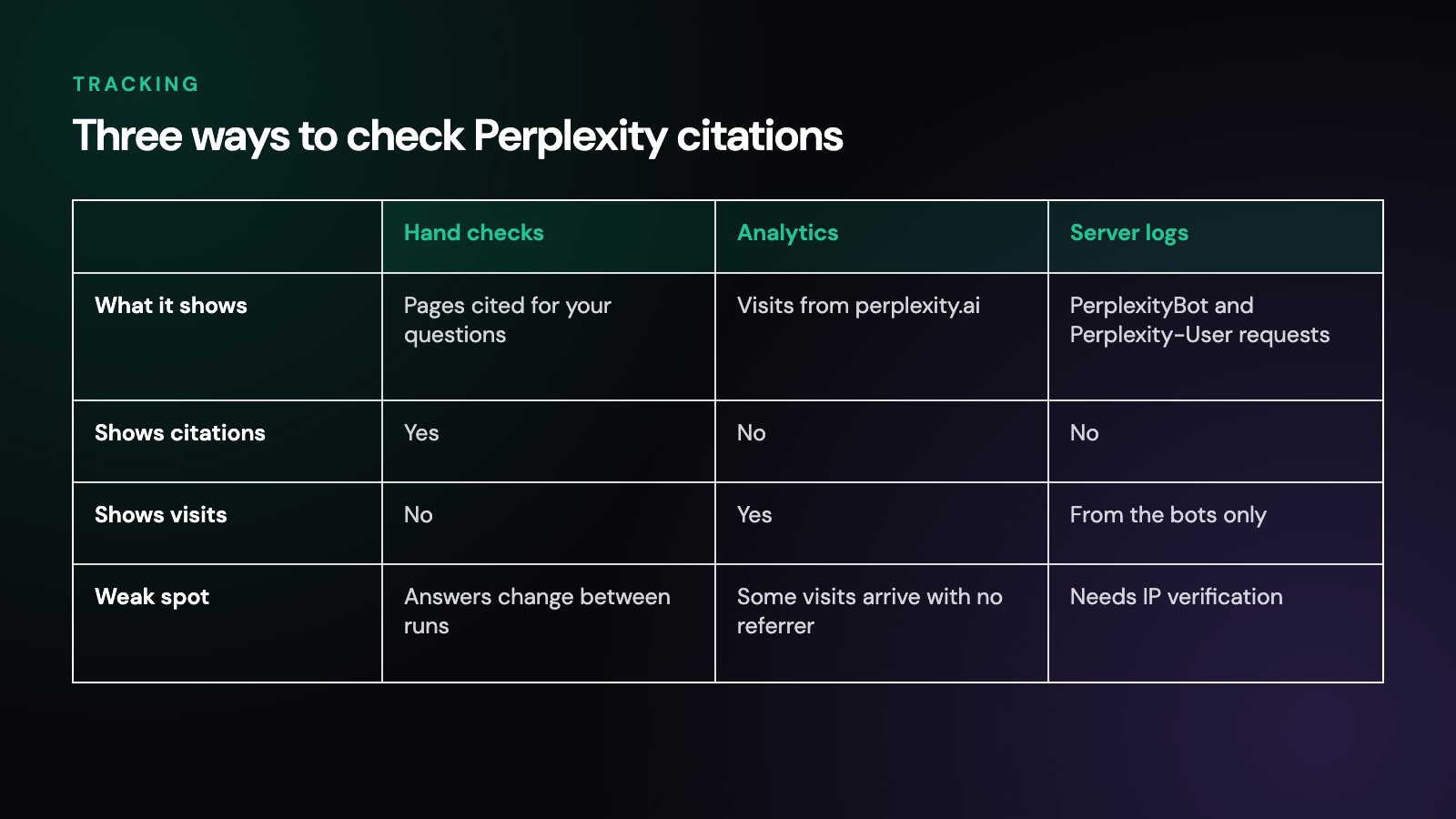
No single report covers it, so use three sources together:
- Hand checks.
Write down a fixed list of real questions your buyers ask. Run each one through Perplexity on a set schedule and record the numbered sources, whether you were cited or named, and which other sites showed up. Answers change from one run to the next, so watch the trend, not one result.
- Your analytics.
Look for visits referred from perplexity.ai. Perplexity’s documentation does not describe a tracking tag on its links. Our read is that some visits, such as those from mobile apps, may not pass a referrer and can land as direct traffic, so read this number as the minimum, not the total.
- Your server logs.
Look for the PerplexityBot and Perplexity-User user agents and check them against Perplexity’s published IP lists. Regular PerplexityBot visits suggest it is crawling your site. Perplexity-User visits suggest real questions are sending it to your pages.
What should you skip?
- Paying for a Perplexity ranking.
There is no such product, and anyone selling one is selling something else.
- Hidden text or instructions aimed at AI tools.
Google’s spam policies already treat hidden text as spam, so it puts your Google results at risk too.
- Swapping the date without changing the page.
Fresh facts matter. A fresh date on stale facts does not.
- Mass-produced pages built only to catch questions.
Google’s spam policies name this scaled content abuse, and thin pages seldom hold the clearest answer anyway.
- Blocking PerplexityBot to protect your content from AI training.
Perplexity says it does not build foundation models and that PerplexityBot is not used to train them. Blocking it mostly keeps you out of its answers.
- Anyone who promises a guaranteed citation.
No one can guarantee that Perplexity will cite your business.
How long does it take to get cited by Perplexity?
Access fixes can show up quickly, since Perplexity says robots.txt changes can take up to 24 hours to reach its systems and it searches the web at the moment of each question. Earning citations over competitors is slower, because content and outside reputation take time to build. Allow three to four months as a general guide for steady citations. Busy topics and young websites tend to need more time.
Should you handle Perplexity SEO yourself or hire help?
Everything on this page so far, from the access checks to the hand checks, you can run on your own. Bringing in help is worth it when fixes touch firewall rules, hosting or plugins, when a lot of pages need rewriting, or when you would rather have Perplexity, ChatGPT and Google handled in one plan instead of three.
Generative Digital is run by one person and works with businesses across the US, with SEO and AI search run as a single program. Our AI SEO agency page explains how that works, with the same person doing your audit, your fixes and your reports.
What else do people ask about Perplexity SEO?
Can I pay to appear in Perplexity answers?
No. Perplexity tested ads in 2024 as sponsored follow-up questions and said advertisers did not shape its answers. The way in is a page Perplexity can reach that answers the question well.
Does Perplexity use my content to train AI models?
Perplexity says it does not build foundation models, so content it indexes is not used for AI model pre-training. It also says PerplexityBot is not used to crawl content for AI foundation models.
If I block PerplexityBot, will Perplexity forget my site?
Not completely. Perplexity says it will not index the text of a page that blocks PerplexityBot, but it may still index the domain, the headline and a brief factual summary. Blocking it mainly keeps your pages out of the numbered sources.
Does Perplexity visit pages that robots.txt blocks?
Sometimes. Perplexity-User fetches a page when a person asks Perplexity a question that needs it, and Perplexity says this fetcher generally ignores robots.txt because a user asked for the visit. PerplexityBot, its crawler, follows robots.txt.
Does schema markup help you rank in Perplexity?
Perplexity has not said whether it reads structured data. Add it because Google documents how it uses structured data, keep it matching what visitors see, and do not count on it alone to earn a Perplexity citation.
Find out if Perplexity can see you
Not sure whether Perplexity can reach and quote your pages today? Our free digital audit checks how search engines and AI tools, including Perplexity, can reach and read your site right now, and what to fix first.
Get startedWorking with businesses across the US
© 2026 Generative Digital LLC