Weight loss marketing for medical weight loss and wellness clinics
Weight loss marketing helps people discover your medical weight loss or wellness clinic, believe what your pages say, and reach out for a consult, whether they start on Google, in Google Maps or by asking an AI tool like ChatGPT. Generative Digital handles weight loss marketing through four things we run ourselves: SEO, AI search, Google Ads and the website that connects them. We work with weight loss and wellness clinics across the US.
Picking a weight loss clinic is closer to choosing a family doctor than buying a gym pass. A program can run for months, it may involve a prescription, and the patient is trusting you with something personal. People read carefully before they book, and they notice when a page promises more than a doctor would.
This guide is part of our med spa marketing section, where the questions about choosing an agency live. Here we stay on what is specific to weight loss and wellness: the claims regulators watch most closely, the extra rules when a program uses compounded medication, and how Google Ads treats this category.
What is weight loss marketing, and what makes it different?
Weight loss marketing uses the same channels any clinic uses. Four things set it apart:
Weight loss claims have a long enforcement history.
The FTC publishes a guide that teaches media outlets how to spot false weight loss claims, and the claims it lists are a good test for any clinic ad.
Medication changes the rules.
Programs built around GLP-1 medication bring in FDA rules on how a drug may be described, and compounded versions carry rules of their own.
Google treats the category carefully.
Prescription drug terms, injections and online prescribing each come with their own ad limits.
Programs run for months.
Patients want to know what happens week to week, who oversees their care and what happens when the program ends. Those are clinical answers, so they come from your providers.
Generative Digital runs SEO, AI search optimization, Google Ads and websites. The full list is on our services page.
How do people choose a medical weight loss clinic?
Most people research for weeks before they book. Along the way they tend to:
- Compare approaches. Medication programs, nutrition and lifestyle coaching, or a mix of both. They search with those words, so your pages should use them too.
- Ask who prescribes and who follows up. They want to know a licensed provider reviews their health history and stays involved after the first visit.
- Check how visits happen. In person, online or both, and how often.
- Look for proof. Reviews, provider backgrounds and pages that explain things in plain words.
- Look for the catch. Many have seen weight loss ads that promised too much. A calm, specific page stands out against them.
A clinic that answers each of those steps on its own pages gives people a reason to stay instead of going back to the search results.
Which pages does a weight loss clinic need?
Should program pages name the drug, the brand or the program?
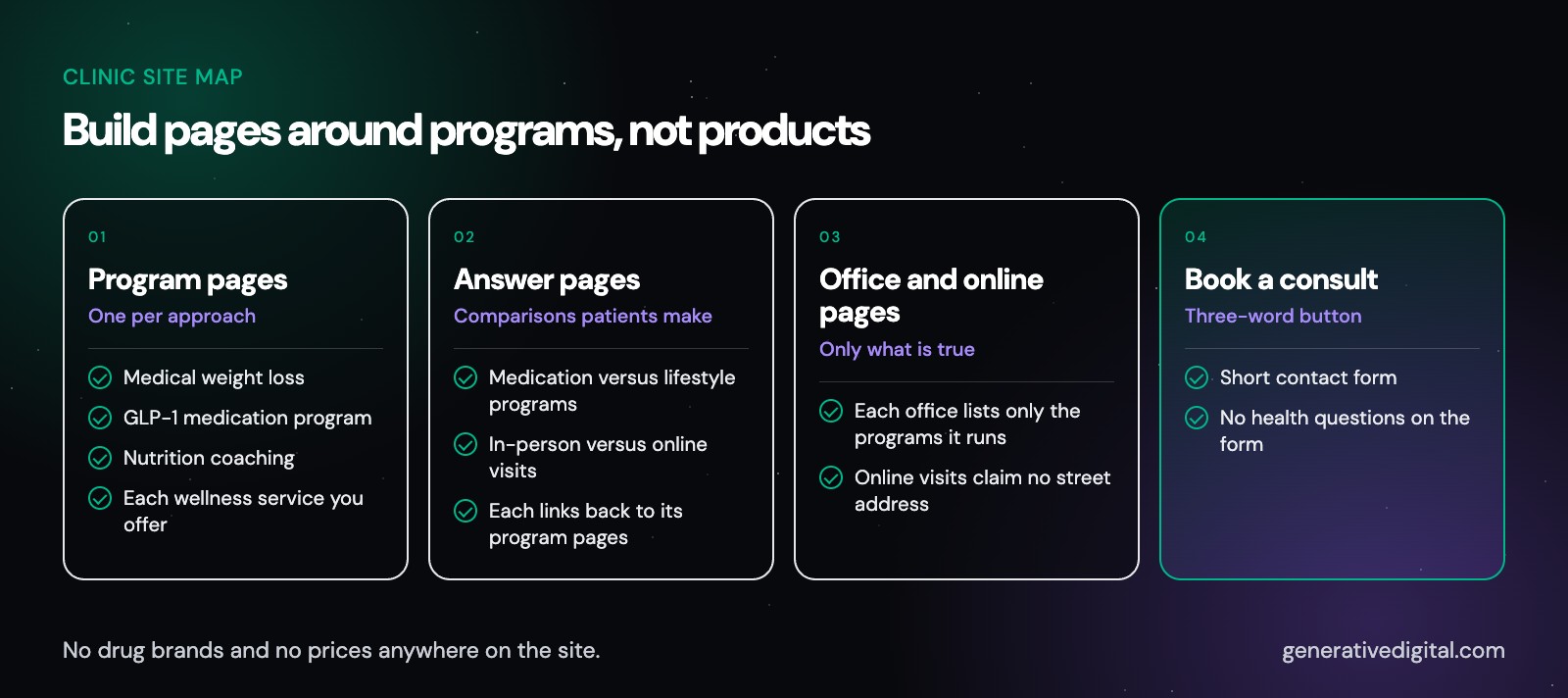
Name the program. Give each approach patients search for its own page, for example medical weight loss, GLP-1 medication programs, nutrition coaching and each wellness service you offer. Use the drug class, such as GLP-1 medication, or a generic drug name only where your provider confirms it is accurate for your program. Keep manufacturer brand names out of titles, URLs and headings. A page built around the program keeps its value when a product or a supplier changes.
Add short answer pages for the comparisons patients make most, such as medication versus lifestyle programs, or in-person versus online visits. Link each one back to the matching program page.
Which lines need sign-off from your provider?
Every clinical line does. Who may be a good candidate, how the program is monitored, how often visits happen, which side effects are possible and what happens when treatment stops are all clinical, so the prescribing provider approves each line before the page goes live. Describe your process as what your clinic does in most cases, never as a promise. A plainly generic example: “In most cases, your provider reviews your health history and current medications before recommending a plan.” Even that line goes live only if your provider confirms it matches how they work.
Words to keep off every page: “guaranteed”, “effortless”, “no diet or exercise needed” and any number of pounds by a date. Side effect and risk figures stay out of marketing copy. Those belong in the consult.
How should provider pages describe who prescribes?
Who may prescribe, and under whose supervision, is set by your state’s laws and your state board. Your attorney answers that question, not your marketing. Three habits keep provider pages and schema markup accurate:
- Copy credentials word for word from each provider’s own live bio, in the page text and in the schema. A fellowship is described as a fellowship, never as board certification, and a membership missing from the bio stays off every other page too.
- Name each role plainly. A prescriber, a nurse, a dietitian and a health coach each do different work, and the page should say who does what.
- List only services you offer in your structured data, so search engines and AI tools never pick up a program you do not run.
What should the consult button do?
Point the main button to a short contact form rather than a phone link. A submitted form lands in your CRM, and marking it as a key event in Google Analytics ties each consult request to the page and channel behind it. Keep the label to three words, for example “Book a consult”, and keep a phone number visible for people who would rather call. We keep health questions out of website forms. A name, contact details and a good time to call are enough to start, and the intake belongs in your clinic’s own systems.
What can a weight loss clinic say about results?
This is where weight loss marketing most often goes wrong. Your attorney and your state board make the final call on what you publish, but these are the lines we plan around:
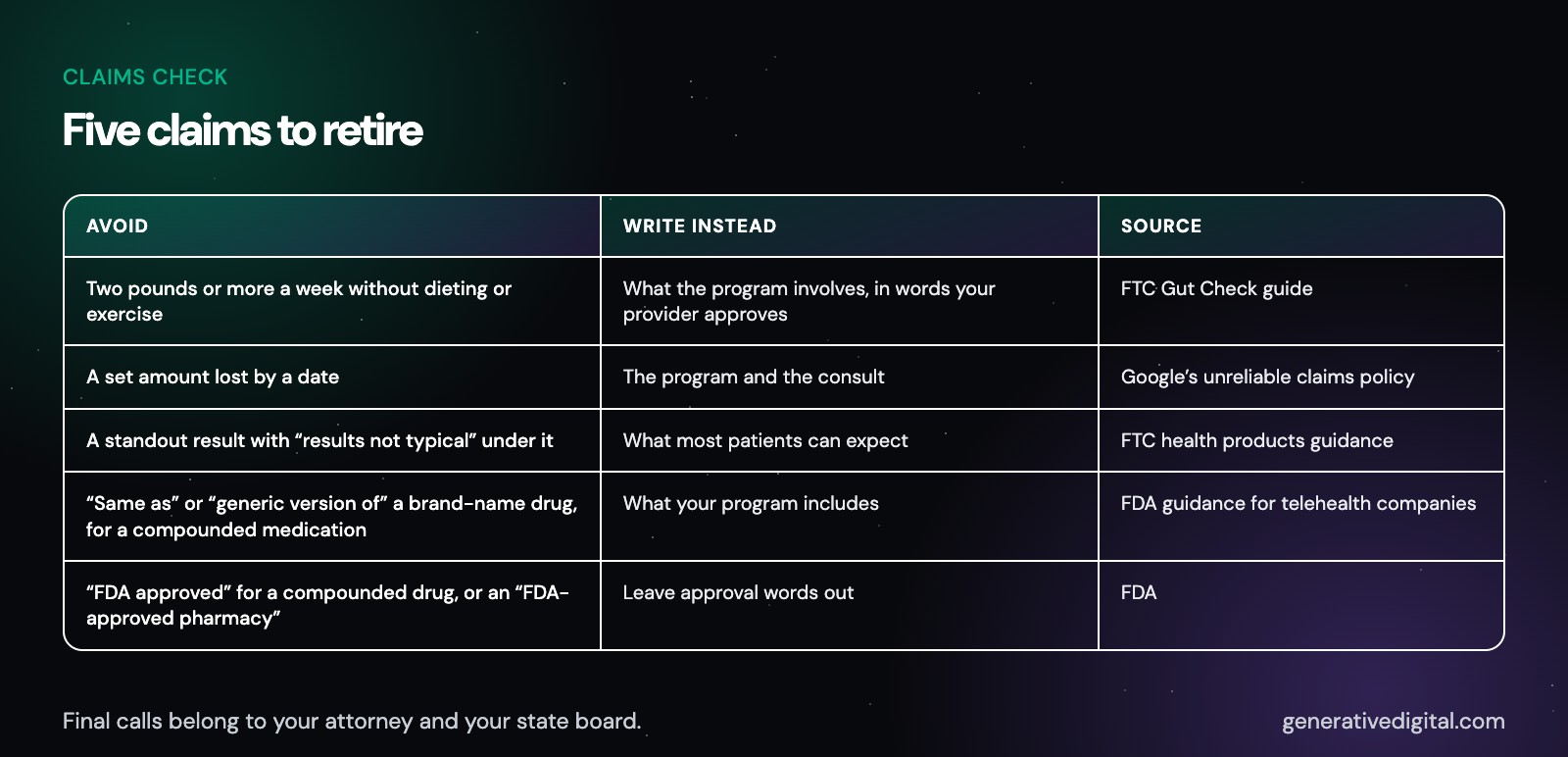
- Retire the classic red flag claims. The FTC’s Gut Check guide lists seven weight loss claims for media outlets to question before they run an ad. Three of them: weight loss of two pounds or more a week for a month or more without dieting or exercise, permanent weight loss even after the person stops using the product, and substantial weight loss for all users. The guide was written about products like pills and wraps, but a clinic ad that echoes those shapes invites the same doubts.
- No speed promises. Google’s unreliable claims policy bars claims of unrealistic weight loss within a specific time frame or requiring little effort. Leave out timelines measured in pounds or clothing sizes.
- Show what most patients can expect. If you feature a patient story, it should reflect a typical result in your program. The FTC’s health products guidance says a story showing a better result than people generally get is likely deceptive even with a “results not typical” line under it. Google separately requires a visible note that results vary when a testimonial claims a specific result. Meeting Google’s rule does not meet the FTC’s.
- Photos need a signed authorization. We hold one line on this: a patient photo or story appears on your website, ads or social media only when that patient’s signed HIPAA authorization is on file. Use unedited photos taken in the same light and from the same angle, and have the provider approve each caption.
- Reviews stay untouched. Ask every patient for a review the same way. Patient reviews are never edited or changed in any way, and any reply we write is a draft your clinic approves before it is posted. A reply never confirms that the reviewer is a patient.
What changes when your program uses compounded GLP-1 medication?
Some clinics prescribe compounded versions of GLP-1 medications. The FDA’s position is plain: compounded drugs are not FDA approved, and the agency does not review their safety, effectiveness or quality before they are marketed.
The FDA’s guidance for telehealth companies that promote compounded drugs lists the claims to avoid. The same wording traps apply to any clinic page:
- No “same as” and no “generic”. Do not describe a compounded drug as the same as an FDA-approved drug, or as a generic version of one.
- No borrowed approval. Do not say or suggest the compounded drug is FDA approved, or that it comes from an FDA-approved or FDA-licensed pharmacy. The FDA does not approve or license pharmacies or outsourcing facilities.
- No borrowed proof. Do not claim a compounded drug is clinically proven to produce the same result as the approved drug.
- No borrowed identity. Do not brand the drug in a way that suggests your clinic made it when a pharmacy did.
Whether your clinic offers compounded medication, and how, is a decision for your providers, your pharmacy partner and your attorney. Our job is to make sure every page describes it accurately, and to update those pages when the rules change.
How do Google Ads work for weight loss clinics?
Google Ads puts your clinic in front of people searching for help right now, while your organic rankings build. Weight loss clinic advertising on Google runs into three policies:
- Prescription drug terms. The generic and brand names of GLP-1 medications are prescription drug terms. Our guide to Botox and filler marketing explains what Google’s current policy allows in ad text, on landing pages and as keywords.
- Unreliable claims. The weight loss speed limits above apply to ad text and landing pages alike.
- Banned products. Google does not allow the promotion of products containing hCG in relation to weight loss or weight control, regardless of any claims of legality.
We build ad groups around the program and the consult, such as a medical weight loss program or a visit with a weight loss provider, send each ad to its matching program page, and judge every campaign on consult requests rather than clicks.
Can weight loss ads use remarketing?
Google’s personalized advertising policy treats Health as a sensitive interest category. Its Health list names invasive medical procedures, including injections, and products, services or procedures to treat or manage chronic health conditions. Ads in that category cannot use advertiser-curated audiences such as customer match or your data segments, which Google used to call remarketing.
The list does not name weight loss itself. Most medication programs involve injections, so our planning position is to treat any campaign that promotes a medication program as if the Health category applies, and to keep your own audience lists out of it. For a nutrition-only or wellness campaign, confirm with Google Ads support before using them. Search intent carries these campaigns without remarketing.
Does an online weight loss program need certification to advertise?
In the US, Google allows telemedicine providers to advertise when they are accredited through LegitScript’s Healthcare Merchant Certification Program, and the advertiser must also be certified with Google. If your clinic prescribes through online visits, plan for that review before launch. Campaigns for in-person consults may be the better place to start while it is pending, and Google Ads support can confirm what your account needs.
What does wellness clinic marketing cover?
Many weight loss clinics also offer wellness services, such as nutrition coaching, IV hydration, vitamin injections or hormone therapy. Wellness clinic marketing follows the same rules with one more trap: the word “wellness” invites broad health claims that nobody has tested.
- Every health benefit needs evidence. The FTC’s health products guidance expects a claimed health benefit to be backed by competent and reliable scientific evidence, and that covers energy, immunity and recovery claims as much as weight loss. If your provider cannot point to the evidence, the claim stays off the page.
- Wellness injections are still injections. Google’s Health list names injections, so we plan those campaigns the same way as medication programs.
- One page per service. IV hydration, hormone therapy and nutrition coaching each get their own page, written from what your providers offer and approve.
- Keep the menu current. If a service is paused, or offered at only one office, the website says so.
When do people search for medical weight loss?
Not always when people expect, and not always in January. Your own data shows your clinic’s pattern better than any national figure. Look at consult requests and search traffic by month for the last two years, then plan around the busy months you actually see.
A simple way to plan around it:
- Before your busy months: refresh program pages and finish provider sign-off before demand rises.
- As demand builds: have campaigns approved and running before searches climb.
- Quieter months: fix technical issues, build the pages you are missing and gather reviews.
Keep the message about a program built with a provider, not a seasonal discount. A price promotion fills the calendar with shoppers. A clear consult fills it with patients.
How does local search work for a weight loss clinic?
Your Google Business Profile drives the map results, and our med spa SEO guide walks through setting one up. Weight loss clinics add two wrinkles: online visits, and offices that do not all offer the same services. Three rules follow:
- An online program is not an office. Online visits can reach patients far from your building, but your profile, pages and schema claim an address only where you see patients in person.
- List only what each office provides. Each office page and each profile names only the programs that office runs.
- Build a city page only for what that office offers. A program page for a city should never suggest a service that office does not provide.
How do AI tools describe a weight loss clinic?
Google says no special code is needed to show up in AI Overviews or AI Mode, and a page can appear as a supporting link only if it is indexed and eligible to show in Search with a snippet. Google also describes query fan-out, where these features break one question into several related searches before writing an answer. Someone asking about medical weight loss might set off searches about medication programs, about monitoring and about online versus in-person care. A clear, provider-approved page for each gives those searches something accurate to find.
Three habits help AI tools describe your clinic the way you would:
- Use the same program names everywhere. Your homepage, program pages, Google Business Profile and schema should call each program by the same name.
- Put the plain answer first. A short, direct answer near the top of each comparison page is easy for an AI tool to quote correctly.
- Check the answers every month. We run a fixed set of patient questions through the AI tools your patients use, note whether your clinic is named and how, and trace any outdated claim back to the page or listing it came from.
Our answer engine optimization guide explains the wider method.
How do you measure weight loss clinic marketing?
Rankings and visits are early signals. What matters is how many people ask for a consult, and how many of them go on to start a program. The reporting we build includes:
- Consult form submissions, marked as key events in Google Analytics and broken out by page and channel.
- Phone calls, with website calls and Google Ads calls counted separately.
- Visits from ChatGPT, Perplexity and other AI tools, split out wherever the platform passes that information along.
- Consults traced to an enrolled program, to the extent your booking software and front desk notes allow.
If a figure has not been measured, our reports say so instead of estimating it.
months
How long before weight loss marketing shows results?
Three to four months, as a general guide, is a fair window before search brings changes you can measure. A new website, a crowded market or a pending ad certification stretches that. Google Ads can bring in consult requests sooner, once campaigns and any required certification are approved.
No agency controls whether Google or an AI tool names your clinic, so treat that promise as a warning sign. What we commit to is careful work, plain reporting and a clear account each month of what changed.
What else do weight loss and wellness clinics ask?
Is weight loss marketing different from med spa marketing?
It is a part of it, with stricter rules on claims. Weight loss adds FTC scrutiny of results, FDA rules on how medication is described and extra Google Ads limits, so the program pages and the ad plan need more care.
Can we say our compounded medication is the same as a brand-name drug?
No. The FDA says compounded drugs are not FDA approved, and it warns against describing them as the same as an approved drug or as a generic version of one. Describe what your program includes, in words your provider and attorney approve.
Can we advertise how much weight patients will lose?
We advise against it. Google’s ad policies bar unrealistic weight loss claims within a specific time frame, and the FTC says a standout result presented as typical is likely deceptive. Describe the program and the consult instead.
Should we put program prices on our website?
We recommend keeping prices and package deals off your service pages. The right plan depends on each patient, so cost belongs in the consult.
How long does weight loss marketing take to work?
For search, three to four months is a general guide before movement you can measure. Google Ads can bring in consult requests earlier, as soon as campaigns are approved.
See where your clinic stands today
A short look at your site now beats guessing at what to fix. Our free digital audit reviews your website, your index status and how AI tools see your clinic, then shows you what to fix first. It costs nothing, and most audits come back within 48 hours.
Get startedWorking with businesses across the US
© 2026 Generative Digital LLC