How to rank in ChatGPT and show up in its answers
To rank in ChatGPT, your website has to be open to OpenAI’s search crawler, easy to quote, and backed up by other trusted sites that describe your business the same way. There is no fixed list of positions to climb. When ChatGPT searches the web, it reads a small set of pages and names the sources it used, so the goal is to be one of the pages it reads and one of the names it repeats. Most of the work is solid SEO, pointed at a new kind of reader.
Think of ChatGPT as a busy researcher on a deadline. When a question needs fresh facts, it runs a few quick searches, skims what comes back and writes a short brief with footnotes. It will not pick a locked filing cabinet, and it trusts a fact more when several sources agree on it. Ranking in ChatGPT means being open, easy to skim and confirmed by others.
This guide covers what OpenAI says about how ChatGPT search works, the steps that make a real difference and how to check your progress. ChatGPT is one tool among several, and our generative engine optimization services cover the rest of them too.
How does ChatGPT decide which websites to show?
ChatGPT answers some questions from what its model already learned and others by searching the web. OpenAI says ChatGPT may search the web automatically when a question would benefit from current information, and people can also start a search themselves. OpenAI says ChatGPT search sometimes partners with other search providers, and when it does, it typically rewrites the question into one or more targeted searches. For a “near me” question, it may use an approximate location to find local results.
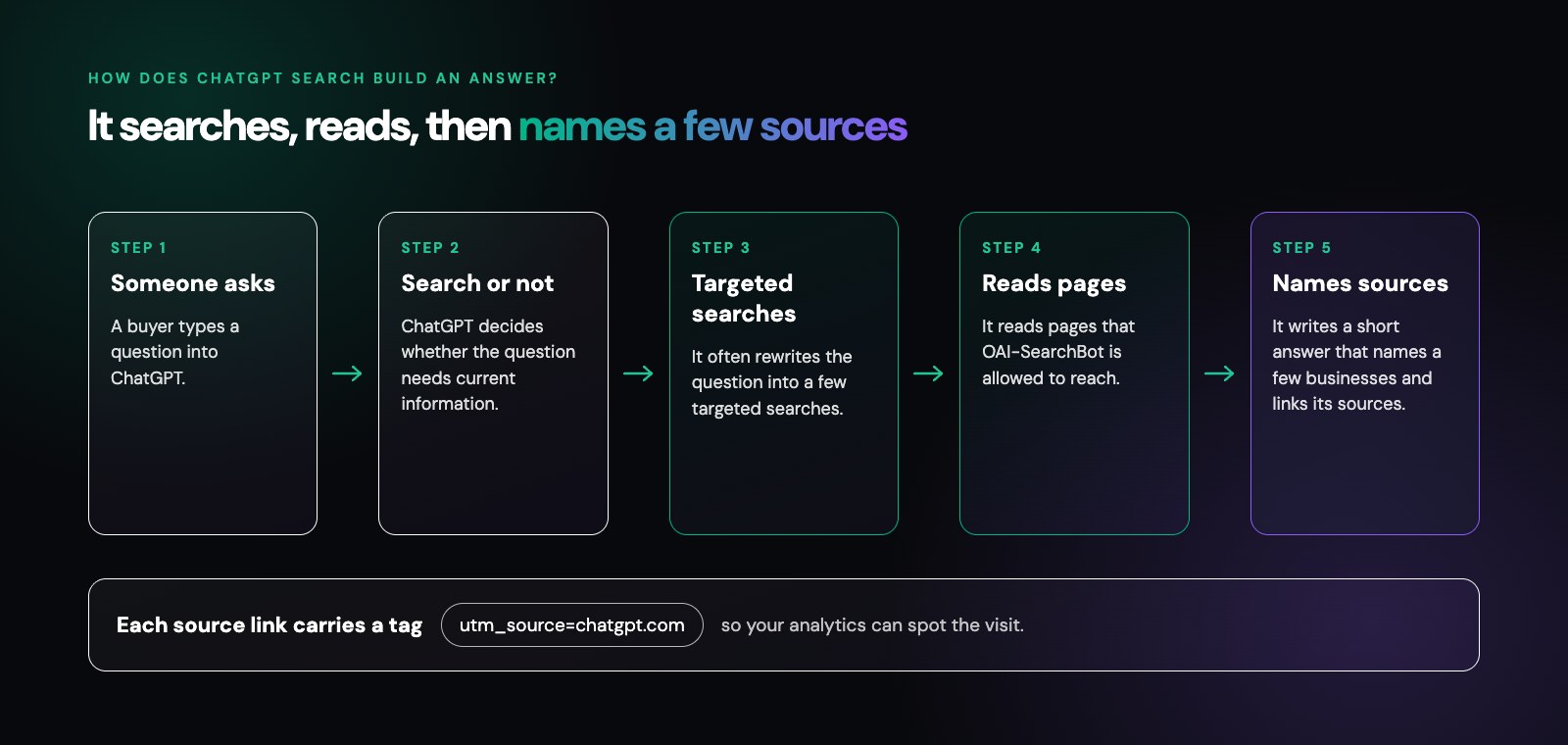
Answers built from a web search can include citations, which are links to the pages ChatGPT used. Those links are where your visits come from.
OpenAI does not publish its full rules. Its own help article says ChatGPT ranks search results using multiple factors and that no site is promised a spot. So treat any list of “ChatGPT ranking factors” as an informed guess, including the advice on this page.
Is there a first place to win in ChatGPT?
Not in the way Google has one. A Google results page has a first spot and a tenth spot. A ChatGPT reply names a few sources in a short answer, and the reply can change with the person asking, the wording or the day. So “rank in ChatGPT” really means “get named often” across many versions of the questions your buyers ask. For the reasons AI answers work this way, read what generative engine optimization is.
There are two ways to get named, and both count:
- Mentioned.
ChatGPT names your business in the text of its answer.
- Cited.
ChatGPT links to one of your pages as a source.
A mention without a link still matters. It can send a buyer to search for you by name later.
Can ChatGPT reach your website?
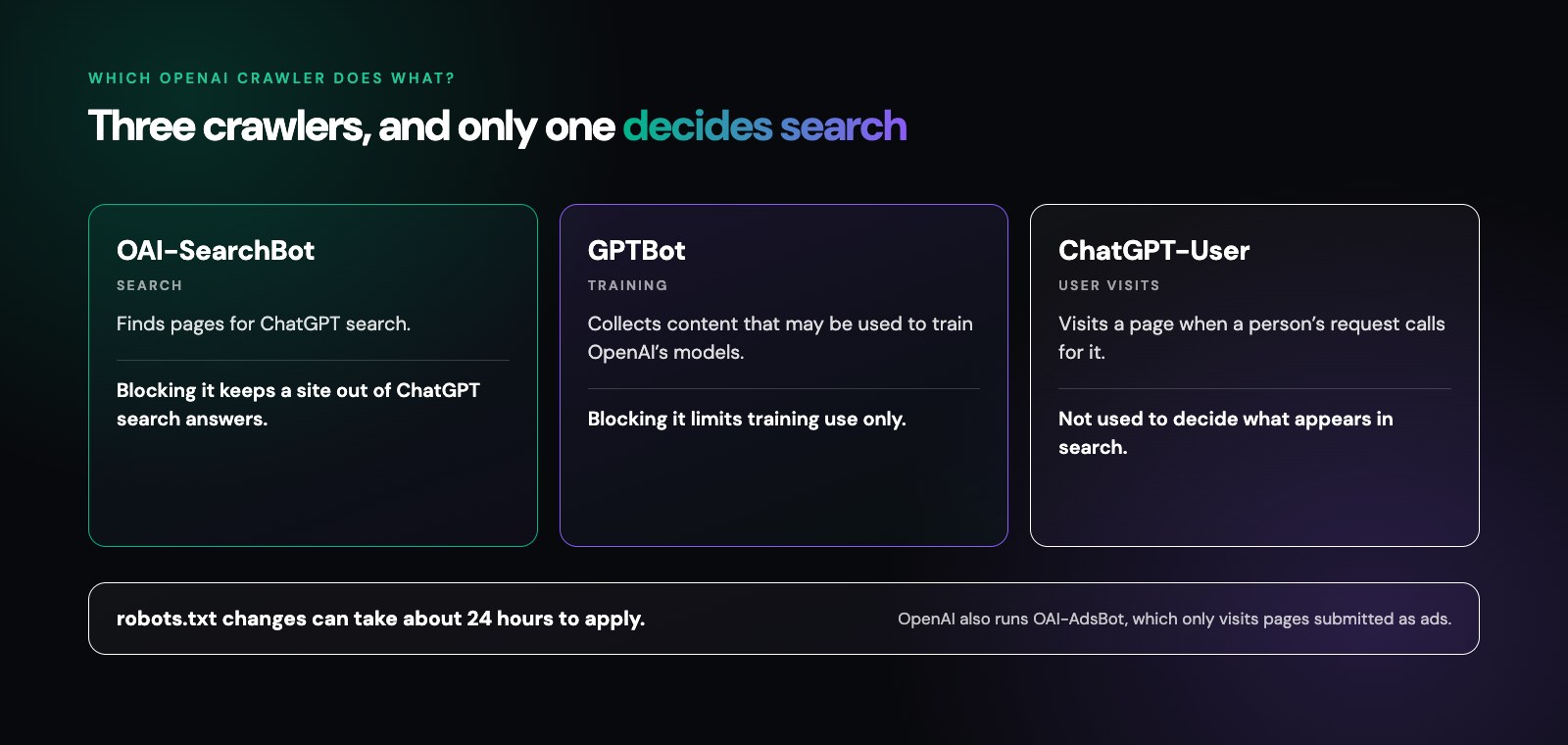
Check this first, because nothing else matters if the door is shut. OpenAI runs separate crawlers, and each one has its own job:
- OAI-SearchBot
finds pages for ChatGPT search. OpenAI says sites that opt out of it are left out of ChatGPT search answers, though they can still appear as plain navigation links.
- GPTBot
collects content that may be used to train OpenAI’s models. Blocking it is a decision about training, not about search. OpenAI treats the two settings separately.
- ChatGPT-User
visits a page when a person’s request calls for it. OpenAI says it is not used to decide whether content may appear in search.
Here is what to check on your own site:
- Your robots.txt file
allows OAI-SearchBot on the pages you want found. That file is a plain text list of rules telling crawlers which parts of your site they may visit.
- Your host, CDN or firewall
lets the crawler in. OpenAI says the host or CDN must allow traffic from OpenAI’s published search bot IP addresses. Security settings that block unknown bots can shut it out without anyone noticing.
- Pages you want kept out
carry a noindex tag. OpenAI says the crawler has to be able to reach a page to read that tag, so a robots.txt block alone is not the same thing.
After a robots.txt change, OpenAI says it can take about 24 hours for its systems to adjust. Our GEO audit checklist walks through every crawler check in order.
How do you write pages that ChatGPT can quote?
ChatGPT pulls a few sentences at a time, so each passage has to make sense with nothing around it.
- Answer first.
Put a one or two sentence reply right under each heading, with the detail below it.
- Use the questions buyers really ask
as headings, in their words, not your team’s.
- Name things plainly.
Say the business name, the service and who it is for. A quoted sentence that only says “we” or “it” loses its meaning.
- Keep key facts in the page text,
not only inside images, PDFs or scripts that load later.
- Show who wrote it.
An author name, credentials that match a real bio, and an updated date that changes only when the content does.
- Give each topic its own page.
A page that tries to cover every service at once gives ChatGPT nothing clear to quote.
Because ChatGPT can turn one question into several searches, cover the follow-up questions too. Think about cost factors, how long something takes, who it suits and how it compares with the other options a buyer is weighing.
Why do other websites matter so much?
When ChatGPT runs its searches, much of what comes back is not your website. Review sites, industry directories, comparison articles, local news and forums all show up. Our read is simple: the more of those pages describe you correctly, the more chances ChatGPT has to name you.
What helps:
- The same facts everywhere.
Your name, address, phone number, services and short description match on every profile.
- Fixes for wrong listings.
An outdated phone number or a closed location in a directory works against you.
- Honest coverage.
A trade group listing, a guest article, an expert quote in a local publication or a podcast interview.
- Real reviews.
Ask real customers to review you on the platforms they already use. Never buy reviews or write them yourself.
What is ChatGPT SEO, and how is it different from Google SEO?
ChatGPT SEO is the work of making your website easier for ChatGPT to find, read and name in its answers. The phrase is also used for something else: using ChatGPT as a writing or keyword tool. This page is about the first meaning.
Most of the groundwork is the same as Google SEO. Pages need to be crawlable, clearly structured, useful and consistent. Three things change:
- The crawler.
OAI-SearchBot joins Googlebot and Bingbot on the list of visitors you need to let in.
- The prize.
A mention or a citation inside an answer, instead of a position in a list.
- The proof.
Hand checks of real questions plus referral visits, instead of a rank report.
ChatGPT is one of several answer engines, alongside Google AI Overviews, Perplexity and Microsoft Copilot. For Google’s version, see how to rank in AI Overviews. For Perplexity, see how to rank in Perplexity. Our guide to answer engine optimization covers all of them, and GEO vs SEO vs AEO puts the three terms in one table.
How do you check whether ChatGPT mentions your business?
You need two kinds of evidence, because neither one tells the whole story.
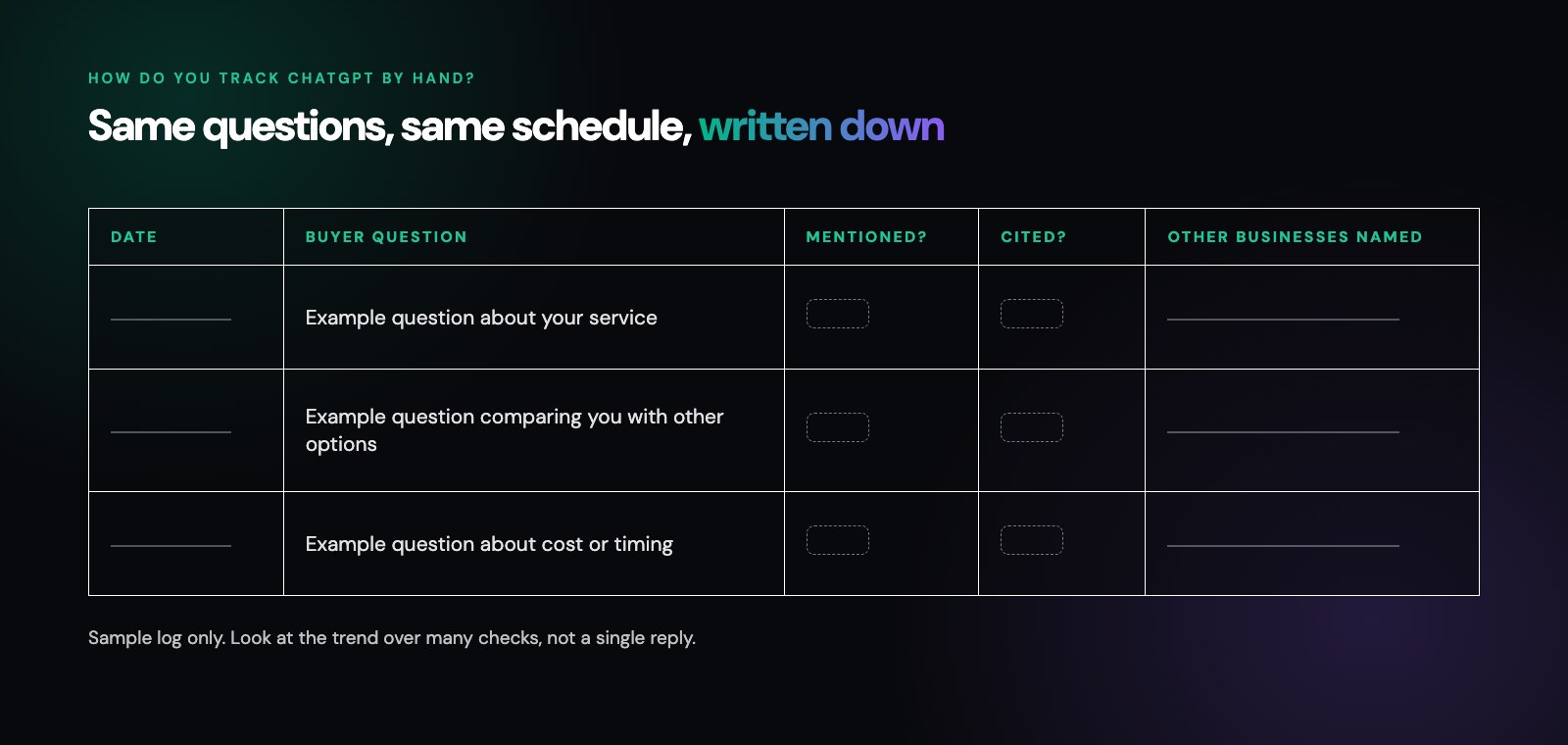
Question checks. Write down a fixed set of questions your buyers ask, worded the way they would say them. Run them in ChatGPT on a regular schedule and record whether you were mentioned, whether you were cited, which sites were cited and which competitors were named. Answers vary from one try to the next, so look at the trend over many checks, not a single reply.
Referral visits. OpenAI says ChatGPT adds utm_source=chatgpt.com to the links in its search answers, so analytics tools like Google Analytics can spot those visits. OpenAI notes this tracking applies to sites that allow OAI-SearchBot. Not every visit keeps that tag, so read the number as a floor, not a full count.
What should you skip?
- Hidden instructions for AI tools,
like white text that tells a chatbot to recommend you.
- Pages stuffed with phrases
and written for a machine instead of a buyer.
- Fake reviews, awards or credentials.
- Anyone promising a set spot in ChatGPT.
OpenAI itself says no site is promised a place.
- All-or-nothing bot rules.
Blocking every AI crawler at once, or allowing all of them without a reason, both skip the real decision.
- Waiting for a special file.
The steps OpenAI lists for publishers are about crawler access and noindex tags, not a new file format. Our guide to llms.txt explains the file people ask about most.
How long does it take to show up in ChatGPT?
Some fixes register quickly. OpenAI says its systems take about 24 hours to adjust after a robots.txt update. The rest takes longer, because content, outside mentions and trust all build over time. For measurable movement, give it three to four months as a general guide. Newer sites and crowded fields usually need more time.
Should you do this yourself or get help?
You can run the crawler checks and the question checks yourself with the steps above. Help makes sense when the fixes reach into hosting and firewall settings, when many pages need rewriting, or when you want the same work done for Google and every AI tool at once.
Generative Digital helps businesses across the US, running SEO and AI search as one program through our AI SEO agency services. One person audits your site, does the fixes and answers your email.
What else do people ask about ranking in ChatGPT?
Can I pay to rank higher in ChatGPT?
No. OpenAI says ads do not influence the answers ChatGPT gives, and that ads are always separate and clearly labeled. A place in the answer itself has to be earned through access, clear pages and a good reputation on other sites.
Does blocking GPTBot keep my business out of ChatGPT?
Not by itself. OpenAI describes GPTBot as its training crawler and OAI-SearchBot as its search crawler, with separate settings. Blocking GPTBot limits training use of your content. Blocking OAI-SearchBot is what keeps you out of ChatGPT search answers.
Why does ChatGPT name my competitor and not me?
Usually it is a mix of three things. Your pages may be blocked or hard to read, the competitor may answer the question more directly, or other sites may mention them more often and more consistently. A side-by-side check of both businesses usually shows which one applies.
Does schema markup help you rank in ChatGPT?
OpenAI has not said that it uses structured data to rank search results. Schema markup is still worth having, because it states your business facts in a form machines can read. Keep it accurate, and make sure it matches what visitors can read.
How do I know if ChatGPT is sending me visitors?
Look for visits with the source chatgpt.com in your analytics. OpenAI says ChatGPT adds that tag to links in its search answers. Pair those numbers with regular question checks, since some visits arrive untagged and many mentions never turn into a click.
Find out if ChatGPT can see you
Want to know where you stand right now? Our free digital audit shows how search engines and AI tools like ChatGPT can reach and read your site today, and what to fix first.
Get startedWorking with businesses across the US
© 2026 Generative Digital LLC