How to rank in AI Overviews and get cited by Google
To rank in AI Overviews, your page has to be in Google’s index, allowed to show a snippet, and written so that a short passage answers the question on its own. Google says its AI features have no additional technical requirements. It builds each AI Overview from pages already in its search index, so the work is solid SEO aimed at the questions behind a search, plus a few settings that decide what Google is allowed to quote.
Think of an AI Overview as the short summary a teacher writes on the board, with a few textbook page numbers underneath. The teacher only points to books already on the classroom shelf, and only to pages that make the point clearly. Ranking in AI Overviews means being on the shelf and being the clearest page on the topic.
AI Overviews are one of several AI tools that write answers. This guide sticks to Google, and our generative engine optimization services handle the rest of them as one program.
What does it mean to rank in an AI Overview?
An AI Overview is the AI-written summary that sits at the top of some Google results, with links to the pages that support it. Ranking in one means a page of yours shows up as one of those supporting links, or your business is named in the summary itself.
Two details from Google change how you read your results:
- Every link shares one position.
Google’s Search Console help says an AI Overview takes up a single position in the results, and every link inside it is given that same position.
- Many searches never get one.
Google says AI Overviews only appear when its systems decide they add something beyond classic results, so they often do not show at all.
That second point shapes your keyword list. Google says AI Overviews are built to help people get to the gist of a complicated topic or question, so longer and more detailed questions are the ones worth checking first.
How does Google choose the sources in an AI Overview?
Google explains the process in its own guide for site owners. Before it writes an AI Overview, Google may split one search into many related searches across subtopics and data sources. Google calls this query fan-out. While the answer is being written, its models look for more pages that support it, which is why an AI Overview often links to a wider mix of sites than the classic results below it.
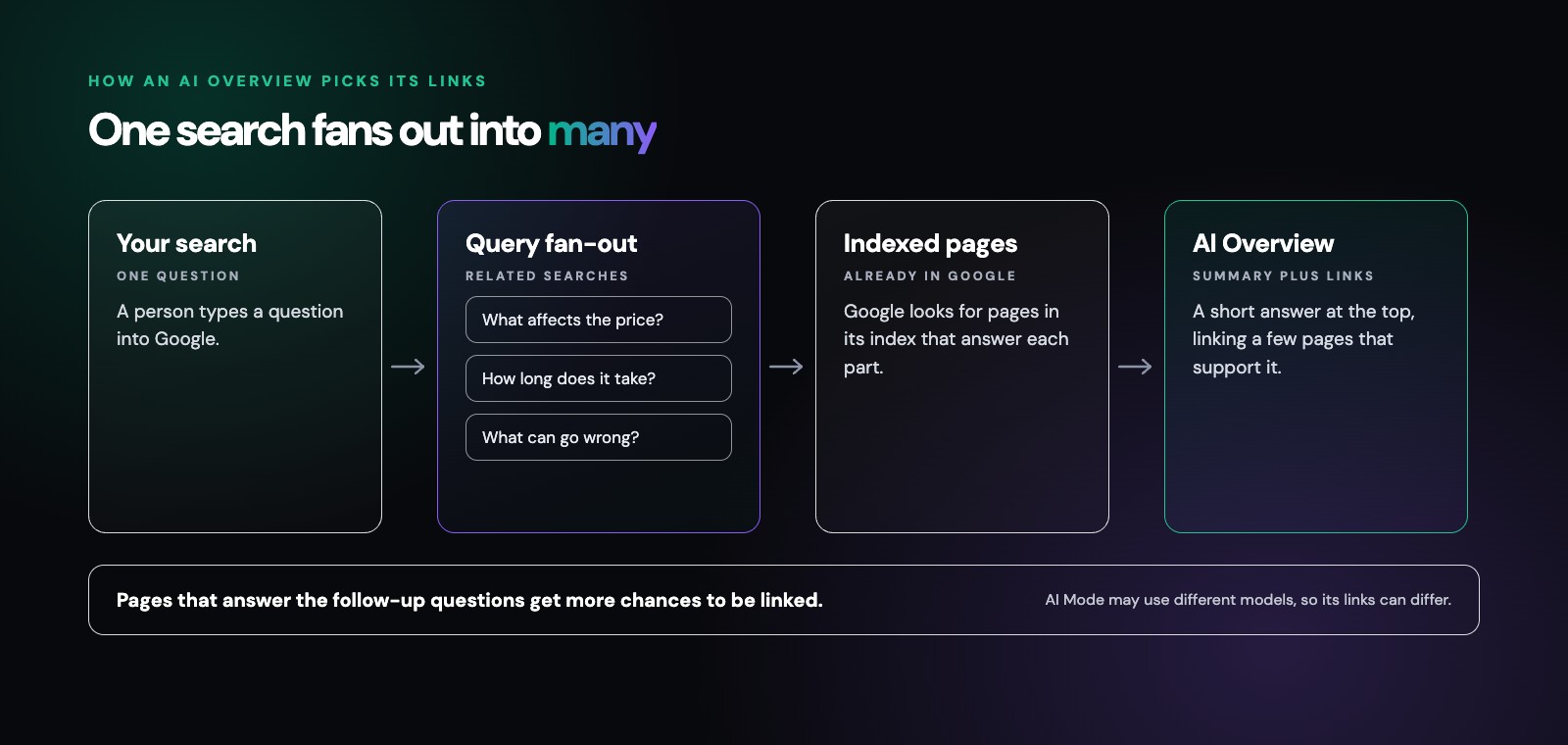
Google also says AI Overviews and AI Mode may use different models and techniques, so the answers and links they show can differ. A page linked in one is not automatically linked in the other.
Google does not publish a list of AI Overview ranking factors. Every list you find online, including the advice on this page, is a read on what Google documents and what can be observed, not a rulebook.
Do you need to rank on page one first?
Not by any rule Google states. Google’s bar is simpler: the page must be indexed and eligible to appear with a snippet, the few lines of preview text Google shows beneath a link. In practice, the things that earn a strong classic ranking are the same things Google points to for its AI features. Those are helpful content, a clear structure and a page Google can crawl.
Our read: if a page is buried in classic results, improve it there first. A page that also ranks for the follow-up questions has more chances to be picked up when one search fans out into many.
Can Google show your page in AI Overviews?
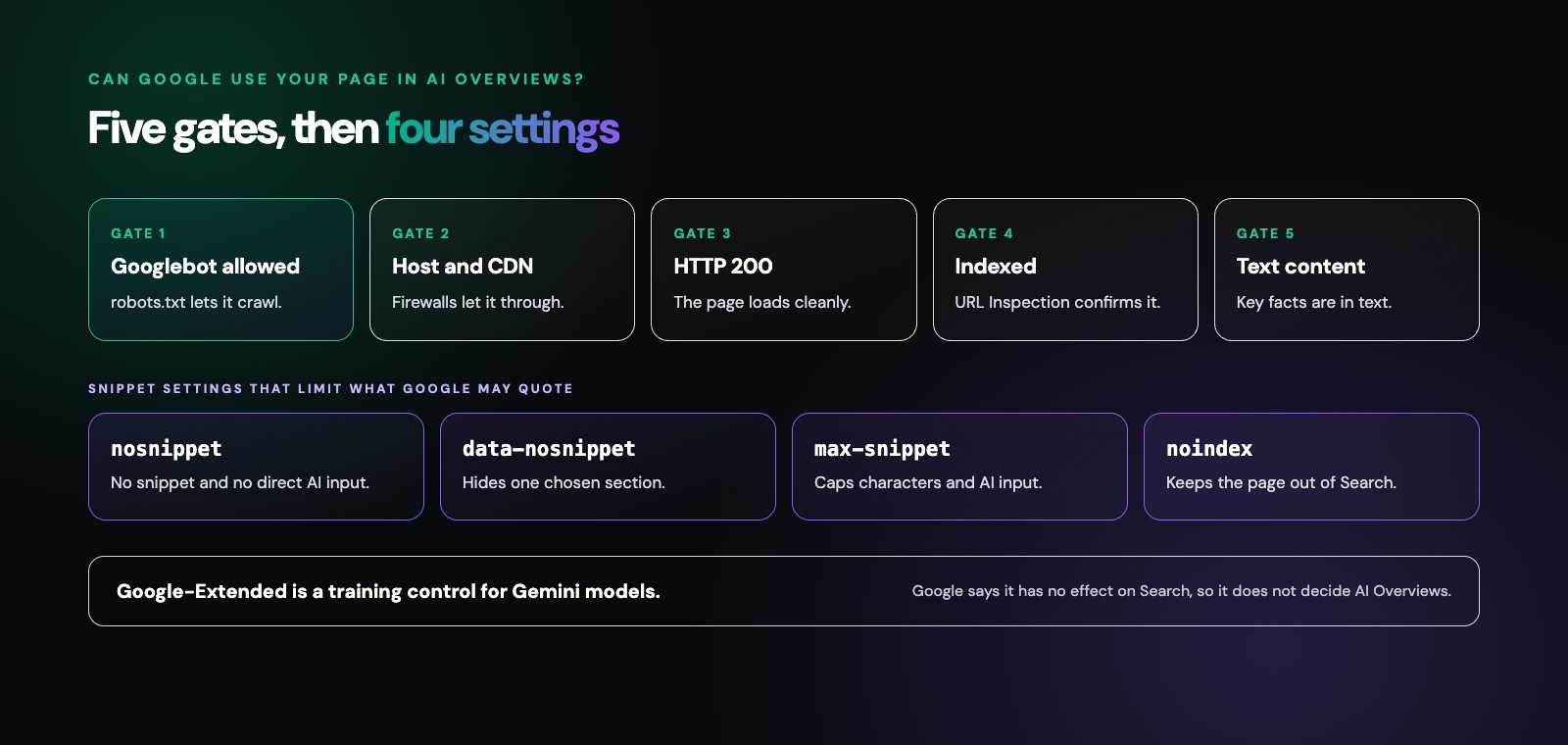
Check this before you touch any content. These are the gates Google names, in order:
- Googlebot is allowed in.
Google says robots.txt rules for Googlebot are the control site owners have over how Search crawls their site, and AI features are part of Search.
- Your host and CDN let it through.
Google calls out CDN and hosting settings alongside robots.txt. A firewall rule that blocks unfamiliar bots can turn away Googlebot by mistake.
- The page works.
Google wants an HTTP 200 (success) status code and content it can index.
- The page is indexed.
The URL Inspection tool in Search Console confirms this and shows the HTML that Googlebot received.
- Key content is in plain text.
Google asks that important content be available as text, not only inside images, video or scripts.
Four settings then decide how much of a page Google may quote. Google’s robots meta tag documentation says they apply to AI Overviews and AI Mode as well as regular results:
- nosnippet
turns off the text snippet. Google says it also stops the page from being used as a direct input for AI Overviews and AI Mode.
- data-nosnippet
is an HTML attribute that hides a chosen section of a page from snippets.
- max-snippet
sets a character limit, which Google says also limits how much of the page can feed its AI features.
- noindex
keeps the page out of Search entirely.
These settings are often switched on years ago by a plugin, a theme or a past developer and then forgotten. Our read is that they are among the first things to check when a strong page never appears in AI Overviews.
Google-Extended is a different switch. Google says it controls whether your content may be used to train future Gemini models, and that it does not affect whether a site is included in Google Search or act as a ranking signal. Blocking it is a training decision, not an AI Overviews decision.
Our GEO audit checklist runs these checks in order, along with the ones for other AI tools.
How do you write content that AI Overviews cite?
Google pulls supporting links for specific points in its summary, so every passage needs to stand up when it is read alone.
- Answer first.
Open each section with the direct answer in a sentence or two, and save the detail for after it.
- Cover the questions that come next.
Because one search can fan out into many, write for the second and third question too: what affects the price, how long it takes, what can go wrong and what to do next.
- Say something others do not.
Google’s May 2025 guidance asks for unique, non-commodity content. A page that repeats what ten other pages say gives Google no reason to pick it.
- Make the main content easy to find.
Google points to page experience, including how a page displays on different devices, how fast it responds and whether visitors can tell the main content apart from everything else.
- Add original images and video where they help.
Google notes that people now search with photos as well as words, and asks for high-quality images and video to support the text.
- Name the author.
Link to a real bio with credentials that match it.
What does Google check besides your page?
Google’s own list of SEO basics for its AI features reaches past the words on the page:
- Structured data that matches what visitors see.
Google says everything in your markup should also be visible on the page, and that you should validate it. Our schema markup guide shows how.
- A current Business Profile,
for any business with a physical location.
- Current Merchant Center data,
for online stores.
- Internal links
that make each page easy to find on your own site.
Our read is that what other sites say about your business matters too, because AI Overviews often link to sites other than yours. Keep outside listings accurate and consistent, and earn coverage honestly.
What is AI Overview optimization, and how is it different from SEO?
AI Overview optimization is the work of making your pages easy for Google to cite in its AI-written summaries. It is SEO with a narrower goal. Google says the same foundational SEO best practices apply to its AI features as to the rest of Search, so most of the work overlaps.
Three things shift:
- The goal.
A supporting link or a mention inside the summary, not only a numbered spot in a list.
- The unit.
A passage that holds up on its own, not the page as a whole.
- The scope.
Coverage of the follow-up questions, since one search can turn into many.
For how Google fits next to ChatGPT, Perplexity and Copilot, read our guide to answer engine optimization. Our page on GEO vs SEO vs AEO explains where each term starts and stops. For ChatGPT on its own, see how to rank in ChatGPT. For Perplexity, read our Perplexity SEO guide.
How do you track AI Overview rankings?
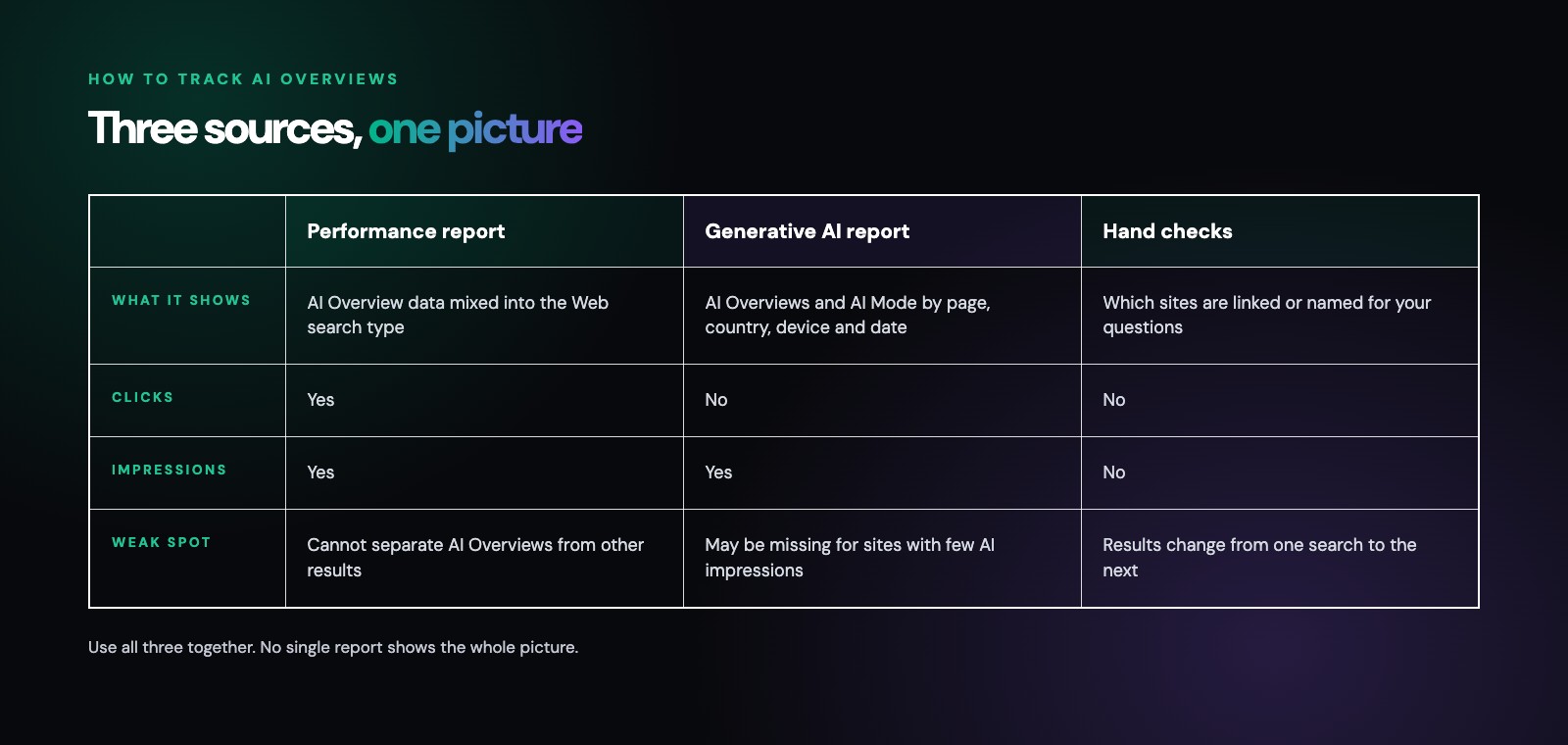
No single report shows everything, so use three sources together.
The Search Console Performance report. Google counts AI Overview clicks and impressions under the “Web” search type, mixed in with regular results. A click on a link inside an AI Overview counts as a click, and because every link in it shares one position, average position for that search can look strange.
The generative AI performance report. Google announced this Search Console report on June 3, 2026. It shows how often your URLs appeared in AI Overviews and AI Mode, broken down by page, country, device and date. It reports impressions, not clicks. If the report is missing from your account, Google says the usual reason is too few impressions in AI features so far.
Hand checks. Search your key buyer questions on a regular schedule in a logged-out browser. Record whether an AI Overview appeared, whether you were linked or named, and which other sites were. Results can change from one search to the next, so read the trend rather than any single result.
Google’s documentation does not describe a separate referral tag for AI Overview clicks, so in your analytics those visits blend in with regular Google organic traffic.
What should you skip?
- Hidden text or instructions aimed at AI systems.
Google’s spam policies already cover hidden text.
- Mass-produced pages written only to catch searches.
Google’s spam policies call this scaled content abuse.
- Special files or schema sold as a shortcut.
Google says its AI features have no additional technical requirements. That includes llms.txt.
- Changing a date without changing the content.
- Anyone promising a guaranteed spot in AI Overviews.
No one can guarantee it, and Google says AI Overviews often do not appear at all.
- Blocking Google-Extended to protect your AI Overview visibility.
It has no effect on Search either way.
How soon can a page appear in AI Overviews?
Technical fixes wait on Google recrawling the page. Google says crawling can take anywhere from several days to several months, depending on how often its systems decide a page needs refreshing, and you can request a recrawl in Search Console. Content and reputation build more slowly. Give it three to four months as a general guide. Crowded topics and newer sites usually take longer.
When does it make sense to get help?
The eligibility checks and the hand checks on this page are ones you can run on your own. Outside help pays off when the fixes reach into hosting, CDN or plugin settings, when a large share of your pages needs new copy, or when Google, ChatGPT and the other AI tools should all be covered by one plan.
We take on businesses across the US and treat SEO and AI search as a single job. That is what our AI SEO agency work covers, with one person handling your audit, the fixes and the reporting.
What else do people ask about AI Overviews?
Can I keep my content out of AI Overviews?
Yes, with the same controls that limit snippets. Google says nosnippet stops a page’s content from being used as a direct input for AI Overviews and AI Mode, and max-snippet limits how much can be used. The trade-off is that both settings also limit your regular search snippets.
Does blocking Google-Extended remove my site from AI Overviews?
No. Google says Google-Extended controls whether your content may be used to train future Gemini models and does not affect inclusion in Google Search. AI Overviews are part of Search, so the controls that apply are your Googlebot rules and snippet settings.
Is ranking in AI Overviews the same as ranking in AI Mode?
Not exactly. Google says the two may use different models and techniques, so the answers and links can differ. The groundwork is the same for both: an indexed page that can show a snippet and answers the question clearly.
Are clicks from AI Overviews worth having?
Google says clicks from results pages with AI Overviews are higher quality, meaning visitors are more likely to spend more time on the site. That is Google’s own claim, so check it against your own results, such as calls, form fills and sales.
Does schema markup help you rank in AI Overviews?
Google lists structured data that matches the visible text as one of the SEO basics for its AI features, but it does not call schema a requirement. Use it to state your facts clearly, keep it accurate and validate it.
Find out if Google can cite you
Not sure whether Google can quote your pages today? Our free digital audit checks how search engines and AI tools, including Google AI Overviews, can reach and read your site right now, and what to fix first.
Get startedWorking with businesses across the US
© 2026 Generative Digital LLC